

Mathematical mysteries: the Goldbach conjecture
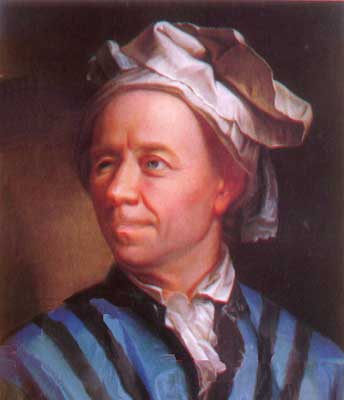
Leonard Euler (1707-1783) corresponded with Christian Goldbach about the conjecture now named after the latter.
Here is one of the trickiest unanswered questions in mathematics:
Can every even whole number greater than 2 be written as the sum of two primes?
A prime is a whole number which is only divisible by 1 and itself. Let's try with a few examples:
- 4 = 2 + 2 and 2 is a prime, so the answer to the question is "yes" for the number 4.
- 6 = 3 + 3 and 3 is prime, so it's "yes" for 6 also.
- 8 = 3 + 5, 5 is a prime too, so it's another "yes".
If you keep on trying you will find that it seems that every even number greater than 2 can indeed be written as the sum of two primes. This is also the conclusion that the Prussian amateur mathematician and historian Christian Goldbach arrived at in 1742. He wrote about his idea to the famous mathematician Leonhard Euler, who at first treated the letter with some disdain, regarding the result as trivial. That wasn't very wise of Euler: the Goldbach conjecture, as it's become known, remains unproven to this day.
In 1938 Nils Pipping showed that the Goldbach conjecture is true for even numbers up to and including 100,000. The latest result, established using a computer search, shows it is true for even numbers up to and including 4,000,000,000,000,000,000 — that's a huge number, but for mathematicians it isn't good enough. Only a general proof will do.
There is a similar question, however, that has been proven. The weak Goldbach conjecture says that every odd whole number greater than 5 can be written as the sum of three primes. Again we can see that this is true for the first few odd numbers greater than 5:
- 7 = 3 + 2 + 2
- 11 = 3 + 3 + 5
- 13 = 3 + 5 + 5
- 17 = 5 + 5 + 7.
Until very recently the result had only been verified for odd numbers greater than 2 x 101346 — that's a number with 1,347 digits! But then, in 2013, the Peruvian mathematician Harald Helfgott closed the enormous gap and proved that the result is true for all odd numbers greater than 5.
The weak and strong Goldbach conjectures are just two of many questions from number theory that are easy to state but very hard to solve. See here to read about some more, and here to find out more about the Goldbach conjecture and our Goldbach calculator.
Comments
Benji
1 is neither prime nor composite. The number 1 is classified as a unit.
Anonymous
3+3 and 23+27
Anonymous
I've got an O level in sums and I'm fairly sure 27 is not a prime!
50 = 3 + 47
Tony GOMIS
Since July 2016, the following statements are established : 1- " Any even number is a difference of two odd prime numbers " 2- "Any odd number is a prime, or a sum or a difference of an odd prime number and the even prime number 2 ".
Therefore, taking into account the classic Goldbach conjecture* stating that "An even number greater than 2 may be expressed as the sum of two prime numbers ", the following general statement is established: " Any integer number is a prime, or a sum or difference of two prime numbers ". More info will be available shortly. in the meantime, the above statements may be checked and double checked.
*also established.
Tony GOMIS
primophiliac
If, as you conjecture, any odd number is a prime, or a prime plus 2, or a prime minus 2.....what about 93?
Jaleel smith
How come it remains unproven? What is considered to be proof? And how is it the weak conjecture has been proven? What will settle as proof?
duchesneraymond
Has anybody ever seen mentions of the following conjectures, very similar in appearance to Goldbach's or Lemoine's?
Lemoine’s conjecture is ”All odd integers greater than 5 can be represented as the sum of an odd prime number and an even semiprime”
We know that it can be can be rewritten:
2n + 1 = p + 2q always has a solution in primes p and q (not necessarily distinct) for n > 2.
It appears that the following very similar conjectures (also applying to the relations between an odd number, a prime and a semi-prime) can also be verified for values greater than 2 millions.
Additional conjecture 1: O = 2n + 1 = p - 2q always has a solution in distinct odd primes p and q for o >= 5
Additional conjecture 2: O = 2n + 1 = 2q - p always has a solution in p and q with q < p, p being an odd prime and q being 1 or an odd prime and o >= 1 (For every odd positive integer O there exists two distinct odd elements from PRIMES&1 p0 and p1 such that p1 is the average of O and p0 )
In addition, the Lemoine conjecture can be split into two different conjectures:
Additional conjecture 3: 2n + 1 = p + 2q always has a solution in p and q where p > q, p odd prime and q in PRIMES&1 for n > 2
And
Additional conjecture 4: 2n + 1 = p + 2q always has a solution in p and q where p <= q , q odd prime and p in PRIMES&1 for n > 2
Similarly the Goldbach conjecture:
E = 2n = p + q with E > 2 has a solution in primes p and q
Has a twin:
E = 2n = p – q with E > 2 has a solution in primes p and q
… but this conjecture, I believe, follows from the Goldbach conjecture and the fact that p+q which is even can always be rewritten as p-q
Anthony V
I would suggest that the Goldbach Conjecture is merely a reflection of the persistently preserved balance inherent in arithmetic number theory. For example, every integer has an additive inverse; every operation has an inverse; the number line maintains symmetry about a zero; etc., etc. And of course the fact that every integer is either prime or is a product of unique prime factorization - this is also a reflection of the symmetric balance maintained throughout the number theoretic "rulebook".
Goldbach pairings also reflect a balance about a midpoint and thus the conjecture appears to me as really just a translated restatement of the governing axioms and conventions. Perhaps instead of calling numbers even and odd we might try calling them balanced or unbalanced - maybe then Goldbach might seem more readily sufficient and necessary. Of course, you can't "prove" axioms - you can only conjure up equivalent statements.
Giovanni di Savino
Euclid, in 300 BC. he stated and demonstrated that there are more prime numbers than one can imagine and his proof is based on the fact that, if there were a finite number of prime numbers, the product of known primes added to 1 (2n+1), it would not imply the existence of other prime numbers and has stated that the result of a product of prime numbers is divisible by the prime numbers that generated it.
Gauss with the Fundamental Theorem of Arithmetic demonstrated that every integer greater than 1 is a prime number or a composite number and can be written as a product of prime numbers, but, when he was a boy, he solved a problem having realized that the even number 100 is the sum of two numbers equidistant from its half and obtained the required result by processing an odd number such as 100+1=2n+1 equal to (101-2n≥1)+(1+2n≥1). Gauss proved that all numbers greater than 1 are the product of prime numbers, but he defined his 100+1 as, 2000 years earlier, Euclid defines 2n+1 as one of the odd numbers; the 101 as all the odd ones become the sum of an even number (2n-2n≥1) plus an odd number (1+2n≥1).
The combinatorics of prime numbers: Euclid and other mathematicians demonstrated that the prime numbers are infinite and, not being able to state how many prime numbers there are and how much time and space are needed to know their value, to satisfy Goldbach's conjecture, they cannot it will never be possible to elaborate all the possible combinations and the values that can be obtained by adding two or three of the infinite prime numbers but it is possible to know all the possible combinations and the values that can be obtained by adding two or three of the known prime numbers which are less than or equal to 2n+1. (Annex A)
In an even number all even numbers and all odd numbers ≥ ½ 2n are equidistant, from the middle of 2n, with even numbers and odd numbers ≤ ½ 2n; in an even number 2n, the numbers that are not multiples of the primes ≤ the square root of the given even number are prime numbers; all prime numbers factors of n that are less than ½ 2n are equidistant from half the even number. Prime numbers ≥ ½ 2n are equidistant, from half the even number, with prime numbers ≤ ½ 2n. There cannot be a finite number of combinations of prime numbers ≥ ½ 2n equidistant with prime numbers ≤ ½ 2n because they would all be factors of 2n and a new prime number in the double of n would not exist.
With the three primes considered by Euclid, 2, 3 and 5, and represented above with 2n+1, we obtain 31 with the pairs of an even number plus a known prime number and they are 2+29, 28+3 and 26+5 but between the largest of the factors and the generated number, (between 5 and 31), there are new prime numbers which, added to an even number, generate 31 and are: 24+7; 20+11; 18+13; 14+17; 12+19, 8+23; on 2+29. In fact, between a prime number ≤ 2*3*5+1 and its preceding prime the distance is ≥ 2: between 31 and 29, between 19 and 17, between 13 and 11, between 7 and 5, between 5 and 3 the distance is 2; between 11 and 7, between 17 and 13, between 23 and 19 the distance is 4; between 29 and 23 the distance is 6, the difference/distance between prime numbers is 2*n≥1.
31, generated by Euclid with 2*3*5+1, is a prime number and this, like all prime numbers greater than 5, denies the existence of a finite number of prime numbers. The 31 which is the sum of an even number (2n) with 1 and which is also the sum of an even number (2n-2*n≥1) with a prime number ≥ (1+2*n≥1) . The difference between an odd number (2n+1) and a prime number (≥3) will always be an even number 2n which is the sum of two numbers that are equidistant by ½ of their sum ((n ≤ ½ 2n + n ≥ ½ 2n) = 2n). The prime number 31 and the prime number 29 form a pair of twin primes, their difference is 2 and, all pairs of twin primes, ≤ 2n+1, are equidistant from other pairs of smaller twin primes; (Annex B)
Euclid 2300 years ago proved that prime numbers are infinite with 2n+1 and stated and Gauss, 2000 years later proved, that all numbers greater than 1 are prime or composite and are the product of prime numbers. Euclid proved that all odd numbers that are the result of the sum of an even number 2n plus 1, are also equal to the sum of an even number (2n-2*n≥1) plus a prime number (1+2*n ≥1). An even number is the sum of two prime numbers it contains and which are equidistant from the middle of 2n. It is not possible to obtain the combinatorics of infinite prime numbers but one can obtain the combinatorics of known primes in an even number.