Home
plus.maths.org

Secondary menu

  • My list
  • About Plus
  • Sponsors
  • Subscribe
  • Contact Us
  • Log in
  • Main navigation

  • Home
  • Articles
  • Collections
  • Podcasts
  • Maths in a minute
  • Puzzles
  • Videos
  • Topics and tags
  • For

    • cat icon
      Curiosity
    • newspaper icon
      Media
    • graduation icon
      Education
    • briefcase icon
      Policy

    Popular topics and tags

    Shapes

    • Geometry
    • Vectors and matrices
    • Topology
    • Networks and graph theory
    • Fractals

    Numbers

    • Number theory
    • Arithmetic
    • Prime numbers
    • Fermat's last theorem
    • Cryptography

    Computing and information

    • Quantum computing
    • Complexity
    • Information theory
    • Artificial intelligence and machine learning
    • Algorithm

    Data and probability

    • Statistics
    • Probability and uncertainty
    • Randomness

    Abstract structures

    • Symmetry
    • Algebra and group theory
    • Vectors and matrices

    Physics

    • Fluid dynamics
    • Quantum physics
    • General relativity, gravity and black holes
    • Entropy and thermodynamics
    • String theory and quantum gravity

    Arts, humanities and sport

    • History and philosophy of mathematics
    • Art and Music
    • Language
    • Sport

    Logic, proof and strategy

    • Logic
    • Proof
    • Game theory

    Calculus and analysis

    • Differential equations
    • Calculus

    Towards applications

    • Mathematical modelling
    • Dynamical systems and Chaos

    Applications

    • Medicine and health
    • Epidemiology
    • Biology
    • Economics and finance
    • Engineering and architecture
    • Weather forecasting
    • Climate change

    Understanding of mathematics

    • Public understanding of mathematics
    • Education

    Get your maths quickly

    • Maths in a minute

    Main menu

  • Home
  • Articles
  • Collections
  • Podcasts
  • Maths in a minute
  • Puzzles
  • Videos
  • Topics and tags
  • Audiences

    • cat icon
      Curiosity
    • newspaper icon
      Media
    • graduation icon
      Education
    • briefcase icon
      Policy

    Secondary menu

  • My list
  • About Plus
  • Sponsors
  • Subscribe
  • Contact Us
  • Log in
  • 'How to build a brain'
    2 June, 2011

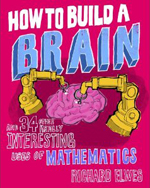
    How to build a brain: And 34 other really interesting uses of mathematics

    By Richard Elwes

    It's quite refreshing to find a book on maths that is so upbeat and infectious as How to build a brain. Certainly the title is a misnomer; one would immediately associate it to artificial intelligence or biology, but in reality this book is about how mathematics finds its way into many aspects of our world.

    Richard Elwes, a researcher in mathematics, Plus author and keen communicator of science, believes in busting the myths surrounding maths (and the people who work with it). At the same time, he is intent on making accessible many ideas "that can astonish with their diversity, captivate with mystery, and enthral with beauty".

    Cue How to build a brain in which he takes the reader on a journey through "35 landmarks of the mathematical world". In each chapter, Elwes introduces a key mathematical idea, often illustrated with a simple problem and surprising connections; who knew that Lewis Fry Richardson's interest in the likelihood of two countries going into war would lead to fractals? Or that there are just 17 possible wallpaper patterns? Furthermore, there are plenty of historical notes related to famous mathematicians and the reader gets an idea of what goes into establishing a bonafide mathematical theorem.

    Topics as diverse as number theory, chaos, the famous P=NP problem, complexity and game theory, among others, are given the Elwes treatment. The writing is concise and always engaging, challenging the reader to think along the examples he presents. And there are also plenty of illustrations for those with short attention spans. My only criticism has to do with the lack of a further reading section, as most of the chapters would leave you wanting for more, though this is nitpicking over details as anyone can Google these days.

    In summary, How to build a brain is a fun ride through mathematics and its developments, a great read for any teen or adult who thought the subject daunting. Anyone who reads it will not only end up learning a little more, but surely be amazed as to where maths pops up.

    Book details:
    How to build a brain
    Richard Elwes
    hardback — 224 pages
    Quercus Publishing Plc (2011)
    ISBN: 978-1849164801

    About the author

    Linda I. Uruchurtu is a Postdoctoral Fellow in theoretical physics, Imperial College London.

    • Log in or register to post comments

    Anonymous

    2 June 2011

    Permalink

    It would be great if we have a Kindle edition of this book. I am in India and either these books are not available in stores out here or we need to incur the shipping charges if we order it via Amazon.

    Regards
    Prashant

    • Log in or register to post comments

    Anonymous

    11 February 2013

    In reply to Kindle Edition by Anonymous

    Permalink

    hi, this book is available at justbooksclc

    • Log in or register to post comments

    Read more about...

    book review
    University of Cambridge logo

    Plus is part of the family of activities in the Millennium Mathematics Project.
    Copyright © 1997 - 2025. University of Cambridge. All rights reserved.

    Terms