

Einstein right on time
A central prediction of Albert Einstein's general theory of relativity is that gravity makes clocks tick more slowly — time passes slower when you're close to a massive body like the Earth, compared to when you're further away from it where its gravitational pull is weaker. This prediction has already been confirmed in experiments using airplanes and rockets, but a new experiment in an atom interferometer measures the slowdown 10,000 times more accurately than before — and finds it to be exactly what Einstein predicted.

The result shows once again how well Einstein's theory describes the real world, said Holger Müller, an assistant professor of physics at the University of California, Berkeley. "This experiment demonstrates that gravity changes the flow of time, a concept fundamental to the theory of general relativity." The phenomenon is often called the gravitational redshift because the oscillations of light waves slow down and move into the red part of the spectrum when tugged by gravity. A report describing the experiment appears in the February 18 issue of the journal Nature.
Müller tested Einsteins theory by taking advantage of a tenet of quantum mechanics: that energy — and therefore matter — exhibits both particle-like and wave-like characteristics. The cesium atoms used in the experiment can be represented by matter waves that oscillate 3 × 1025 times per second — that is, about 30 million billion billion times per second.
When the cesium atom matter wave enters the experiment, it encounters a carefully tuned flash of laser light. The laws of quantum mechanics step in, and each cesium atom enters two alternate realities. In one, the laser has pushed the atom up one-tenth of a millimeter, giving it a tiny lift away from the Earth, to a realm where Earth's gravitational field is slightly weaker. In the other, the atom remains unmoved inside Earth's gravitational well, where time flies by less quickly.
Just as an optical interferometer uses interfering light waves to measure time or distance to within a fraction of a wavelength, an atom interferometer uses interfering matter waves. Because matter waves oscillate at a much higher frequency than light waves, they can be used to measure correspondingly smaller times and distances.
Müller and his colleagues used the interference between the cesium matter waves in the alternate realities to measure the resulting difference between their oscillations, and thus the redshift.
The equations of general relativity predicted precisely the measured slowing of time, to an accuracy of about one part in 100 million (7 × 10⁻⁹). This is 10,000 times more accurate than the measurements made 30 years ago using two hydrogen maser clocks, one on Earth and the other launched via rocket to a height of 10,000 kilometers.
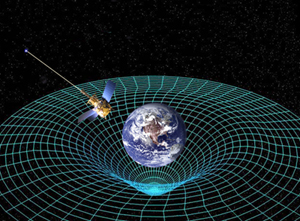
According to Einstein's theory of general relativity gravity curves spacetime. Image courtesy NASA.
"Two of the most important theories in all of physics are quantum mechanics and the general theory of relativity," noted Müller's collaborator, Steven Chu, a former UC Berkeley professor of physics and former director of Lawrence Berkeley National Laboratory (LBNL). Chu was one of the originators of the atom interferometer, which is based on his Nobel Prize-winning development of cold laser traps. "The paper that we are publishing in Nature uses two fundamental aspects of the quantum description of matter to perform one of the most precise tests of the general theory of relativity." Müller noted that the experiment demonstrates very clearly "Einstein's profound insight, that gravity is a manifestation of curved space and time, which is among the greatest discoveries of humankind."
Far from being merely theoretical, the results have implications for Earth's global positioning satellite system (GPS), for precision timekeeping, and for gravitational wave detectors. "If we used our best clocks, with 17-digit precision, in global positioning satellites, we could determine position to the millimeter," said Nüller. "But lifting a clock by 1 meter creates a change in the 16th digit. So, as we use better and better clocks, we need to know the influence of gravity [to a greater precision]."
Müller is building ever more precise atom interferometers to measure the gravitational redshift. Eventually, he hopes to build an experiment capable of observing another prediction of Einstein's theory: gravitational waves. These tiny fluctuations in gravity, generated by interactions between massive stars or black holes, are thought to propagate through spacetime, but have as yet only been observed indirectly. To filter out noise from Earth's gravity and other perturbations, like a passing truck, such an experiment would have to involve at least two atom interferometers separated by a large distance. An ideal spot for the experiment would be the Deep Underground Science and Engineering Laboratory at the former Homestake mine in South Dakota.
Further reading
- You can find out more about why gravity slows time on the website of the Perimeter Institute for Theoretical Physics;
- To find out more about wave-particle duality, read the Plus article Light's identity crisis;
- You can learn about gravitational waves in the Plus article How does gravity work?;
- To find out how GPS works, have a look at our teacher toolkit on navigation, part of our teacher package Maths and climate change in the Arctic.
Comments
Marianne
So what is the maximum and minimum speed of time in our universe?
Marianne
The longest interval of time for some process (eg a heart beat or a human lifetime) is that measured by a clock moving with the observer. It is
called proper time. The length of that interval measured by some other clock in relative motion to that observer is always less than the proper time and as the relative speed approaches that of light, it tends to zero.
The twin paradox (see http://plus.maths.org/issue36/features/aiden) is related. If a twin stays at home and lives for 10 years on his watch while his identical twin goes off on a spacetrip at near light speed, then the travelling twin will return to find that he is
younger than his stay-at-home twin when he is reunited with him on earth.
So the maximal time is given by the proper time measured by a clock moving with you, and the minimum time can be arbitrarily small as the relative speed approaches that of light, or the gravitational field approaches the value needed to
make a black hole.
Marianne
There is no such thing as the General Theory Of Relativity. Einstein was successful in developing the Special Theory Of Relativity which seems to describe much of what we know about our own universe in accord with conditions that he defined in the theory. He was unsuccessful in deriving the General Theory Of Relativity which, if ever derived, would apply under any set Of conditions. The Special Theory Of Relativity is to the Generla Theory Of Relativity as a Square is to a Polygon.
mdharley@hotmail.com
Marianne
Einsten has also admitted that" my theory can also be failed" as he was aware that the physicists(R. Hosemann & S. N. Bagchi,1962) has proved by their results that every measurement on instruments contains error. Also, Hesinberg posed the Uncertainty in Physics due to the fact of the results based on Statists & Probability which are based on deficiencies in function definition & structure of function y=f(x) pointed out by Logician(A. Church,1941) & Experimental Physicists Hosemann & Bagchi,1962.