
Home
plus.maths.org

Secondary menu

  • My list
  • About Plus
  • Sponsors
  • Subscribe
  • Contact Us
  • Log in
  • Main navigation

  • Home
  • Articles
  • Collections
  • Podcasts
  • Maths in a minute
  • Puzzles
  • Videos
  • Topics and tags
  • For

    • cat icon
      Curiosity
    • newspaper icon
      Media
    • graduation icon
      Education
    • briefcase icon
      Policy

    Popular topics and tags

    Shapes

    • Geometry
    • Vectors and matrices
    • Topology
    • Networks and graph theory
    • Fractals

    Numbers

    • Number theory
    • Arithmetic
    • Prime numbers
    • Fermat's last theorem
    • Cryptography

    Computing and information

    • Quantum computing
    • Complexity
    • Information theory
    • Artificial intelligence and machine learning
    • Algorithm

    Data and probability

    • Statistics
    • Probability and uncertainty
    • Randomness

    Abstract structures

    • Symmetry
    • Algebra and group theory
    • Vectors and matrices

    Physics

    • Fluid dynamics
    • Quantum physics
    • General relativity, gravity and black holes
    • Entropy and thermodynamics
    • String theory and quantum gravity

    Arts, humanities and sport

    • History and philosophy of mathematics
    • Art and Music
    • Language
    • Sport

    Logic, proof and strategy

    • Logic
    • Proof
    • Game theory

    Calculus and analysis

    • Differential equations
    • Calculus

    Towards applications

    • Mathematical modelling
    • Dynamical systems and Chaos

    Applications

    • Medicine and health
    • Epidemiology
    • Biology
    • Economics and finance
    • Engineering and architecture
    • Weather forecasting
    • Climate change

    Understanding of mathematics

    • Public understanding of mathematics
    • Education

    Get your maths quickly

    • Maths in a minute

    Main menu

  • Home
  • Articles
  • Collections
  • Podcasts
  • Maths in a minute
  • Puzzles
  • Videos
  • Topics and tags
  • Audiences

    • cat icon
      Curiosity
    • newspaper icon
      Media
    • graduation icon
      Education
    • briefcase icon
      Policy

    Secondary menu

  • My list
  • About Plus
  • Sponsors
  • Subscribe
  • Contact Us
  • Log in
  • Maths in a minute: Is greed good?
    23 January, 2014
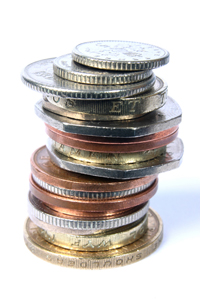
    Coins

    Vending machines that don't return change are annoying, especially if the prices they demand aren't nice round figures you can make up with a single coin. If that's the case, then there's nothing but to cram through your wallet, fishing out the right coins to make up the amount exactly. What's the best way of doing that? Without noticing many of us probably follow this recipe: find the biggest (as in largest denomination) coin that fits into the amount, then the next-biggest that fits into the remainder, and so on, until you (hopefully) hit the required sum. As an example, if you're being asked for 85p, you probably fish a 50p coin out first, then a 20p coin, then a 10p coin, and finally a 5p coin. And what if you haven't got all of the coins just mentioned in your wallet? In that case you follow the same recipe using what you've got.

    This greedy recipe (greedy because you always go for the biggest coin that fits) seems to offer the best solution in that it seems to involve the fewest number of coins to make up the amount you need. For example, supposing you do have a 20p coin, but decide to go for two 10p coins instead, you increase the number of coins to make up 85p from four to five. So the greedy algorithm seems useful, not just for people struggling with vending machines, but also for cashiers returning change to customers.

    But is greed really always the best option? It turns out that this depends on the coins that are available. Imagine, for example, you need to make up 8p. Greed would tell you to go for a 5p coin, then a 2p coin and then a 1p coin. And that's indeed the smallest number of coins to make up 8p with if you are using Pound Sterling, Euros, US Dollars, and most other currencies. But now imagine a currency that in addition to these denominations also has a 4p coin. Then you could make up 8p with two of those, beating the greedy strategy by one. Such a currency system might seem silly but it's not unheard-of: the pre-decimal British coinage system was one for which the greedy recipe failed when it came to minimising the number of coins needed to make up a given amount.

    Read more about...
    coin problems
    greedy algorithm
    Maths in a minute
    • Log in or register to post comments

    Anonymous

    25 January 2014

    Permalink

    I usually do the opposite ... looking for the lowest denomination coins because those I want to get rid of, then I start up to the next higher and so on ... then at the end i will jiggle things a bit to make the right amount.

    • Log in or register to post comments

    ddnrkik

    11 February 2014

    In reply to not how i do it by Anonymous

    Permalink

    ohh same with me

    Kaos

    • Log in or register to post comments

    Read more about...

    coin problems
    greedy algorithm
    Maths in a minute
    University of Cambridge logo

    Plus is part of the family of activities in the Millennium Mathematics Project.
    Copyright © 1997 - 2025. University of Cambridge. All rights reserved.

    Terms