Home
plus.maths.org

Secondary menu

  • My list
  • About Plus
  • Sponsors
  • Subscribe
  • Contact Us
  • Log in
  • Main navigation

  • Home
  • Articles
  • Collections
  • Podcasts
  • Maths in a minute
  • Puzzles
  • Videos
  • Topics and tags
  • For

    • cat icon
      Curiosity
    • newspaper icon
      Media
    • graduation icon
      Education
    • briefcase icon
      Policy

    Popular topics and tags

    Shapes

    • Geometry
    • Vectors and matrices
    • Topology
    • Networks and graph theory
    • Fractals

    Numbers

    • Number theory
    • Arithmetic
    • Prime numbers
    • Fermat's last theorem
    • Cryptography

    Computing and information

    • Quantum computing
    • Complexity
    • Information theory
    • Artificial intelligence and machine learning
    • Algorithm

    Data and probability

    • Statistics
    • Probability and uncertainty
    • Randomness

    Abstract structures

    • Symmetry
    • Algebra and group theory
    • Vectors and matrices

    Physics

    • Fluid dynamics
    • Quantum physics
    • General relativity, gravity and black holes
    • Entropy and thermodynamics
    • String theory and quantum gravity

    Arts, humanities and sport

    • History and philosophy of mathematics
    • Art and Music
    • Language
    • Sport

    Logic, proof and strategy

    • Logic
    • Proof
    • Game theory

    Calculus and analysis

    • Differential equations
    • Calculus

    Towards applications

    • Mathematical modelling
    • Dynamical systems and Chaos

    Applications

    • Medicine and health
    • Epidemiology
    • Biology
    • Economics and finance
    • Engineering and architecture
    • Weather forecasting
    • Climate change

    Understanding of mathematics

    • Public understanding of mathematics
    • Education

    Get your maths quickly

    • Maths in a minute

    Main menu

  • Home
  • Articles
  • Collections
  • Podcasts
  • Maths in a minute
  • Puzzles
  • Videos
  • Topics and tags
  • Audiences

    • cat icon
      Curiosity
    • newspaper icon
      Media
    • graduation icon
      Education
    • briefcase icon
      Policy

    Secondary menu

  • My list
  • About Plus
  • Sponsors
  • Subscribe
  • Contact Us
  • Log in
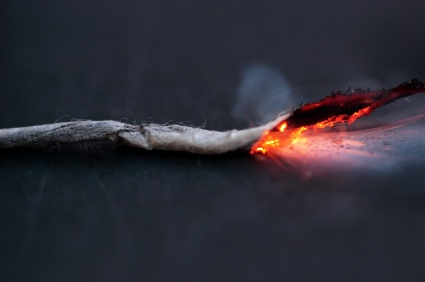
  • Lit fuse

    Fun with fuses

    1 September, 2009
    September 2009
    Lit fuse


    You are given two fuses, each of which burns for exactly one minute. However, since the fuses are not of uniform thickness, they do not burn at a uniform rate along their lengths. How can you use the two fuses to measure 45 seconds?

    This puzzle was taken from Norman Do's regular Puzzle Corner column for the Gazette of the Australian Mathematical Society. Why not try your hand at the problems in the latest Puzzle Corner?


    If you are stumped by last issue's puzzle, here is the solution.

    For some challenging mathematical puzzles, see the NRICH puzzles from this month or last month.

    Solution link
    Fun with fuses solution
    • Log in or register to post comments

    Anonymous

    2 August 2010

    Permalink
    Comment

    Bend one of the fuses so the two ends are touching at the center point of itself, then light the center of that fuse, and one end of the other fuse. When the bent fuse has burned completely, you have 3 quarters of an hour remaining on the other fuse.

    This works because lighting the center of the fuse is like cutting it in half, doubling it's burning time, just like lighting both ends at once. If both ends are lit, in addition to the center, the total burning time is reduced to one quarter of it's original time.

    • Log in or register to post comments

    Anonymous

    3 August 2010

    In reply to I have an alternate solution by Anonymous

    Permalink
    Comment

    Sorry, I found this puzzle on another website that didn't have the ability to comment, and that version was using hours instead of minutes

    • Log in or register to post comments

    Anonymous

    23 September 2010

    In reply to I have an alternate solution by Anonymous

    Permalink
    Comment

    The offered alternative solution only works if the fuses burn at a constant speed. The questions says we can't assume this.

    • Log in or register to post comments

    Anonymous

    27 February 2011

    Permalink
    Comment

    LIGHT ONE FUSE AT BOTH ENDS AND AT THE SAME TIME LIGHT THE OTHER AT ONE END

    THE TIMING STARTS NOW

    AFTER 30 SECONDS THE FUSE THAT WAS LIT AT BOTH ENDS WILL HAVE PASSED AWAY !

    AT THIS INSTANCE LIGHT THE OTHER FUSE AT THE END THAT IS STILL INTACT

    WHEN THIS HAS DIED ANOTHER 15 SECONDS WILL HAVE GONE

    45 IN TOTAL

    • Log in or register to post comments

    M

    21 January 2019

    In reply to FUSES SOLUTION by Anonymous

    Permalink
    Comment

    "AFTER 30 SECONDS THE FUSE THAT WAS LIT AT BOTH ENDS WILL HAVE PASSED AWAY !"

    How do you know that. Burning speed is not constant.

    • Log in or register to post comments
    University of Cambridge logo

    Plus is part of the family of activities in the Millennium Mathematics Project.
    Copyright © 1997 - 2025. University of Cambridge. All rights reserved.

    Terms