
Russian roulette solution
Russian roulette
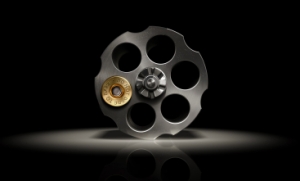
Your mother did tell you to stay away from gambling, but now it's far, far too late to head her advice. You're sitting in a smoke-filled room, your single opponent staring you down. Between you, on a table, there is six-shot revolver, containing exactly one live bullet. Someone has spun the cylinder so neither of you knows whether the next shot will be blank or lethal. Each of you will take one shot at the opponent in turn, and the cylinder will be spun again after each shot. The game ends, obviously, when one of you fires the lethal shot, and the other person is dead. It's your choice whether to go first or second — which should you choose? Does it matter?
Solution
Let a be the chance that the person to shoot first wins the game and let b be the chance that the person to shoot second does, so a+b=1. Suppose that you go first. The probability b that your opponent wins is equal to the probability p that he or she survives your first shot times the probability q that he or she wins the game from then on, after having survived the first shot. Since 5 of the 6 chambers are empty and each has an equal chance of containing the bullet, we get p=5/6. Once your opponent has survived the first round, he or she turns into the player to go first, with probability a of winning the game, so q=a. This gives b=5/6a. Putting this together with the fact that a+b=1 gives a=6/11 and b=5/11. Hence you have a greater chance of winning if you take the first shot.
This puzzle was inspired by a problem in the book Number Story, which is reviewed in this issue of Plus.
Back to main puzzle page
Anonymous
Since who ever goes first (say "A") has the same chance of killing the other ("B")... that is 1/6...
"A" might as well go first.. to increase the chance... and hope "B" gets killed... and "B" will never have the chance to strike back.
If "B" survives.... then it is back to square one.
So, who ever goes first have higher success rate.
Does this make sense??
Anonymous
If the odds of losing are 1/6 for every shot he fired at himself, then the total odds of losing are 1/6 raised to the S (for shots fired at himself)
The last person to shoot will at times have shot one fewer than his oponent and at times shot the same. He will never have fired more shots. The number of shots fired will dictate the odds of losing. Shoot last and you won't shoot most - guaranteed.
Anonymous
The chance of being shot if you go first is
1/6+5/6×5/6×1/6+... = p
the chance if you go second is
5/6×1/6+5/6×5/6×5/6×1/6+... = 5/6 p
Thus best to go second and p = 6/11
Anonymous
After each shot that does not kill one empty chamber is out of the game since you only spin randomly once and after that just keep taking the next chamber until someone dies. Thus for exmple if the second shot happens it has a chance of 4/5 not to kill instead of 5/6 since one empty chamber will already have been removed from the game.
Anonymous
There are 6 chambers in the gun (1,2,3,4,5,6) and the bullet has an equal chance of being in each chamber. Player A is getting shot at by half of the chambers (1,3,5) and B by the other half (2,4,6). There's a 50% chance of A being shot, and 50% chance of B being shot.
Anonymous
In theory, you can have player A take the first three shots and player B take the last thee. It makes no difference whether you go first or last. The chances are 50/50.
Case closed.
Anonymous
Wrong. You aren't considering the fact that when I take the first three shots at my opponent, if the bullet fires in one of those three shots I win and so do not face the risk of being shot at three times.
Anonymous
Let p for every shot = probability of the chamber containing the bullet * probability that the bullet is still in the gun (hasn't fired yet)
P(1st shot) = 1/6 * 6/6 = 1/6 (1/6 chance that the bullet still contains the bullet * 100% chance the gun still contains the bullet)
P(2nd shot) = 1/5 * 5/6 = 1/6 (assuming first shot didn't fire, 1 in 5 chance of the bullet * 5/6 chance the gun still contains the bullet)
P(3rd shot) = 1/4 * 4/6 = 1/6
P(4th shot) = 1/3 * 3/6 = 1/6
P(5th shot) = 1/2 * 2/6 = 1/6
Now, there's only one bullet left and 100 % chance of it still being in the gun but 1 in 6 chance that the game would get to this point:
P(6th shot) = 1/1 * 1/6 = 1/6
Person 1 = 1/6 + 1/6 + 1/6 = 50%
Person 2 = 1/6 + 1/6 + 1/6 = 50%
Makes no differnce
Anonymous
The given solution is false because it should be 5/6a=5/6b. If we assume that b shot first then for a the chance to win the game is 5/6 * the chance that he wins the resulting 5 chamber game in which he gets to go first. But for b the chance to win is 5/6 * the chance that he wins the resulting game of 5 chambers where he goes last. The answer modified a to mean winning the resulting 5 chamber game but he left b to mean winning the original 6 chamber game. and then he made the formula 5/6a=b which is correct but a+b=1 is not. It is not true that the chance that a wins the 5 chamber game after the first shot has been made + the chance that b wins the original 6 chamber game before the first shot has been made is 1. In fact with his new a and b a+b<1 since a has only 5/6 to happen while the original 6 chamber game a had 1 chance to happen.
There have been multiple comments showing different good arguments as to why both players have equal probability of winning. Allow me to add yet another good argument:
Assuming that players take turns shooting themselves instead of shooting the other, the chance that the first player dies is 1/6 on his first turn, 1/4 on his second, and 1/2 on his third. His first turn has 1 chance of happening, his second has (5/6)*(4/5) chance of happening , and his third has (5/6)*(4/5)*(3/4)*(2/3) chance of happening. That is because for every turn to happen all previous turns need to not result in a death, and every turn that someone does not die one empty chamber is out of the game. Add all those probabilities to get the chance that the person shooting first dies: (1/6)+(5/6)*(4/5)*(1/4)+(5/6)*(4/5)*(3/4)*(2/3)*(1/2)=1/2. Thus he has 1/2 chance to die and 1/2 chance to win and so does his opponent dince there will always be a winner and a die'er.
Anon
A lot of people aren't reading the problem carefully. The cylinder is spun after every shot. Each shot is 1/6. There are no "used chambers" when the next player shoots.
Takushi Itadani
If I go first, let me calculate my death probability.
This is basically the sum of an infinite geometric progression.
* I die by the 1st shot: 1/6
* Both survive after the first 2 shots and I die by the 3rd shot: (5/6)^2 * 1/6
* Both survive after the first 4 shots and I die by the 5th shot: (5/6)^4 * 1/6
...and so forth
The sum of the above: 1/6 * (1/(1-(5/6)^2))
= 1/6 * 1/(1-25/36) = 1/6 * 36/11 = 6/11
If I go second, my death probability = 5/11