
Home
plus.maths.org

Secondary menu

  • My list
  • About Plus
  • Sponsors
  • Subscribe
  • Contact Us
  • Log in
  • Main navigation

  • Home
  • Articles
  • Collections
  • Podcasts
  • Maths in a minute
  • Puzzles
  • Videos
  • Topics and tags
  • For

    • cat icon
      Curiosity
    • newspaper icon
      Media
    • graduation icon
      Education
    • briefcase icon
      Policy

    Popular topics and tags

    Shapes

    • Geometry
    • Vectors and matrices
    • Topology
    • Networks and graph theory
    • Fractals

    Numbers

    • Number theory
    • Arithmetic
    • Prime numbers
    • Fermat's last theorem
    • Cryptography

    Computing and information

    • Quantum computing
    • Complexity
    • Information theory
    • Artificial intelligence and machine learning
    • Algorithm

    Data and probability

    • Statistics
    • Probability and uncertainty
    • Randomness

    Abstract structures

    • Symmetry
    • Algebra and group theory
    • Vectors and matrices

    Physics

    • Fluid dynamics
    • Quantum physics
    • General relativity, gravity and black holes
    • Entropy and thermodynamics
    • String theory and quantum gravity

    Arts, humanities and sport

    • History and philosophy of mathematics
    • Art and Music
    • Language
    • Sport

    Logic, proof and strategy

    • Logic
    • Proof
    • Game theory

    Calculus and analysis

    • Differential equations
    • Calculus

    Towards applications

    • Mathematical modelling
    • Dynamical systems and Chaos

    Applications

    • Medicine and health
    • Epidemiology
    • Biology
    • Economics and finance
    • Engineering and architecture
    • Weather forecasting
    • Climate change

    Understanding of mathematics

    • Public understanding of mathematics
    • Education

    Get your maths quickly

    • Maths in a minute

    Main menu

  • Home
  • Articles
  • Collections
  • Podcasts
  • Maths in a minute
  • Puzzles
  • Videos
  • Topics and tags
  • Audiences

    • cat icon
      Curiosity
    • newspaper icon
      Media
    • graduation icon
      Education
    • briefcase icon
      Policy

    Secondary menu

  • My list
  • About Plus
  • Sponsors
  • Subscribe
  • Contact Us
  • Log in
  • Fuzzy pizza

    by
    Rachel Thomas
    17 December, 2002
    17/12/2002


    Fuzziness is usually the last thing you would want to associate with a pizza, as it conjures up images of quietly decaying remnants of last week's dinner. However, researchers from University College, Dublin are relying on fuzziness to help deliver you the perfect pizza.
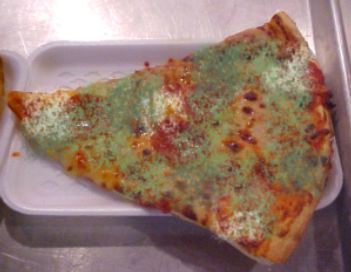
    Fuzzy pizza

    Mmmmm... fuzzy pizza...

    As pizza has become more popular, producers have had to develop their manufacturing methods to ensure efficiency and quality - the last thing hungry customers want is a wonky non-circular base and sloppily spread sauce. To this end, Da-Wen Sun and Tadhg Brosnan have used a combination of computer vision and fuzzy logic to monitor the quality of pizza bases and how sauce is spread in pizza production.

    By analysing images of pizza bases, they used computer methods to calculate measures of the quality of the base, such as overall diameter and circularity. Similarly, images of bases spread with sauce provided the information needed to calculate the sauce area percentage and other relevant sauce quality measures.

    From this data they then established fuzzy logic rules for the computer to decide whether a photographed pizza was of an acceptable standard. "Fuzzy logic embodies the nature of [the human] mind in some sense," the researchers said in their paper in Journal of Food Engineering. This is because fuzzy logic can use approximate information and uncertainty to generate decisions, just as we can.

    Fuzzy logic is based on a mathematical process of deciding to which fuzzy set (e.g. the set of acceptable pizzas, the set of unacceptable pizzas) a fuzzy variable (in this case, the percentage of the pizza base covered in sauce) belongs. The flexibility of fuzzy logic comes from the blurred, or fuzzy, boundaries of these sets - an object can partially belong to a set and the sets can overlap. The sets are described by a mathematical equation called a Membership Function (MF), which gives every object a membership value between 1 (completely in the set) and 0 (completely out of the set). This makes fuzzy logic much more similar to a human assessment of such questions than strict Boolean logic. In Boolean logic an object is either in (an MF of 1) or out (an MF of 0) of a set, whereas in the fuzzy universe, not only can objects be completely in the set, or completely out, but they can "sort of be", or "be just a bit" in the set (an MF somewhere between 0 or 1).

    In fact, according to their trials, the researchers' methods of fuzzy logic gave a 92% accurate assessment of sauce spread on pizza bases, compared to human monitoring. An encouraging result for discerning pizza connoisseurs, who may now be asking for an extra topping of fuzzy logic with their next pizza.

    Read more about...
    fuzzy logic
    quality control
    food engineering
    • Log in or register to post comments

    Comments

    Anonymous

    24 November 2012

    Permalink

    if it aint moving eat it

    • Log in or register to post comments

    Read more about...

    fuzzy logic
    quality control
    food engineering
    University of Cambridge logo

    Plus is part of the family of activities in the Millennium Mathematics Project.
    Copyright © 1997 - 2025. University of Cambridge. All rights reserved.

    Terms