
Home
plus.maths.org

Secondary menu

  • My list
  • About Plus
  • Sponsors
  • Subscribe
  • Contact Us
  • Log in
  • Main navigation

  • Home
  • Articles
  • Collections
  • Podcasts
  • Maths in a minute
  • Puzzles
  • Videos
  • Topics and tags
  • For

    • cat icon
      Curiosity
    • newspaper icon
      Media
    • graduation icon
      Education
    • briefcase icon
      Policy

    Popular topics and tags

    Shapes

    • Geometry
    • Vectors and matrices
    • Topology
    • Networks and graph theory
    • Fractals

    Numbers

    • Number theory
    • Arithmetic
    • Prime numbers
    • Fermat's last theorem
    • Cryptography

    Computing and information

    • Quantum computing
    • Complexity
    • Information theory
    • Artificial intelligence and machine learning
    • Algorithm

    Data and probability

    • Statistics
    • Probability and uncertainty
    • Randomness

    Abstract structures

    • Symmetry
    • Algebra and group theory
    • Vectors and matrices

    Physics

    • Fluid dynamics
    • Quantum physics
    • General relativity, gravity and black holes
    • Entropy and thermodynamics
    • String theory and quantum gravity

    Arts, humanities and sport

    • History and philosophy of mathematics
    • Art and Music
    • Language
    • Sport

    Logic, proof and strategy

    • Logic
    • Proof
    • Game theory

    Calculus and analysis

    • Differential equations
    • Calculus

    Towards applications

    • Mathematical modelling
    • Dynamical systems and Chaos

    Applications

    • Medicine and health
    • Epidemiology
    • Biology
    • Economics and finance
    • Engineering and architecture
    • Weather forecasting
    • Climate change

    Understanding of mathematics

    • Public understanding of mathematics
    • Education

    Get your maths quickly

    • Maths in a minute

    Main menu

  • Home
  • Articles
  • Collections
  • Podcasts
  • Maths in a minute
  • Puzzles
  • Videos
  • Topics and tags
  • Audiences

    • cat icon
      Curiosity
    • newspaper icon
      Media
    • graduation icon
      Education
    • briefcase icon
      Policy

    Secondary menu

  • My list
  • About Plus
  • Sponsors
  • Subscribe
  • Contact Us
  • Log in
  • Gravitational waves reveal cosmic hum

    25 July, 2023

    There's been some huge news in the world of cosmology: for the first time scientists have detected a low frequency hum of gravitational waves. The new results were published by the North American Nanohertz Observatory for Gravitational Waves, NANOGrav for short. The NANOGrav team were not alone — they coordinated with collaborations in Europe, India, Australia, and China, which released similar findings at the same time.

    In this podcast we find out what these new results mean, and why they're so exciting, with Michalis Agathos, Amelia Drew, and Ulrich Sperhake of the Stephen Hawking Centre for Theoretical Cosmology at the University of Cambridge. Join us on this fascinating, and slightly mind-bending, cosmic ride!

    To find out more about the topics discussed in this podcast see:

    • Maths in a minute: Gravitational waves
    • Maths in a minute: Black holes
    • Maths in a minute: Einstein's general theory of relativity

    You might also want to listen to our recent podcast A new map of dark matter.

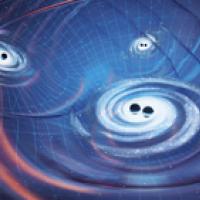
    The illustration above is an artist's rendering of black hole binaries emitting gravitational waves, produced by Olena Shmahalo for NANOGrav and reproduced here under CC BY 4.0.

    • Log in or register to post comments
    You can listen to the podcast using the player above, and you can listen and subscribe to our podcast through Apple Podcasts, Spotify and through most other podcast providers via podbean.

    Read more about...

    cosmology
    gravitational wave
    gravitational wave detector
    general relativity
    black hole
    University of Cambridge
    University of Cambridge logo

    Plus is part of the family of activities in the Millennium Mathematics Project.
    Copyright © 1997 - 2025. University of Cambridge. All rights reserved.

    Terms