
Home
plus.maths.org

Secondary menu

  • My list
  • About Plus
  • Sponsors
  • Subscribe
  • Contact Us
  • Log in
  • Main navigation

  • Home
  • Articles
  • Collections
  • Podcasts
  • Maths in a minute
  • Puzzles
  • Videos
  • Topics and tags
  • For

    • cat icon
      Curiosity
    • newspaper icon
      Media
    • graduation icon
      Education
    • briefcase icon
      Policy

    Popular topics and tags

    Shapes

    • Geometry
    • Vectors and matrices
    • Topology
    • Networks and graph theory
    • Fractals

    Numbers

    • Number theory
    • Arithmetic
    • Prime numbers
    • Fermat's last theorem
    • Cryptography

    Computing and information

    • Quantum computing
    • Complexity
    • Information theory
    • Artificial intelligence and machine learning
    • Algorithm

    Data and probability

    • Statistics
    • Probability and uncertainty
    • Randomness

    Abstract structures

    • Symmetry
    • Algebra and group theory
    • Vectors and matrices

    Physics

    • Fluid dynamics
    • Quantum physics
    • General relativity, gravity and black holes
    • Entropy and thermodynamics
    • String theory and quantum gravity

    Arts, humanities and sport

    • History and philosophy of mathematics
    • Art and Music
    • Language
    • Sport

    Logic, proof and strategy

    • Logic
    • Proof
    • Game theory

    Calculus and analysis

    • Differential equations
    • Calculus

    Towards applications

    • Mathematical modelling
    • Dynamical systems and Chaos

    Applications

    • Medicine and health
    • Epidemiology
    • Biology
    • Economics and finance
    • Engineering and architecture
    • Weather forecasting
    • Climate change

    Understanding of mathematics

    • Public understanding of mathematics
    • Education

    Get your maths quickly

    • Maths in a minute

    Main menu

  • Home
  • Articles
  • Collections
  • Podcasts
  • Maths in a minute
  • Puzzles
  • Videos
  • Topics and tags
  • Audiences

    • cat icon
      Curiosity
    • newspaper icon
      Media
    • graduation icon
      Education
    • briefcase icon
      Policy

    Secondary menu

  • My list
  • About Plus
  • Sponsors
  • Subscribe
  • Contact Us
  • Log in
  • Mysterious magnetism: From the Earth to the stars

    1 December, 2022

    We've known for centuries that compass needles point North, but why they do so is still a mystery. It's down to the Earth's magnetic field, of course, but exactly where this field comes from and how it behaves still isn't properly understood. The same goes for the magnetic fields of other planets, the Sun, and other stars further afield. Experts from around the world are currently gathered together for a research programme about the topic at the Isaac Newton Institute for Mathematical Sciences (INI) in Cambridge, hoping to lift the magnetic mystery.

    This collection of articles explores what exactly is going on at the research programme and provides some background reading.
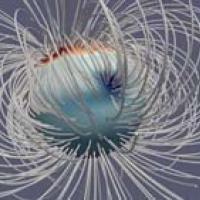
    Why is the Earth a magnet? — Here's a brief introduction to the mechanism scientists believe creates the Earth's magnetic field, as well as those of other planets and stars. They all act like giant dynamos.
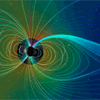
    Mysterious magnetism — Many questions are still open, however. This article looks into them, and why they are so hard to answer.

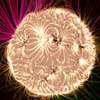
    Maths in a minute: The Navier-Stokes equations — The Earth's magnetic field is believed to be generated by a fluid moving around in its core. This is why the Navier-Stokes equations, which describe the behaviour of fluids, are important in understanding the magnetic field.
    Maxwell's equations and the secrets of nature — Where magnets are involved, Maxwell's equation of electromagnetism always have a part to play. Here's a look at the equations and their role in physics.

    What are liquid metal batteries? — The theory that explores the magnetic fields of planets and stars can also be used to understand liquid metal batteries. In this podcast we talk to Donald Sadoway about what liquid metal batteries are and why they hold much hope in our move to renewables.

    We produced this collection of content as part of our collaboration with the Isaac Newton Institute for Mathematical Sciences (INI), an international research centre and our neighbour here on the University of Cambridge's maths campus. INI attracts leading mathematical scientists from all over the world, and is open to all. Visit www.newton.ac.uk to find out more.

    INI logo

    Read more about...
    INI
    geomagnetism
    magnetohydrodynamics
    magnetic field
    mathematical modelling
    electromagnetism
    fluid dynamics
    • Log in or register to post comments

    Read more about...

    INI
    geomagnetism
    magnetohydrodynamics
    magnetic field
    mathematical modelling
    electromagnetism
    fluid dynamics
    University of Cambridge logo

    Plus is part of the family of activities in the Millennium Mathematics Project.
    Copyright © 1997 - 2025. University of Cambridge. All rights reserved.

    Terms