Home
plus.maths.org

Secondary menu

  • My list
  • About Plus
  • Sponsors
  • Subscribe
  • Contact Us
  • Log in
  • Main navigation

  • Home
  • Articles
  • Collections
  • Podcasts
  • Maths in a minute
  • Puzzles
  • Videos
  • Topics and tags
  • For

    • cat icon
      Curiosity
    • newspaper icon
      Media
    • graduation icon
      Education
    • briefcase icon
      Policy

    Popular topics and tags

    Shapes

    • Geometry
    • Vectors and matrices
    • Topology
    • Networks and graph theory
    • Fractals

    Numbers

    • Number theory
    • Arithmetic
    • Prime numbers
    • Fermat's last theorem
    • Cryptography

    Computing and information

    • Quantum computing
    • Complexity
    • Information theory
    • Artificial intelligence and machine learning
    • Algorithm

    Data and probability

    • Statistics
    • Probability and uncertainty
    • Randomness

    Abstract structures

    • Symmetry
    • Algebra and group theory
    • Vectors and matrices

    Physics

    • Fluid dynamics
    • Quantum physics
    • General relativity, gravity and black holes
    • Entropy and thermodynamics
    • String theory and quantum gravity

    Arts, humanities and sport

    • History and philosophy of mathematics
    • Art and Music
    • Language
    • Sport

    Logic, proof and strategy

    • Logic
    • Proof
    • Game theory

    Calculus and analysis

    • Differential equations
    • Calculus

    Towards applications

    • Mathematical modelling
    • Dynamical systems and Chaos

    Applications

    • Medicine and health
    • Epidemiology
    • Biology
    • Economics and finance
    • Engineering and architecture
    • Weather forecasting
    • Climate change

    Understanding of mathematics

    • Public understanding of mathematics
    • Education

    Get your maths quickly

    • Maths in a minute

    Main menu

  • Home
  • Articles
  • Collections
  • Podcasts
  • Maths in a minute
  • Puzzles
  • Videos
  • Topics and tags
  • Audiences

    • cat icon
      Curiosity
    • newspaper icon
      Media
    • graduation icon
      Education
    • briefcase icon
      Policy

    Secondary menu

  • My list
  • About Plus
  • Sponsors
  • Subscribe
  • Contact Us
  • Log in
  • Maths in a minute: Peano arithmetic

    20 April, 2023
    1 comments

    There's nothing simpler than 1,2,3, ... we understand these numbers instinctively and that's why they're called the natural numbers. But if you really think about it, what are these numbers? How would you describe them to an alien devoid of a number instinct? Here's one way of defining them, developed by the Italian mathematician Giuseppe Peano:
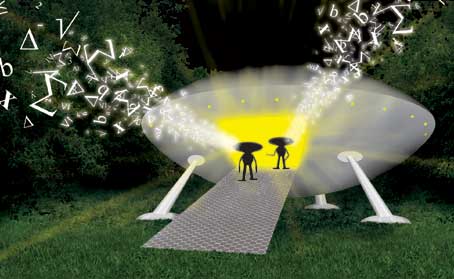
    aliens

    Explaining numbers to aliens.

    1. First you proclaim that 1 is a natural number
    2. Then you say that every natural number n has a successor s(n), which you can also write as n+1.
    3. We also insist that this successor is never equal to 1
    4. And that different numbers have different successors.

    These four rules give you all the natural numbers, neatly ordered in a line, starting from 1 (you could also have started from 0). They also give you arithmetic, since addition and multiplication are about repeatedly adding 1s and you know how to do this: you simply move up to the successor of the number you're looking at. Subtraction and division are just the reverse of addition and multiplication. So equipped with these rules your innumerate alien could actually do some pretty decent number theory.

    The four rules form the basis of what's called Peano arithmetic. It's a formal mathematical system based on a set of axioms (which includes these four rules) together with a language in which to speak about numbers and rules for logical inference. In the beginning of the 20th century mathematicians hoped they could turn all of maths into one giant formal system similar to Peano's arithmetic. That way they could prove everything directly from the axioms, without any hidden assumptions, and make sure that maths contains no contradictions. But their dream was shattered in the 1930s by the logician Kurt Gödel, who showed that there are logical limits to what you can do using formal systems. Find out more in

    • Gödel and the limits of logic
    • We must know, we will know
    • Searching for the missing truth
    • Log in or register to post comments

    Comments

    Chris

    12 June 2023

    Permalink

    My suggestion for linking formal logic and natural numbers is to see counting 1 2 3 4 5 6 and so on as a series of propositions each of which contradicts and updates the previous. There's 1 sheep in the field. Oh no there isn't, there are 2. Oh no, I've just spotted another, so 3. Hold on, there aren't 3 but 4. And so on.

    In formal logic this could be expressed as P, Q ⊃ not-P, R, R ⊃ not-Q, . . .. The material implication symbol "⊃" can be interpreted as the updating function. The conventional two-valued truth table for this function whereby 1 1 = 1, 0 1 = 1, 1 0 = 0, 0 0 = 1, means that 1 0 is a failure to update.

    • Log in or register to post comments

    Read more about...

    Maths in a minute
    arithmetic
    logic
    axiom
    INI

    Our Podcast: Maths on the Move

    Our Maths on the Move podcast brings you the latest news from the world of maths, plus interviews and discussions with leading mathematicians and scientists about the maths that is changing our lives.

    Apple Podcasts
    Spotify
    Podbean

    Plus delivered to you

    Keep up to date with Plus by subscribing to our newsletter or following Plus on X or Bluesky.

    University of Cambridge logo

    Plus is part of the family of activities in the Millennium Mathematics Project.
    Copyright © 1997 - 2025. University of Cambridge. All rights reserved.

    Terms