
Home
plus.maths.org

Secondary menu

  • My list
  • About Plus
  • Sponsors
  • Subscribe
  • Contact Us
  • Log in
  • Main navigation

  • Home
  • Articles
  • Collections
  • Podcasts
  • Maths in a minute
  • Puzzles
  • Videos
  • Topics and tags
  • For

    • cat icon
      Curiosity
    • newspaper icon
      Media
    • graduation icon
      Education
    • briefcase icon
      Policy

    Popular topics and tags

    Shapes

    • Geometry
    • Vectors and matrices
    • Topology
    • Networks and graph theory
    • Fractals

    Numbers

    • Number theory
    • Arithmetic
    • Prime numbers
    • Fermat's last theorem
    • Cryptography

    Computing and information

    • Quantum computing
    • Complexity
    • Information theory
    • Artificial intelligence and machine learning
    • Algorithm

    Data and probability

    • Statistics
    • Probability and uncertainty
    • Randomness

    Abstract structures

    • Symmetry
    • Algebra and group theory
    • Vectors and matrices

    Physics

    • Fluid dynamics
    • Quantum physics
    • General relativity, gravity and black holes
    • Entropy and thermodynamics
    • String theory and quantum gravity

    Arts, humanities and sport

    • History and philosophy of mathematics
    • Art and Music
    • Language
    • Sport

    Logic, proof and strategy

    • Logic
    • Proof
    • Game theory

    Calculus and analysis

    • Differential equations
    • Calculus

    Towards applications

    • Mathematical modelling
    • Dynamical systems and Chaos

    Applications

    • Medicine and health
    • Epidemiology
    • Biology
    • Economics and finance
    • Engineering and architecture
    • Weather forecasting
    • Climate change

    Understanding of mathematics

    • Public understanding of mathematics
    • Education

    Get your maths quickly

    • Maths in a minute

    Main menu

  • Home
  • Articles
  • Collections
  • Podcasts
  • Maths in a minute
  • Puzzles
  • Videos
  • Topics and tags
  • Audiences

    • cat icon
      Curiosity
    • newspaper icon
      Media
    • graduation icon
      Education
    • briefcase icon
      Policy

    Secondary menu

  • My list
  • About Plus
  • Sponsors
  • Subscribe
  • Contact Us
  • Log in
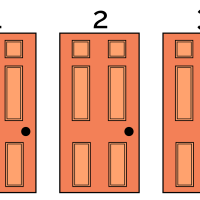
  • 3 doors labelled 1,2 and 3

    Three doors

    1 January, 1998
    January 1998

    This issue's puzzle is based on a well-known problem in probability.

    Red door
    Green door
    Blue door

    A game show host hides a prize behind one of three doors. The contestant has to guess which door hides the prize. The rules of the game are as follows.

    Firstly, the contestant chooses a door and tells the host this is the one she thinks the prize is behind. The host must then open one of the other doors. Of course, the host does not want to reveal the whereabouts of the prize so he always opens a losing door.

    The host then asks the contestant if she would like to stick with the door she originally chose or switch to the other unopened one.

    Should she switch doors?

    We will publish the best explanation in the next issue, along with the answer to the problem itself.

    Solution

    • Log in or register to post comments

    Anonymous

    29 January 2013

    Permalink
    Comment

    No, she should stay with her first thoughts on the door that she picked, because now she has a even chance of winning a prize.

    • Log in or register to post comments

    Anonymous

    14 February 2013

    Permalink
    Comment

    Switch doors to get a 67% chance of winning the prize. The door you pick 1st has a 67% chance of NOT containing the prize, forcing the host to open the other non-prize door, leaving the door the host didn't open with a 67% chance of hiding the prize.
    Palmer

    • Log in or register to post comments

    Read more about...

    probability
    three door problem
    puzzle
    University of Cambridge logo

    Plus is part of the family of activities in the Millennium Mathematics Project.
    Copyright © 1997 - 2025. University of Cambridge. All rights reserved.

    Terms