

Home
plus.maths.org

Secondary menu

  • My list
  • About Plus
  • Sponsors
  • Subscribe
  • Contact Us
  • Log in
  • Main navigation

  • Home
  • Articles
  • Collections
  • Podcasts
  • Maths in a minute
  • Puzzles
  • Videos
  • Topics and tags
  • For

    • cat icon
      Curiosity
    • newspaper icon
      Media
    • graduation icon
      Education
    • briefcase icon
      Policy

    Popular topics and tags

    Shapes

    • Geometry
    • Vectors and matrices
    • Topology
    • Networks and graph theory
    • Fractals

    Numbers

    • Number theory
    • Arithmetic
    • Prime numbers
    • Fermat's last theorem
    • Cryptography

    Computing and information

    • Quantum computing
    • Complexity
    • Information theory
    • Artificial intelligence and machine learning
    • Algorithm

    Data and probability

    • Statistics
    • Probability and uncertainty
    • Randomness

    Abstract structures

    • Symmetry
    • Algebra and group theory
    • Vectors and matrices

    Physics

    • Fluid dynamics
    • Quantum physics
    • General relativity, gravity and black holes
    • Entropy and thermodynamics
    • String theory and quantum gravity

    Arts, humanities and sport

    • History and philosophy of mathematics
    • Art and Music
    • Language
    • Sport

    Logic, proof and strategy

    • Logic
    • Proof
    • Game theory

    Calculus and analysis

    • Differential equations
    • Calculus

    Towards applications

    • Mathematical modelling
    • Dynamical systems and Chaos

    Applications

    • Medicine and health
    • Epidemiology
    • Biology
    • Economics and finance
    • Engineering and architecture
    • Weather forecasting
    • Climate change

    Understanding of mathematics

    • Public understanding of mathematics
    • Education

    Get your maths quickly

    • Maths in a minute

    Main menu

  • Home
  • Articles
  • Collections
  • Podcasts
  • Maths in a minute
  • Puzzles
  • Videos
  • Topics and tags
  • Audiences

    • cat icon
      Curiosity
    • newspaper icon
      Media
    • graduation icon
      Education
    • briefcase icon
      Policy

    Secondary menu

  • My list
  • About Plus
  • Sponsors
  • Subscribe
  • Contact Us
  • Log in
  • Outer space: Bridging that gap
    by
    John D. Barrow
    1 September, 2006
    September 2006

    Back to the Constructing our lives package

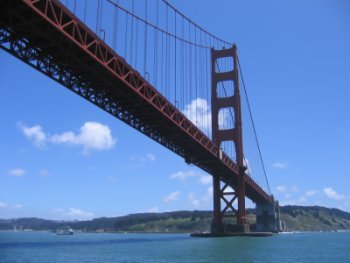
    The Golden Gate Bridge

    The Golden Gate Bridge in California

    One of the great human engineering achievements has been the construction of great bridges to span rivers and gorges that would otherwise be impassable. These vast construction projects often have an aesthetic quality about them that places them in the first rank of the modern wonders of the world. The elegant Golden Gate Bridge, Brunel's remarkable Clifton Suspension Bridge, or the Ponte Hercilio Luz in Brazil, have spectacular shapes that look smooth and similar. But what are they?

    Many mathematicians might, at first sight, suspect that these bridges follow the catenary shape of a hanging chain discovered separately by Gottfried von Leibniz, Christiaan Huygens, David Gregory and Johann Bernoulli, in 1691, following a challenge problem being set by his brother Jacob Bernoulli a year earlier.
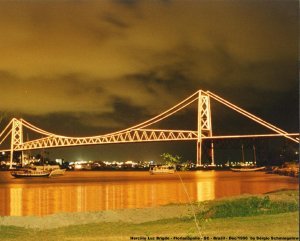
    The Ponte Hercilio Luz in Brazil

    The Ponte Hercilio Luz in Brazil

    However, there is a big difference between a hanging chain and a suspension bridge like the Clifton or the Golden Gate. Suspension bridges don't only have to support the weight of a single chain suspended from two points. The vast bulk of the weight to be supported by the suspension bridge cable is that of the flat deck of the bridge itself. If the deck is horizontal, with a constant density and cross-sectional area all the way along it, then the weight per unit length of bridge will be constant. The weight of each section is supported by the tension in the cable above it. Suppose the shape of the supporting bridge cable is some curve y(x) with its lowest point at the origin, where x = 0 and y = 0, located in the centre of the bridge. What is this curve's shape?

    The slope of the cable at any point is just given by the ratio of the weight below it (which is equal to the weight per unit length times x) divided by the tension in the supporting cable. But this slope is also equal to the derivative dy/dx. Hence, equating the two, and integrating x with respect to dx, we have the equation of a parabola with the lowest point located at x = 0 and y = 0. The equation for the shape of the suspension cable is now found to be a parabola y = x2/2B, where B is a constant equal to the tension divided by the weight per unit length of the bridge deck (see if you can fill in the details for yourself).

    Here is a picture of the beautiful parabolic Tsing Ma suspension bridge in Hong Kong, the sixth largest in the world. It spans 1377 metres and is 206 metres high. Its equation is therefore y = x2/2301.13 m because its two extremities pass through the points where x = 688.5m, y = 206m and x = -688.5m, y = 206m and the origin of coordinates is located at the lowest point of the cable.

    The Tsing Ma suspension bridge in Hong Kong

    The Tsing Ma Suspension Bridge in Hong Kong

    Here in England, one of the most remarkable engineering feats of the nineteenth century was the Clifton Suspension Bridge in Bristol, designed by Isambard Kingdom Brunel in 1829, but only completed in 1865, three years after his death. It spans 214 metres and is 21.3 metres high. Can you work out its equation?
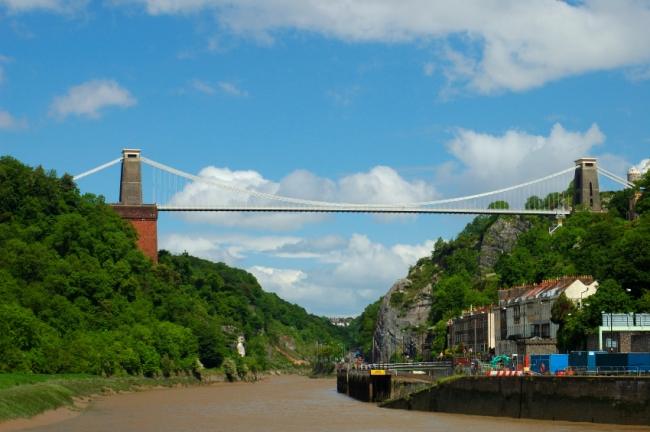
    The Clifton suspension bridge in Bristol

    The Clifton Suspension Bridge in Bristol


    Did you manage to answer the puzzle posed in Outer space: Superficiality? If not, you can find the answer here!
    • Log in or register to post comments

    Read more about...

    quadratic equation
    engineering
    outerspace

    Our Podcast: Maths on the Move

    Our Maths on the Move podcast brings you the latest news from the world of maths, plus interviews and discussions with leading mathematicians and scientists about the maths that is changing our lives.

    Apple Podcasts
    Spotify
    Podbean

    Plus delivered to you

    Keep up to date with Plus by subscribing to our newsletter or following Plus on X or Bluesky.

    University of Cambridge logo

    Plus is part of the family of activities in the Millennium Mathematics Project.
    Copyright © 1997 - 2025. University of Cambridge. All rights reserved.

    Terms