
Plus Advent Calendar Door #2: Computational fluid dynamics
Suppose you want to design the fastest car, engineer a replacement heart valve or simulate the flow of air in a building to limit the risk of infectious disease. All of these rely on fluid dynamics, which can lead to some pretty tricky mathematics.
The flow of fluids, be they air, blood or any other, is described by the Navier-Stokes equations. You can read more about these equations here, but on first glance you'll get a sense of how hard they are to solve.
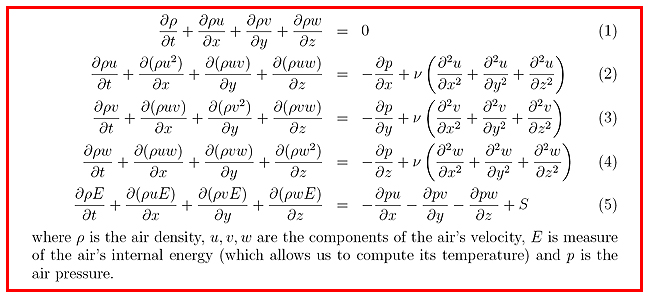
The Navier-Stokes equations.
If you want to use these equations to simulate the flow of a fluid around a car, heart valve or building, you need to solve them for your specific scenario: that is, you want a mathematical formula giving you the velocity and pressure of the fluid at every point in your system. But the hitch is there are no exact solutions for the most general forms of the Navier-Stokes equations, and the exact solutions that do exist are for simplified problems of no physical interest.
Thankfully, applying fluid dynamics in the real world is possible thanks to computational fluid dynamics. As Ben Evans explained in his article Supersonic Bloodhound, you have to break the problem down into smaller, more manageable chunks, using a method known as the finite element method. "In essence, we divide the space surrounding the car into a massive assortment of very small elements (100,000 million of them!). We call this a mesh. Then we tackle the problem element by element, each element making a simplified approximation to the solution across it, and with each element in constant discussions with its neighbours, until we have the complete solution. From this solution we get the air density, air velocity, air temperature and air pressure at all points surrounding the car."
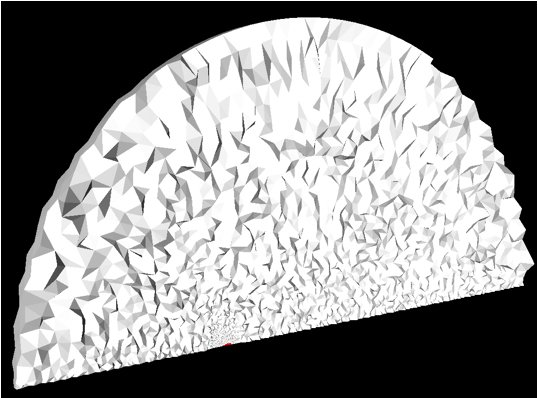
A mesh for solving the Navier-Stokes equations.
Once Evans has used this method to calculate how the pressure over a vehicle varies as it accelerates up to its top speed, he can use integration to sum up the effects of this pressure over the vehicle and work out the total forces. "The procedure is very similar to the trapezium rule, which estimates the area under a curve by approximating it by trapezia, and then summing their areas."
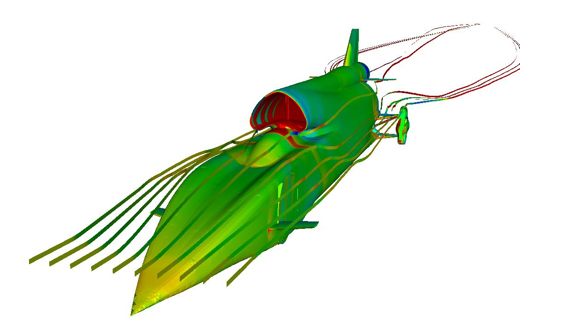
Pressure contours and streamlines over Bloodhound SSC.
You can find out how computational fluid dynamics helped Evans answer questions such as how much drag his supersonic car would experience, and whether it can stay on the ground at all speeds, and how this drove the design process of the car and particularly its external shape (in the articles Supersonic Bloodhoud and The fastest mathematician on Earth). And you can find out more about how it is used in areas such as biomedical engineering and aerosol physics to keep us healthy.
This article is partly based on a section of Supersonic Bloodhoud, by Ben Evans.
Return to the Plus advent calendar 2021.
This article was produced as part of our collaboration with the Isaac Newton Institute for Mathematical Sciences (INI) – you can find all the content from our collaboration here. The INI is an international research centre and our neighbour here on the University of Cambridge's maths campus. It attracts leading mathematical scientists from all over the world, and is open to all. Visit www.newton.ac.uk to find out more.
