
Home
plus.maths.org

Secondary menu

  • My list
  • About Plus
  • Sponsors
  • Subscribe
  • Contact Us
  • Log in
  • Main navigation

  • Home
  • Articles
  • Collections
  • Podcasts
  • Maths in a minute
  • Puzzles
  • Videos
  • Topics and tags
  • For

    • cat icon
      Curiosity
    • newspaper icon
      Media
    • graduation icon
      Education
    • briefcase icon
      Policy

    Popular topics and tags

    Shapes

    • Geometry
    • Vectors and matrices
    • Topology
    • Networks and graph theory
    • Fractals

    Numbers

    • Number theory
    • Arithmetic
    • Prime numbers
    • Fermat's last theorem
    • Cryptography

    Computing and information

    • Quantum computing
    • Complexity
    • Information theory
    • Artificial intelligence and machine learning
    • Algorithm

    Data and probability

    • Statistics
    • Probability and uncertainty
    • Randomness

    Abstract structures

    • Symmetry
    • Algebra and group theory
    • Vectors and matrices

    Physics

    • Fluid dynamics
    • Quantum physics
    • General relativity, gravity and black holes
    • Entropy and thermodynamics
    • String theory and quantum gravity

    Arts, humanities and sport

    • History and philosophy of mathematics
    • Art and Music
    • Language
    • Sport

    Logic, proof and strategy

    • Logic
    • Proof
    • Game theory

    Calculus and analysis

    • Differential equations
    • Calculus

    Towards applications

    • Mathematical modelling
    • Dynamical systems and Chaos

    Applications

    • Medicine and health
    • Epidemiology
    • Biology
    • Economics and finance
    • Engineering and architecture
    • Weather forecasting
    • Climate change

    Understanding of mathematics

    • Public understanding of mathematics
    • Education

    Get your maths quickly

    • Maths in a minute

    Main menu

  • Home
  • Articles
  • Collections
  • Podcasts
  • Maths in a minute
  • Puzzles
  • Videos
  • Topics and tags
  • Audiences

    • cat icon
      Curiosity
    • newspaper icon
      Media
    • graduation icon
      Education
    • briefcase icon
      Policy

    Secondary menu

  • My list
  • About Plus
  • Sponsors
  • Subscribe
  • Contact Us
  • Log in
  • Outer space: The rule of two

    by
    John D. Barrow
    1 September, 2005
    September 2005

    Infinities are tricky things and have perplexed mathematicians and philosophers for thousands of years. Sometimes a never-ending list of numbers will become infinitely large; sometimes it will get closer and closer to a definite number; sometimes it will defy having any type of definite limit at all. A little while ago I was giving a talk about "Infinity" that included a look at the simple geometric series

    $$ S = \frac{1}{2} + \frac{1}{4} + \frac{1}{8} + \frac{1}{16} + \frac{1}{32} + \frac{1}{64} +... $$

    and so on, forever. Every term in the sum exactly half the size of its predecessor. The sum of this series is actually equal to 1 but someone in the audience who wasn't a mathematician wanted to know if there was any way that he could see why that was true.
    diagram

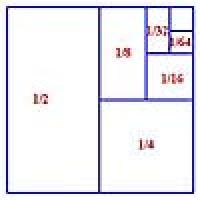
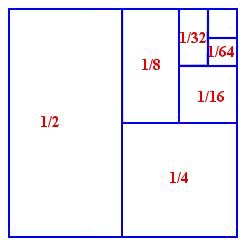
    Fortunately, there is an impressive demonstration that just uses a picture. Draw a square of size $1 \times 1$, so its area is 1. Now divide the square in half, into two rectangles, by drawing a line from top to bottom. Each of them must have an area $\frac{1}{2}$. Now divide one of these rectangles in two to make two smaller rectangles, each with area equal to $\frac{1}{4}$. Now divide one of these smaller rectangles in half to make two more rectangles, each of area equal to $\frac{1}{8}$. Keep on going like this, making a rectangle of half the area of the previous one, and look at the picture. The original square has just had its whole area subdivided into a never-ending sequence of regions that fill it completely. The total area of the square is equal to the sum of the areas of the pieces that I have left intact at each stage of the cutting process and the areas of these pieces is just equal to our series $S$. So the sum of the series $S$ must be equal to 1, the total area of the square.

    Usually when we encounter a series like $S$ for the first time we work out its sum in another way. We notice that each successive term is one half of the previous one and then multiply the whole series by $\frac{1}{2}$ so we have $$ \frac{1}{2} \times S = \frac{1}{4} + \frac{1}{8} + \frac{1}{16} + \frac{1}{32} + \frac{1}{64} +... $$ But we notice that the series on the right is just the original series, $S$, minus the first term, which is $\frac{1}{2}$ . So we have that $$ \frac{1}{2} \times S = S - \frac{1}{2}. $$ and $S$ = 1 again.

    Here is a little problem involving this series. If you live in the United Kingdom you will know that the sales tax added on to many purchases is called "Value Added Tax", or VAT. It amounts to 17.5% of the price of the goods bought. If we suppose that the 17.5% rate of VAT was devised to allow it to be easily calculated by mental arithmetic, what do you expect the next increase in the rate of VAT to be ? And what will the VAT rate grow to be in the infinite future?!


    • Log in or register to post comments

    Read more about...

    infinite series
    infinity
    outerspace

    Our Podcast: Maths on the Move

    Our Maths on the Move podcast brings you the latest news from the world of maths, plus interviews and discussions with leading mathematicians and scientists about the maths that is changing our lives.

    Apple Podcasts
    Spotify
    Podbean

    Plus delivered to you

    Keep up to date with Plus by subscribing to our newsletter or following Plus on X or Bluesky.

    University of Cambridge logo

    Plus is part of the family of activities in the Millennium Mathematics Project.
    Copyright © 1997 - 2025. University of Cambridge. All rights reserved.

    Terms