

The Abel Prize 2026: Gerd Faltings
This year's Abel Prize has been awarded to the German mathematician Gerd Faltings. The Abel Prize is one of the highest accolades in mathematics. It has been awarded by the Norwegian Academy of Science and Letters since 2003 and comes with a prize money of 7.5 million Norwegian Kroner (around £580,000 pounds).
Faltings received the prize for "introducing powerful tools in arithmetic geometry and resolving long-standing Diophantine conjectures of Mordell and Lang".

Solving equations
Falting's most famous result goes back to 1983 when he proved what was known as the Mordell conjecture. "This was a big open problem," says Helge Holden, Chair of the Abel Prize committee. "People tried to attack it but couldn't get anywhere, it was considered wide open for 60 years. Then came this unknown and very young German, from a small university, and solved the problem. He proved that the conjecture was correct and it's now called Falting's theorem."
Faltings himself has said that he "got lucky" solving the problem and that he has been "travelling first class in mathematics ever since."
The result concerns the solving of equations. This won't come as surprise — it's maths after all. But what is surprising is the richness, the beauty, and the depth of the mathematics that arises even from comparatively simple questions.
As an example of the kind of problem involved, here's a question. Can you find whole numbers $x$ and $y$ so that
$$x^2+y^2=25.$$
If this looks complicated be soothed by the fact that there’s a particularly nice solution, namely $x=3, y=4:$
$$3^2+4^2=9+16=25$$
Realising that $25=5^2$ we arrive at the beautiful fact that
$$3^2+4^2=5^2.$$
If this has given you some joy then you’re on the way to appreciating Falting's 1983 result.
Ancient equations
The equation above is an example of a Diophantine equation, named after Diophantus of Alexandria who was born around 200 CE. One inspiration for considering Diophantine equations comes from real life. Equations containing squares of the variables, such as $x^2$ and $y^2,$ come up quite naturally when you are calculating areas, for example of pieces of land. Restricting yourself to integers (or fractions) is also quite a natural thing to do. It means you are only thinking in terms of whole (or fractional) units of measurement, such as meters or square meters.
Once you let go of real-life applications and become interested in equations for their own sake, you might consider the more general class of polynomial equations with integer (or fractional) coefficients. That’s exactly what Diophantine equations are. When solving them one is usually only interested in integer (or fractional) solutions.
Ancient geometry
Finding solutions to equations is all about numbers, so it’s no surprise the problem belongs to the realm of number theory. But interestingly, geometry also enters the picture.
If you remember your school geometry then our equation above might have reminded you of Pythagoras’ theorem. It’s a result about right-angled triangles. If the side lengths of such a triangle are $x$, $y$, and $z$, with $z$ being the side opposite the right angle, then the three numbers satisfy the equation
$$x^2+y^2=z^2.$$
And as our solution above suggests, there’s indeed a right-angled triangle with side lengths $x=3, y=4, z=5.$
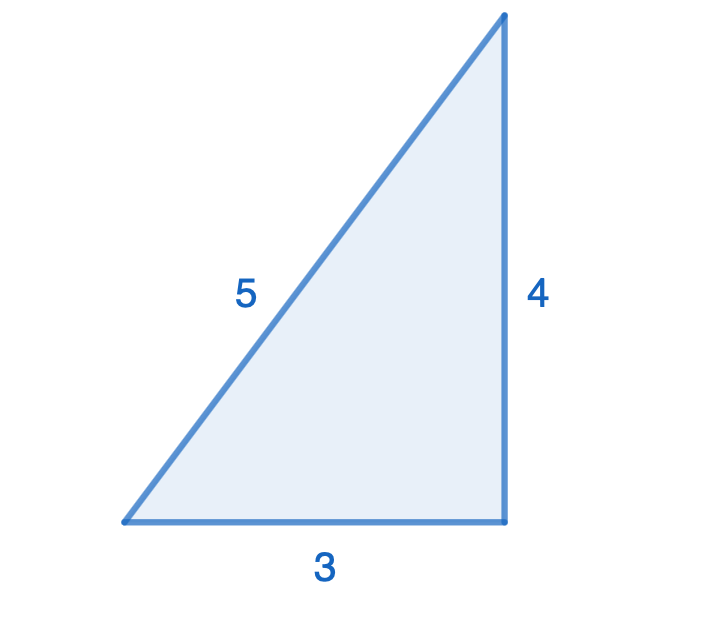
And there is more. You can imagine placing this triangle in a Cartesian coordinate system as shown below. Now draw a circle with centre at the point $(0,0)$ and with radius $5$:
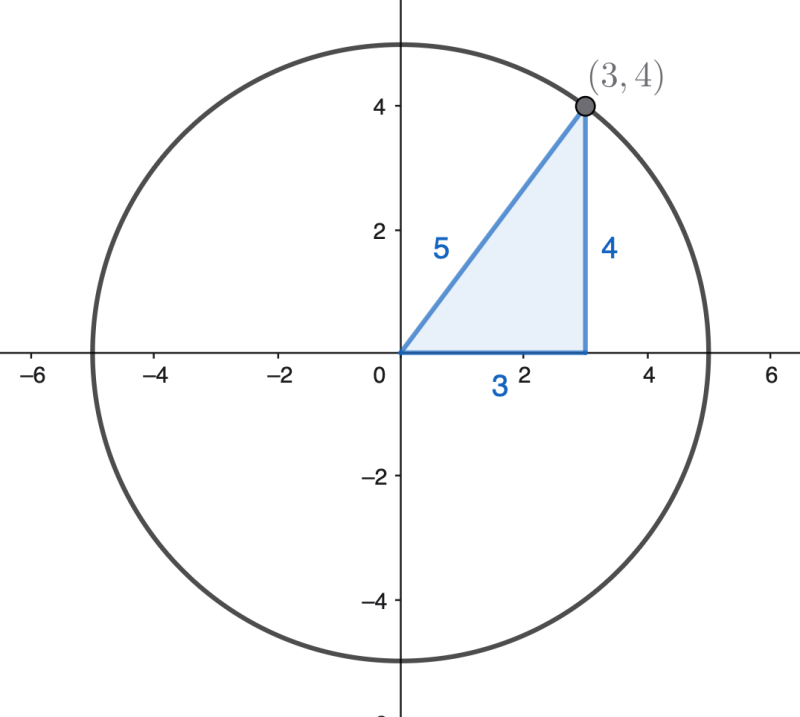
One corner of the triangle now lies on the circle. And because the two sides adjacent to the right angle have lengths 3 and 4, that point has coordinates $(3,4)$.
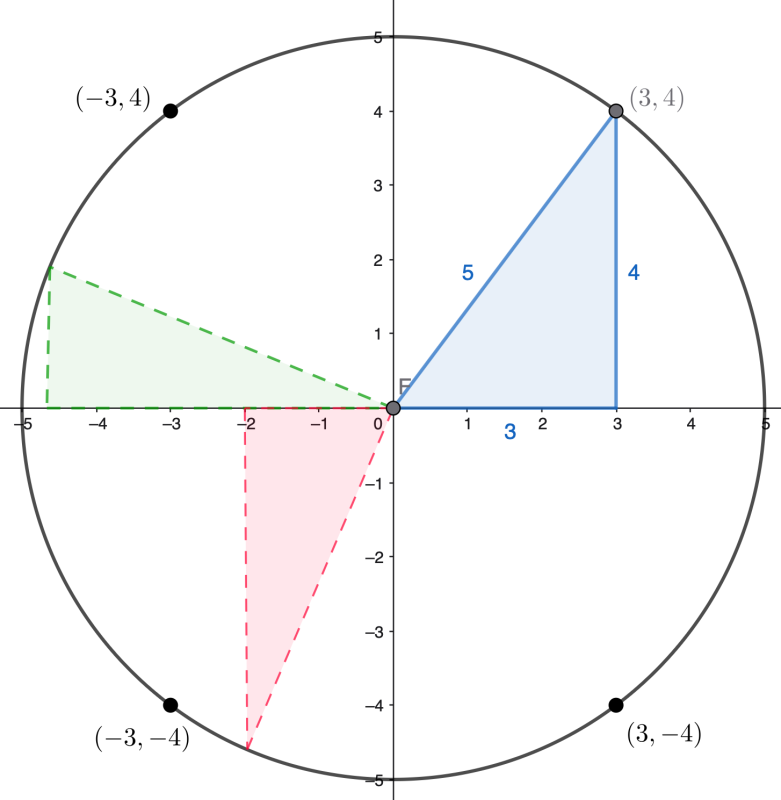
It turns out that all the other points on the circle also have coordinates $x$ and $y$ that satisfy
$$x^2+y^2=25=5^2.$$
That's because for any such point you can fit a right-angled triangle into the coordinate system so that $x, y$ and $5$ are the relevant side lengths. Our solution $x=3, y=4$ gives a point on this circle whose coordinates are both integers. There are three more such points. They come from letting one or both of the coordinates be negative numbers.
Beyond circles
We can play a similar game for other Diophantine equations of two variables $x$ and $y$. For example, the equation
$$y=x^2$$
defines a parabola. There are infinitely many points on this parabola that correspond to integer solutions, namely $(1,1), (2,4), (3,9), (4,16)$ and so on, as well as $(-1,1), (-2,4), (-3,9), (-4,16)$ if we allow negative numbers.
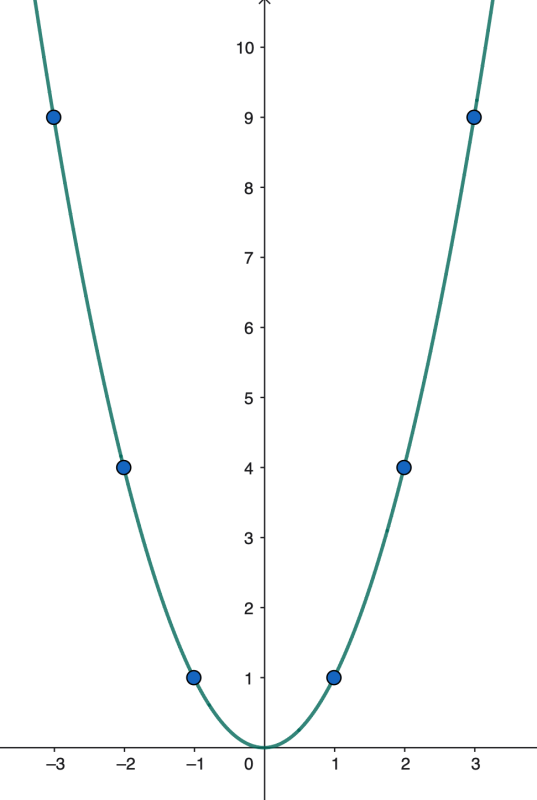
The parabola with some integer points marked.
The equation
$$y^2=x^3-x+1$$
Gives what is known as an elliptic curve. Integer solutions are $x=1$ and $y=1$, as well as $x=3$ and $y=5$ (as well as their negatives if you allow negative numbers).
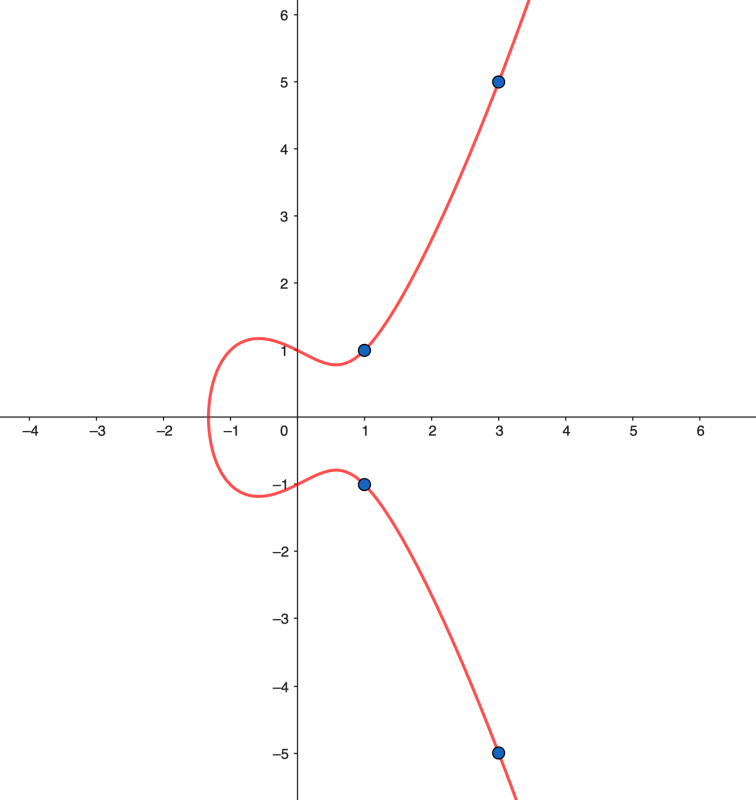
Mordell's conjecture is exactly in this vein, only a little more general. To understand it we need to add, quite literally, another dimension.
Add a dimension
To see how the other dimension comes into the picture, first note that when plotting our curves above we allowed the variables $x$ and $y$ to be real numbers. Amongst all these real numbers we then looked for solutions that were integers.
It turns out that there is a bigger family of numbers known as complex numbers. We won't explain them in detail here, you can find out more in this brief introduction. Suffice to say that if you allow the variables $x$ and $y$ to be complex numbers, then Diophantine equations involving just those two variables no longer define just curves, but surfaces. That's the extra dimension: while a curve is a one-dimensional object, a surface is a two-dimensional object. The surfaces, perhaps confusingly, are known as algebraic curves.
What people have been interested in is how many points on such a surface for a given equation correspond to solutions that are rational numbers, in other words fractions. These are called rational points.
The aim here was to make general statements, rather than only looking at individual examples of Diophantine equations. So it was no longer about saying "this particular equation comes with exactly $n$ rational points" but about saying things like "this family of Diophantine equations has zero, or finitely many, or infinitely many rational points".
We're now nearly ready to look at Mordell's conjecture. It involves the amazing fact fact that the number of rational points of an algebraic curve is determined by the overall shape of the surface associated to the equation! It's a beautiful confluence of number theory and geometry.
A question of holes
But what do we mean by the overall shape of a surface? It turns out that, unless you're dealing with a freak example of a singular surface, the surfaces involved are characterised by the number of holes they have. Some of these surfaces have no holes at all, like a sphere. Others have one hole, like donut. Yet others have two, three, four, etc, holes. The number of holes of such a surface is also called its genus and it’s a topological invariant. You can find out more about topology and its relation to holes in this article.
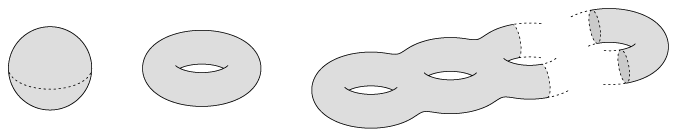

If the surface coming from a Diophantine equation in two variables has no holes (genus 0) then it turns out that it has either zero rational points or infinitely many — there's nothing in between. The example of the circle and the parabola above fall in this class and in both cases there are infinite many rational points. For the parabola we have already see this. We found infinitely many integer points, and since integers are also rational numbers, this proves the result. We only found finitely many integer points for the circle, but there’s an infinity of points with rational coefficients.
If the surface in question has one hole (genus 1) then there are either finitely many or infinitely many rational points. This isn't saying much, but there's an extra bit information that's interesting. According to results by Louis Mordell and André Weil from the 1920s, the rational points in this case form a particular mathematical structure called a finitely generated Abelian group.You can find out what a group is in this brief introduction. Abelian groups are named after Niels Henrik Abel, just like the Abel Prize. Our elliptic curve above falls into this category.
In his paper from 1922 Mordell also conjectured what would happen for surfaces with two or more holes. He said they would only have finitely many rational points.
This is Mordell’s conjecture. "[Faltings' proof] caused a big splash in mathematics," says Holden. "People didn't think that the problem was within reach of mathematical technology at the time. Faltings' techniques didn’t follow what people thought was the path towards the proof."
The result earned Faltings a prestigious Fields Medal in 1986.
A central pillar
Faltings' theorem was hugely influential. Mathematicians’ interest in the area was revived, and after Paul Vojta came up with an alternative proof of Mordell’s conjecture in 1989, Faltings adapted the approach to prove a vast generalisation of his own result called the Mordell-Lang conjecture. Faltings' theorem also provided an important step towards a famous result called Fermat’s Last theorem, which was proved by Andrew Wiles around a decade later. According to the Abel Prize citation, "Faltings' work still stands as the central pillar in modern diophantine geometry."
Faltings has also produced groundbreaking results in the theory that arises from the study of elliptic curves and made major contributions to something called Hodge theory (find out more in this article).
The Abel Prize citation says that Faltings is "a towering figure in arithmetic geometry. His ideas and results have reshaped the field, settling major long-standing conjectures, while also establishing new frameworks that have guided decades of subsequent work. His exceptional achievements unite geometric and arithmetic perspectives and exemplify the power of deep structural insight."
Faltings will receive the Prize from Crown Prince Haakon in Oslo on May 26, 2026. Congratulations!
About this article
Marianne Freiberger is Editor of Plus.