
Home
plus.maths.org

Secondary menu

  • My list
  • About Plus
  • Sponsors
  • Subscribe
  • Contact Us
  • Log in
  • Main navigation

  • Home
  • Articles
  • Collections
  • Podcasts
  • Maths in a minute
  • Puzzles
  • Videos
  • Topics and tags
  • For

    • cat icon
      Curiosity
    • newspaper icon
      Media
    • graduation icon
      Education
    • briefcase icon
      Policy

    Popular topics and tags

    Shapes

    • Geometry
    • Vectors and matrices
    • Topology
    • Networks and graph theory
    • Fractals

    Numbers

    • Number theory
    • Arithmetic
    • Prime numbers
    • Fermat's last theorem
    • Cryptography

    Computing and information

    • Quantum computing
    • Complexity
    • Information theory
    • Artificial intelligence and machine learning
    • Algorithm

    Data and probability

    • Statistics
    • Probability and uncertainty
    • Randomness

    Abstract structures

    • Symmetry
    • Algebra and group theory
    • Vectors and matrices

    Physics

    • Fluid dynamics
    • Quantum physics
    • General relativity, gravity and black holes
    • Entropy and thermodynamics
    • String theory and quantum gravity

    Arts, humanities and sport

    • History and philosophy of mathematics
    • Art and Music
    • Language
    • Sport

    Logic, proof and strategy

    • Logic
    • Proof
    • Game theory

    Calculus and analysis

    • Differential equations
    • Calculus

    Towards applications

    • Mathematical modelling
    • Dynamical systems and Chaos

    Applications

    • Medicine and health
    • Epidemiology
    • Biology
    • Economics and finance
    • Engineering and architecture
    • Weather forecasting
    • Climate change

    Understanding of mathematics

    • Public understanding of mathematics
    • Education

    Get your maths quickly

    • Maths in a minute

    Main menu

  • Home
  • Articles
  • Collections
  • Podcasts
  • Maths in a minute
  • Puzzles
  • Videos
  • Topics and tags
  • Audiences

    • cat icon
      Curiosity
    • newspaper icon
      Media
    • graduation icon
      Education
    • briefcase icon
      Policy

    Secondary menu

  • My list
  • About Plus
  • Sponsors
  • Subscribe
  • Contact Us
  • Log in
  • Advent calendar door 5

    Advent calendar door #5: The trouble with five

    5 December, 2026

    We are all familiar with the simple ways of tiling the plane by equilateral triangles, squares, or hexagons. These are the three regular tilings: each is made up of identical copies of a regular polygon — a shape whose sides all have the same length and angles between them — and adjacent tiles share whole edges, that is, we never have part of a tile's edge overlapping part of another tile's edge.
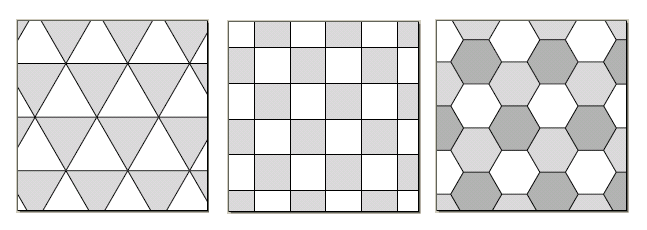
    Tesselating triangles, squares, and hexagons
    Figure 1: The three regular tilings.

    In this collection of tilings by regular polygons the number five is conspicuously absent. Why did I not mention a regular tiling by pentagons? It turns out that no such tiling can exist, and it's not too hard to see why: a regular pentagon has five interior angles of 108°. If we try to place pentagons around a point, we find that three must leave a gap — because 3 × 108 = 324, which is less than the 360° of the full circle — and four must overlap — because 4 × 108 = 432, which is more than the 360° of the circle (see figure 2).
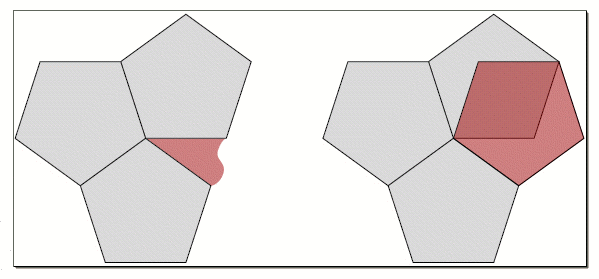
    An image with three pentagons showing a gap, and one with four showing that they overlap
    Figure 2: Three pentagons arranged around a point leave a gap, and four overlap.

    But there is no reason to give up yet: we can try to find other interesting tilings of the plane involving the number five by relaxing some of the constraints on regular tilings. Read more in this article.

    Back to the Plus advent calendar 2026

    • Log in or register to post comments

    Read more about...

    advent calendar 2026

    Our Podcast: Maths on the Move

    Our Maths on the Move podcast brings you the latest news from the world of maths, plus interviews and discussions with leading mathematicians and scientists about the maths that is changing our lives.

    Apple Podcasts
    Spotify
    Podbean

    Plus delivered to you

    Keep up to date with Plus by subscribing to our newsletter or following Plus on X, Bluesky, Facebook or LinkedIn.

    University of Cambridge logo
    Twitter / X logo Bluesky logo LinkedIn logo

    Plus is part of the family of activities in the Millennium Mathematics Project.
    Copyright © 1997 - 2026. University of Cambridge. All rights reserved.

    Terms