Article

Catching waves with Kip Thorne

What happens when one black hole meets another? Professor Kip Thorne shows us how to eavesdrop on these cosmic events by watching for telltale gravitational waves.

News story

Happy Birthday Stephen Hawking!

This issue of Plus is a special, marking the occasion of Stephen Hawking's 60th birthday. Plus attended his Birthday Conference in Cambridge, where we interviewed some of the world's most influential mathematicians and physicists.
Article

Mathematical mysteries: Survival of the nicest?

One of the most puzzling aspects of human behaviour is cooperation, in situations where backstabbing and selfishness would seem to be more rewarding. From the point of view of evolutionary theory, the very existence of altruism and cooperation appear mysterious.
Article

Natural born mathematicians

Neuropsychologist Brian Butterworth tells us about research showing that even newborn babies have a basic understanding of number. It seems we are all mathematicians!
Article

Maths in the dock

Chemists John Watling and Allen Thomas talk to Plus about the vital role of maths in presenting criminal evidence.
Article
infinite series of surprises

An infinite series of surprises

Infinite series occupy a central and important place in mathematics. C. J. Sangwin shows us how eighteenth-century mathematician Leonhard Euler solved one of the foremost infinite series problems of his day.

Article
Tchokwe pictogram

New designs from Africa

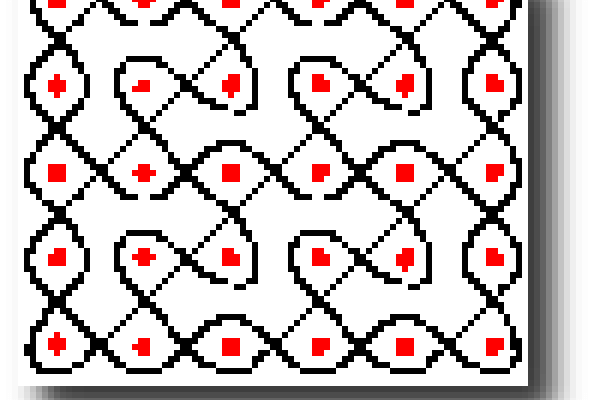
Paulus Gerdes takes us on a tour of the mathematical properties of some beautiful designs inspired by the traditional art of Angolan tribespeople.

Article
Two white backgammon pieces

Backgammon, doubling the stakes, and Brownian motion

Backgammon is said to be one of the oldest games in the world. In this article, Jochen Blath and Peter Mörters discuss one particularly interesting aspect of the game - the doubling cube. They show how a model using Brownian motion can help a player to decide when to double or accept a double.

Article
linking knots

Why knot: knots, molecules and stick numbers

Knots crop up all over the place, from tying a shoelace to molecular structure, but they are also elegant mathematical objects. Colin Adams asks when is a molecule knot a molecule? and what happens if you try to build a knot out of sticks?