
Advent calendar door #19: Dreaming the dream
Imagine you're an isolated brain floating lonely through the vast expanse of the Universe with all your thoughts, memories and perceptions just figments of your imagination. That's a depressing thought, but not a new one. There'd even be a name for you: you'd be a Boltzmann brain.
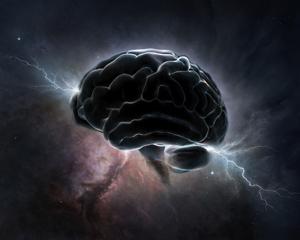
Boltzmann brains are of interest to physicists, in particular to cosmologists. The idea is that, according to quantum mechanics, there is energy in empty space which can fluctuate, producing particles as it does so. "If you wait long enough then these fluctuations will form, not just a particle here and a particle there, but a whole complex collection of them. A virus, or a little bunny rabbit, or even a functioning human being," explains Sean Carroll, a theoretical physicist at California Institute of Technology. "The idea is that a brain is the simplest thing that can randomly fluctuate into existence and can still be counted as a conscious being." Such a brain is called a Boltzmann brain (after the 19th century physicist Ludwig Boltzmann who studied fluctuations in systems that are made up of many particles, such as gases).
Even if you are not a cosmologist you will probably accept that the Universe is very large and very old. If you also accept that these fluctuations exist (they do), then you must accept that there may be some likelihood that within all this time and space Boltzmann brains do pop up. So these unfortunate beings are a real possibility in cosmology.
What worries cosmologists is not so much the possibility that we might all be Boltzmann brains dreaming unreal dreams about the world around us. Nobody seriously believes that. Cosmologists build theories about the Universe and how it evolves. In other areas of science, when you have come up with a theory (say about the behaviour of mice) you then set up an experiment (observe many mice) to see if your theory fits with observations. If it does, good, if not, you need to improve the theory, or throw it out. But since it's impossible to replicate our Universe in a lab, cosmologists can't do this. They need to come up with other ways of finding out whether a theory is plausible.
This is where Boltzmann brains come in. Once you have constructed a theory about the Universe you can calculate the probability that certain types of observers (including Boltzmann brains) come into existence. If the calculation suggests that we are overwhelmingly likely to be Boltzmann brains, rather than the good and honest observers we know we are, then that's an indication that something about the theory, or the assumptions you made in your probability calculation, is wrong.

The obvious problem here is the word "know" in the previous sentence. How do we actually know that we are not Boltzmann brains? Well, we don't, but we might as well agree that we are not. "[If you are a Boltzmann brain] then all your ideas about history, your memory, the laws of physics and the rules of logic have all just fluctuated into your brain," explains Carroll. "And therefore you have no right to believe them because other laws, incorrect laws, could also have fluctuated into your brain. So you can't simultaneously believe that you're a Boltzmann brain and have any good reason to believe you're a Boltzmann brain."
Paradoxically, this paradox lets us off the hook: there is no point in doing science if we're not happy to agree that we're not Boltzmann brains and that our observations about the world are real. "I would advocate to try to come up with theories in which we're not likely to be Boltzmann brains and then we're on safe ground," says Carroll.
Cosmologists really do think along those lines. One theory that has suffered Boltzmann brain problems is called eternal inflation. You can find more about it here, but loosely speaking the idea is that our universe constantly sprouts new self-contained regions, like bubbles popping up in a bubble bath. We live in just one of those regions and have no access to the others, which could be very different from ours. Here calculations have suggested that we're extremely unlikely to be normal brains. This discovery sparked lively debate about the theory itself, the way people calculate the probability of our existence, and the question of whether we are "typical" beings or very rare ones.
If all of this makes you wonder whether cosmologists have lost the plot completely, be reassured that most of them urge caution when it comes to untestable theories and such probabilistic arguments. "All of this so beyond what we can immediately observe and test, that we need to be very skeptical and cautious," says Carroll. "We can't be too confident that we are on the right track. We always need to be very, very humble about making these extrapolations."
Sean Carroll has a great blog in which you can read about Boltzmann brains and many other mind boggling things.
About this article
Marianne Freiberger is Editor of Plus. She talked to Sean Carroll at the International Philosophy of Cosmology in September 2014.