
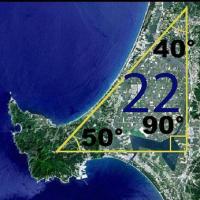
One of the neatest rules you learn about geometry at school is that the angles of a triangle always add up to 180 degrees. But despite what your teacher told you this is not always true! It took mathematicians centuries to understand why. The history of geometry shows how developments in mathematics have fundamentally changed the way we think about the world around us.
Officially the story of geometry begins with the mathematician Euclid who lived in Egypt around 300 BC. Euclid wrote The Elements, a book which gave a set of five axioms on which he thought all of geometry should be built. These were statements that were so obvious that everyone should be able to just accept them as true with no further justification needed.
The rule that the angles of a triangle always add to 180 degrees is a version of Euclid's fifth axiom. Compared to the other four axioms, which contained simple statements such as “a straight line can be drawn through any two points”, the fifth seemed way too complicated. And indeed, it isn't always true. To find out why, read our article on the history of geometry.
Back to the Plus advent calendar 2026
This article was produced as part of our collaboration with the Isaac Newton Institute for Mathematical Sciences (INI) – you can find all the content from our collaboration here. The INI is an international research centre and our neighbour here on the University of Cambridge's maths campus. It attracts leading mathematical scientists from all over the world, and is open to all. Visit www.newton.ac.uk to find out more.
