Home
plus.maths.org

Secondary menu

  • My list
  • About Plus
  • Sponsors
  • Subscribe
  • Contact Us
  • Log in
  • Main navigation

  • Home
  • Articles
  • Collections
  • Podcasts
  • Maths in a minute
  • Puzzles
  • Videos
  • Topics and tags
  • For

    • cat icon
      Curiosity
    • newspaper icon
      Media
    • graduation icon
      Education
    • briefcase icon
      Policy

    Popular topics and tags

    Shapes

    • Geometry
    • Vectors and matrices
    • Topology
    • Networks and graph theory
    • Fractals

    Numbers

    • Number theory
    • Arithmetic
    • Prime numbers
    • Fermat's last theorem
    • Cryptography

    Computing and information

    • Quantum computing
    • Complexity
    • Information theory
    • Artificial intelligence and machine learning
    • Algorithm

    Data and probability

    • Statistics
    • Probability and uncertainty
    • Randomness

    Abstract structures

    • Symmetry
    • Algebra and group theory
    • Vectors and matrices

    Physics

    • Fluid dynamics
    • Quantum physics
    • General relativity, gravity and black holes
    • Entropy and thermodynamics
    • String theory and quantum gravity

    Arts, humanities and sport

    • History and philosophy of mathematics
    • Art and Music
    • Language
    • Sport

    Logic, proof and strategy

    • Logic
    • Proof
    • Game theory

    Calculus and analysis

    • Differential equations
    • Calculus

    Towards applications

    • Mathematical modelling
    • Dynamical systems and Chaos

    Applications

    • Medicine and health
    • Epidemiology
    • Biology
    • Economics and finance
    • Engineering and architecture
    • Weather forecasting
    • Climate change

    Understanding of mathematics

    • Public understanding of mathematics
    • Education

    Get your maths quickly

    • Maths in a minute

    Main menu

  • Home
  • Articles
  • Collections
  • Podcasts
  • Maths in a minute
  • Puzzles
  • Videos
  • Topics and tags
  • Audiences

    • cat icon
      Curiosity
    • newspaper icon
      Media
    • graduation icon
      Education
    • briefcase icon
      Policy

    Secondary menu

  • My list
  • About Plus
  • Sponsors
  • Subscribe
  • Contact Us
  • Log in
  • Tesselating aperiodic monotiles and 4

    Advent Calendar Door #4: Aperiodic Monotiles

    4 December, 2026

    Tiles and tessellation can feel like very ordinary things. We are surrounded by them from bathrooms to fireplaces to quilts.
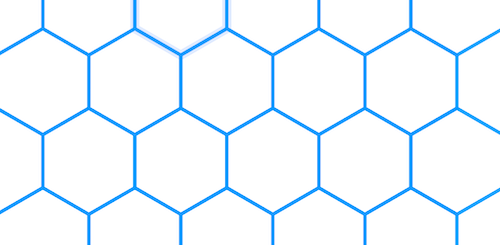
    Hexagonal tiling

    Most of the tilings that we are familiar with are periodic. If you were to pick the whole thing up, move it to the left or right by the width of a tile, and then put it down again, the pattern you'd see would look exactly the same as what you saw to start with. The same would apply if you moved it up or down by the height of a tile, and even if you moved it diagonally in the directions indicated by the diagonals of the squares. You can make periodic tilings with a range of shapes: squares, triangles, regular hexagons, even by combining several different shapes.

    But for centuries, mathematicians have been wondering whether you could find a single shape that can tile the entire plane (without overlaps or gaps) and for which the pattern you produce is not periodic. If you pick such a pattern up and move it along in any direction by any distance, the picture you see will never look the same as what you saw to start with. Relevant ideas appear in the work of the 16th century artist Albrecht Dürer and the 17th century polymath Johannes Kepler. In the 1970s the eminent mathematician Roger Penrose built on Kepler's ideas to discover aperiodic tilings that involve more than one shape.
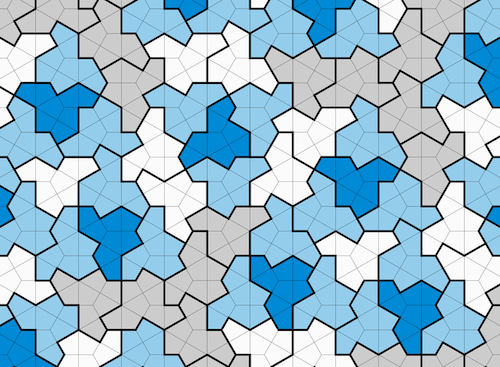
    Aperiodic tiling in blues, grey and white.
    A patch of an aperiodic tiling by hats. Image by David Smith, Joseph Samuel Myers, Craig S. Kaplan, and Chaim Goodman-Strauss, CC BY 4.0 Deed.

    But it was only in 2023 that an aperiodic monotile was discovered. To find out more and see the beautiful patterns that it makes, read our article on the discovery.

    Back to the Plus advent calendar 2026

    • Log in or register to post comments

    Read more about...

    advent calendar 2026

    Our Podcast: Maths on the Move

    Our Maths on the Move podcast brings you the latest news from the world of maths, plus interviews and discussions with leading mathematicians and scientists about the maths that is changing our lives.

    Apple Podcasts
    Spotify
    Podbean

    Plus delivered to you

    Keep up to date with Plus by subscribing to our newsletter or following Plus on X, Bluesky, Facebook or LinkedIn.

    University of Cambridge logo
    Twitter / X logo Bluesky logo LinkedIn logo

    Plus is part of the family of activities in the Millennium Mathematics Project.
    Copyright © 1997 - 2026. University of Cambridge. All rights reserved.

    Terms