
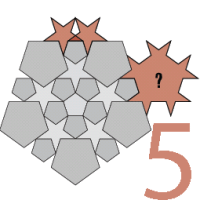
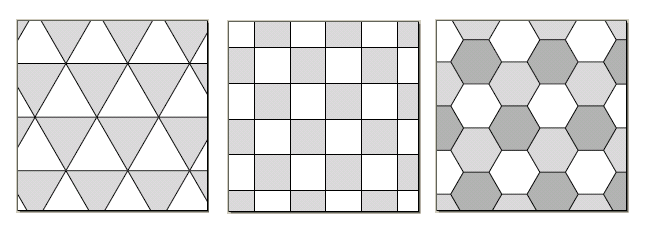
We are all familiar with the simple ways of tiling the plane by equilateral triangles, squares, or hexagons. These are the three regular tilings: each is made up of identical copies of a regular polygon — a shape whose sides all have the same length and angles between them — and adjacent tiles share whole edges, that is, we never have part of a tile's edge overlapping part of another tile's edge.
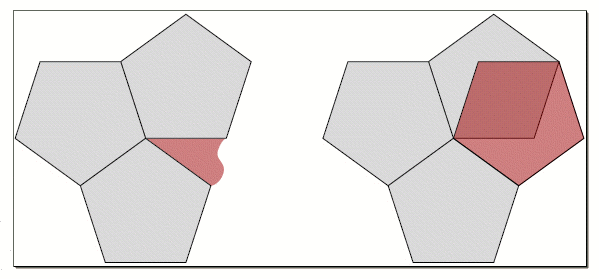
In this collection of tilings by regular polygons the number five is conspicuously absent. Why did I not mention a regular tiling by pentagons? It turns out that no such tiling can exist, and it's not too hard to see why: a regular pentagon has five interior angles of 108°. If we try to place pentagons around a point, we find that three must leave a gap — because 3 × 108 = 324, which is less than the 360° of the full circle — and four must overlap — because 4 × 108 = 432, which is more than the 360° of the circle (see figure 2).
But there is no reason to give up yet: we can try to find other interesting tilings of the plane involving the number five by relaxing some of the constraints on regular tilings. Read more in this article.