
Our brains are an unimaginably complex network of billions of neurons connected by trillions of synapses. And the complexity becomes even denser when you consider the neurons come in a variety of shapes and sizes and orientations, and there are other factors such as the layers of blood vessels in a brain to consider.
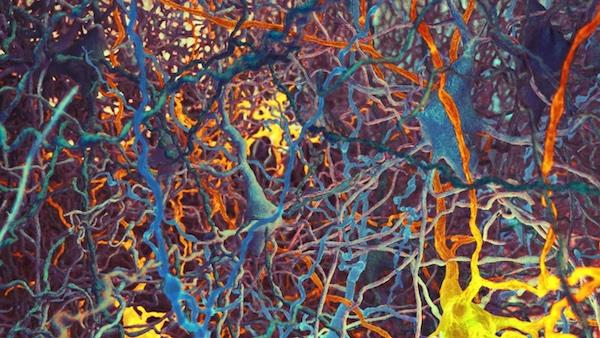
"To avoid being overwhelmed by this complexity, we apply a trick familiar to all mathematicians," says Kathryn Hess, professor of mathematics at École Polytechnique Fédérale de Lausanne. That trick is dimension reduction, finding a simplified representation of the information you are dealing with, and something Hess explains we all instinctively do. To find out how it can be applied to our brains, read our article on her work.