

Home
plus.maths.org

Secondary menu

  • My list
  • About Plus
  • Sponsors
  • Subscribe
  • Contact Us
  • Log in
  • Main navigation

  • Home
  • Articles
  • Collections
  • Podcasts
  • Maths in a minute
  • Puzzles
  • Videos
  • Topics and tags
  • For

    • cat icon
      Curiosity
    • newspaper icon
      Media
    • graduation icon
      Education
    • briefcase icon
      Policy

    Popular topics and tags

    Shapes

    • Geometry
    • Vectors and matrices
    • Topology
    • Networks and graph theory
    • Fractals

    Numbers

    • Number theory
    • Arithmetic
    • Prime numbers
    • Fermat's last theorem
    • Cryptography

    Computing and information

    • Quantum computing
    • Complexity
    • Information theory
    • Artificial intelligence and machine learning
    • Algorithm

    Data and probability

    • Statistics
    • Probability and uncertainty
    • Randomness

    Abstract structures

    • Symmetry
    • Algebra and group theory
    • Vectors and matrices

    Physics

    • Fluid dynamics
    • Quantum physics
    • General relativity, gravity and black holes
    • Entropy and thermodynamics
    • String theory and quantum gravity

    Arts, humanities and sport

    • History and philosophy of mathematics
    • Art and Music
    • Language
    • Sport

    Logic, proof and strategy

    • Logic
    • Proof
    • Game theory

    Calculus and analysis

    • Differential equations
    • Calculus

    Towards applications

    • Mathematical modelling
    • Dynamical systems and Chaos

    Applications

    • Medicine and health
    • Epidemiology
    • Biology
    • Economics and finance
    • Engineering and architecture
    • Weather forecasting
    • Climate change

    Understanding of mathematics

    • Public understanding of mathematics
    • Education

    Get your maths quickly

    • Maths in a minute

    Main menu

  • Home
  • Articles
  • Collections
  • Podcasts
  • Maths in a minute
  • Puzzles
  • Videos
  • Topics and tags
  • Audiences

    • cat icon
      Curiosity
    • newspaper icon
      Media
    • graduation icon
      Education
    • briefcase icon
      Policy

    Secondary menu

  • My list
  • About Plus
  • Sponsors
  • Subscribe
  • Contact Us
  • Log in
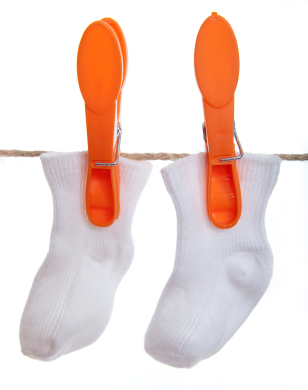
  • White Socks on a Clothes Line

    Tick-tock...take socks
    12 July, 2010


    socks

    Unfortunately I am lazy and disorganised. One symptom of this is that I can never be bothered to fold up my socks in pairs when they come out of the wash. I just chuck them in the drawer. Another symptom is that I always wake up late for work and end up having to rush. Given that I only have white and black socks, how many socks do I have to grab out of my drawer at random to make sure the collection I've grabbed contains a matching pair?

    This puzzle is part of the Hands-on risk and probability show, an interactive event culminating in Who Wants to be a Mathionaire? workshop sessions, which you can book to perform at your school. The puzzle appeared in the book How any socks make a pair? by Rob Eastaway.


    For some challenging mathematical puzzles, see the NRICH puzzles from this month or last month.

    Solution link
    How many socks make a pair - solution
    • Log in or register to post comments

    Anonymous

    5 January 2011

    Permalink
    Comment

    2+2

    • Log in or register to post comments

    Anonymous

    19 January 2011

    In reply to ans by Anonymous

    Permalink
    Comment

    3
    first one is lets say black
    second is (worst case scenario) white
    third one will make a pair with either the first or second sock

    • Log in or register to post comments

    Anonymous

    20 May 2011

    In reply to 2+2?? by Anonymous

    Permalink
    Comment

    This is a simple application of the pigeonhole principle. If you have k pigeonholes and k+1 pigeons, then one pigeonhole will contain more than one pigeon.

    • Log in or register to post comments

    Anonymous

    27 September 2011

    In reply to 2+2?? by Anonymous

    Permalink
    Comment

    yep

    • Log in or register to post comments

    Anonymous

    29 March 2011

    Permalink
    Comment

    2

    • Log in or register to post comments

    Anonymous

    25 August 2011

    Permalink
    Comment

    4

    • Log in or register to post comments

    Anonymous

    12 November 2011

    Permalink
    Comment

    Likewise, an extension of the problem is 'how many socks do I have to pull out' if I have three colors? Four? n colors? When you see the solution for all of these, the answer, elegant (to me), is always 'colors + 1'. --That last one will always duplicate one of the previous colors for what is in this case defined as "pair". (Not that I would like to pull out six socks [for five colors] each morning, leaving the remains all over the sink, simply because I was too lazy to pair them in the first place.)

    A then more challenging question is 'how many pulls' for two colors, to make THREE identical socks? Or three colors, three socks, etc.

    • Log in or register to post comments

    Anonymous

    21 May 2014

    In reply to More colors by Anonymous

    Permalink
    Comment

    The answer to above problem is c*(n-1)+1. Because the answer is strictly greater than c*(n-1) as the combination c11,c12,...,c1n;c21,c22,...,c2n;...;c(n-1)1,c(n-1)2,...,c(n-1)n (where cij is color j) is a possible outcome and contains no n-group of any color. Now, let us assume that we took out c*(n-1) socks and still there is no n-group than I claim that the outcome is a permutation of above mentioned outcome.
    Proof of claim:
    let ni, for i=1,2,3,...c be number of socks there are which have color j. And assume that there is no n-group.
    Then:
    for all i, ni<=n-1
    summing up for all i:
    sum(ni)<=c(n-1)
    Now let us suppose that color I does not have n-1 number, then the sum(ni)

    • Log in or register to post comments

    Anonymous

    23 December 2011

    Permalink
    Comment

    3
    first lets say white
    second black
    third black or white either one it makes a pair

    • Log in or register to post comments

    Anonymous

    19 May 2012

    Permalink
    Comment

    Haha. Even after reading the question several times, I spent ages trying to figure out how to guarantee the guy gets one of each colour, instead of just an individual pair. Anyway my answer for that (wrong) question was 1/2 all socks + 1. ^0^

    Ho ho.

    • Log in or register to post comments

    Anonymous

    22 September 2012

    Permalink
    Comment

    3
    2 and a spare in cause you get a black and a white so you then will either have a pair of white or a pair of black socks

    • Log in or register to post comments

    Anonymous

    15 December 2012

    Permalink
    Comment

    3
    if sock a is white,
    and sock b is black,
    then sock c can be either black or white and would make a pair

    • Log in or register to post comments

    Anonymous

    23 August 2015

    Permalink
    Comment

    at first I was like 2 but then I thought this is supposed to be hard so then this puzzle got me thinking and I said it depends on the colour so for example you can have 1 black and 1 white you need another black or white sock to make a full pair so therefore the answer is ..... 3 ( in this case ) but logically you need 2 cause you only have 2 feet and to make a PAIR you need 2 like to apples make a pair 2 carrots make a pair etc. And that is my answer and I think most of you will agree !!!!

    By ... Zainab !!!

    • Log in or register to post comments

    Anonymous

    30 October 2023

    Permalink
    Comment

    If the first 2 socks don't match, then the third has to match with one of them as there are only 2 colours

    • Log in or register to post comments
    University of Cambridge logo

    Plus is part of the family of activities in the Millennium Mathematics Project.
    Copyright © 1997 - 2025. University of Cambridge. All rights reserved.

    Terms