Home
plus.maths.org

Secondary menu

  • My list
  • About Plus
  • Sponsors
  • Subscribe
  • Contact Us
  • Log in
  • Main navigation

  • Home
  • Articles
  • Collections
  • Podcasts
  • Maths in a minute
  • Puzzles
  • Videos
  • Topics and tags
  • For

    • cat icon
      Curiosity
    • newspaper icon
      Media
    • graduation icon
      Education
    • briefcase icon
      Policy

    Popular topics and tags

    Shapes

    • Geometry
    • Vectors and matrices
    • Topology
    • Networks and graph theory
    • Fractals

    Numbers

    • Number theory
    • Arithmetic
    • Prime numbers
    • Fermat's last theorem
    • Cryptography

    Computing and information

    • Quantum computing
    • Complexity
    • Information theory
    • Artificial intelligence and machine learning
    • Algorithm

    Data and probability

    • Statistics
    • Probability and uncertainty
    • Randomness

    Abstract structures

    • Symmetry
    • Algebra and group theory
    • Vectors and matrices

    Physics

    • Fluid dynamics
    • Quantum physics
    • General relativity, gravity and black holes
    • Entropy and thermodynamics
    • String theory and quantum gravity

    Arts, humanities and sport

    • History and philosophy of mathematics
    • Art and Music
    • Language
    • Sport

    Logic, proof and strategy

    • Logic
    • Proof
    • Game theory

    Calculus and analysis

    • Differential equations
    • Calculus

    Towards applications

    • Mathematical modelling
    • Dynamical systems and Chaos

    Applications

    • Medicine and health
    • Epidemiology
    • Biology
    • Economics and finance
    • Engineering and architecture
    • Weather forecasting
    • Climate change

    Understanding of mathematics

    • Public understanding of mathematics
    • Education

    Get your maths quickly

    • Maths in a minute

    Main menu

  • Home
  • Articles
  • Collections
  • Podcasts
  • Maths in a minute
  • Puzzles
  • Videos
  • Topics and tags
  • Audiences

    • cat icon
      Curiosity
    • newspaper icon
      Media
    • graduation icon
      Education
    • briefcase icon
      Policy

    Secondary menu

  • My list
  • About Plus
  • Sponsors
  • Subscribe
  • Contact Us
  • Log in
  • Peg and hole puzzle: Solution

    23 April, 2012

    Which gives a tighter fit: a square peg in a round hole or a round peg in a square hole? (The tighter fit is the one for which the ratio of peg area to hole area is greater.)

    Solution

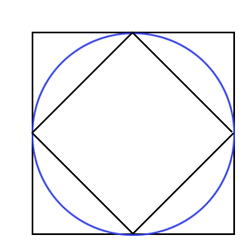
    Consider the following picture:

    key
    Suppose that the side length of the large square is $a,$ so its area is $a^2.$ Then the circle has radius $a/2,$ so its area is $\pi a^2/4.$ By Pythagoras' theorem the small square has side length $\sqrt{a^2/2}$ so it's got area $a^2/2.$ The square peg in round hole fit is given by the ratio of the area of the small square to the area of the circle, which is $2/\pi.$ The round peg in square hole fit is given by the ratio of the area of the circle to the area of the large square, which is $\pi/4.$ Since $\pi > 3$ we have $\pi^2>8$ so $\pi > 8/\pi.$ Dividing by 4 gives $\pi/4 > 2/\pi$ so the round peg in a square hole gives the better fit.

    Back to original puzzle


    This puzzle was contributed by Colm Mulcahy, Associate Professor of Mathematics at Spelman College in Atlanta, Georgia. Colm's own puzzles have appeared in Math Horizons and in the New York Times. He is a long-time columnist for the Mathematical Association of America and has his own blog. You can follow Colm on Twitter.

    • Log in or register to post comments

    Anonymous

    23 April 2012

    Permalink
    Comment

    pi/4 > 3/4 > 2/3 > 2/pi

    • Log in or register to post comments

    Anonymous

    12 February 2013

    Permalink
    Comment

    Couldn't you also consider this problem from the direction of a pressure fit?
    In this case, if the height of each peg is the same then the "pressure fit" is equal for both the rectangular prism and the cylindrical hole described above.

    A peg is a cylinder with a height, h. The peg would contact the sides of the square hole at the cylinder's tangents lines of length,h. Pressure = force*area. Pressure =force*(4h*negligible width of each contact line)

    A rectangular prism peg with the same height, h would contact a cylindrical hole at it's 4 edges. Again the pressure would be equal. Pressure = force*4h*negligible width of each contact line.

    • Log in or register to post comments

    Anonymous

    6 April 2013

    Permalink
    Comment

    A related problem which is fun, is to design a peg which fits into a triangular hole, a square hole, and a circular hole leaving no gaps.
    Tim Davis

    • Log in or register to post comments

    Anonymous

    8 December 2013

    Permalink
    Comment

    The entire puzzle is rendered invalid inasmuch as the puzzle asked which gives a 'tighter fit', while the answer suggested a 'better fit'. Details, details, details...

    • Log in or register to post comments

    Anonymous

    4 February 2014

    Permalink
    Comment

    I thought the answer is just intuitive than mathematical: a round peg in a square hole can rotate about its axis. Whereas, a square peg in round hole cannot. (this is why manhole covers are square, though the hole itself is round)

    • Log in or register to post comments

    Robertson Pon

    15 September 2018

    In reply to round peg, square hole by Anonymous

    Permalink
    Comment

    I’ve read this 5 times and it still doesn’t make sense. Which axis are you talking about? If the z-axis, you are wrong, both can rotate. Any other, you are still wrong, neither can rotate as they are pegs.

    • Log in or register to post comments
    University of Cambridge logo

    Plus is part of the family of activities in the Millennium Mathematics Project.
    Copyright © 1997 - 2025. University of Cambridge. All rights reserved.

    Terms