

Mathematical mysteries: the Goldbach conjecture
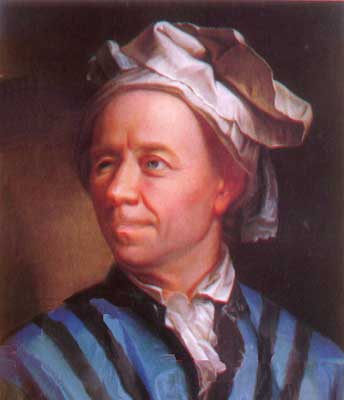
Leonard Euler (1707-1783) corresponded with Christian Goldbach about the conjecture now named after the latter.
Here is one of the trickiest unanswered questions in mathematics:
Can every even whole number greater than 2 be written as the sum of two primes?
A prime is a whole number which is only divisible by 1 and itself. Let's try with a few examples:
- 4 = 2 + 2 and 2 is a prime, so the answer to the question is "yes" for the number 4.
- 6 = 3 + 3 and 3 is prime, so it's "yes" for 6 also.
- 8 = 3 + 5, 5 is a prime too, so it's another "yes".
If you keep on trying you will find that it seems that every even number greater than 2 can indeed be written as the sum of two primes. This is also the conclusion that the Prussian amateur mathematician and historian Christian Goldbach arrived at in 1742. He wrote about his idea to the famous mathematician Leonhard Euler, who at first treated the letter with some disdain, regarding the result as trivial. That wasn't very wise of Euler: the Goldbach conjecture, as it's become known, remains unproven to this day.
In 1938 Nils Pipping showed that the Goldbach conjecture is true for even numbers up to and including 100,000. The latest result, established using a computer search, shows it is true for even numbers up to and including 4,000,000,000,000,000,000 — that's a huge number, but for mathematicians it isn't good enough. Only a general proof will do.
There is a similar question, however, that has been proven. The weak Goldbach conjecture says that every odd whole number greater than 5 can be written as the sum of three primes. Again we can see that this is true for the first few odd numbers greater than 5:
- 7 = 3 + 2 + 2
- 11 = 3 + 3 + 5
- 13 = 3 + 5 + 5
- 17 = 5 + 5 + 7.
Until very recently the result had only been verified for odd numbers greater than 2 x 101346 — that's a number with 1,347 digits! But then, in 2013, the Peruvian mathematician Harald Helfgott closed the enormous gap and proved that the result is true for all odd numbers greater than 5.
The weak and strong Goldbach conjectures are just two of many questions from number theory that are easy to state but very hard to solve. See here to read about some more, and here to find out more about the Goldbach conjecture and our Goldbach calculator.
Comments
Anonymous
After receiving a B.S in Mathematics, i realized that i could just barely start to see the beauty in this marvelous subject...
Surprising it is that how simple conjectures can resist a solid proof for centuries...
Anonymous
The conjecture is actually worded a bit differently.
Every even number greater than 2 can be written as the sum of two prime numbers.
The initial wording of the conjecture included 2 as a number that could be written as a sum of two prime numbers but that was also assuming 1 was a prime number.
4 is the first applicable number of the conjecture. It is also the only number than can have it's sums expressed with even numbers. 2 is the only even prime number. If you subtract 2 from an even number you get an even number which means it is at least divisible by 2, thus not a prime number.
J. Crick
Shouldn't the conjecture say 'as a sum of two primes' rather than 'as the sum of two primes'? Since the word 'the' suggests uniqueness of the primes which is not the case because 20=17+3=13+7.
Anonymous
This calculator does a great job, but does not list situations when the two prime numbers are the same (for example, 6 can only be expressed as 3+3, which does not calculate in the applet).
Anonymous
The article explains this clearly - read the part in parenthesis.
Anonymous
The Goldbach pairs (Goldbach partitions), when considered multiplicatively rather than additively, can be used to generate what are known as odd semiprimes - the products of two odd prime factors (unique or identical). When you realize that fact, then you may make the conjecture that every perfect square integer can be expressed as the sum of an odd semiprime and another perfect square. We know that odd times odd will always generate odd, and we also know that the sequence of odds sum progressively to the sequence of perfect squares. We also know that the integers 0 and 1, the so-called identity elements, are also perfect squares. We also know that another way of stating the strong Goldbach conjecture is to say that every integer n is the average of two odd primes - hence, the Goldbach relates to midpoint. So we have the introduction of perfect squares and midpoint into the Goldbach conjecture which leads to a conclusion that the Goldbach conjecture has much deeper roots than the simple statement first suggested by Christian Goldbach. The conjecture relates to all the group axioms of arithmetic, along with the principles of elementary calculus and the principles of Euclidian geometry and the bilateral symmetry of the Cartesian grid.
I would suggest that the true gist of Goldbach lies in the principles of universality and reversibility that underlie the entire fabric of human logic and mathematics.
Example: Perfect square 25 = perfect square 4 plus semiprime 21=prime 3 x prime 7. Try a few billion others ( and don't forget those identity elements are also perfect squares)
And this all can be seen by using the group axioms and operations to see that every even integer can be rearranged as a model of the standard numberline. for example, the even integer 8:
0 1 2 3 4 5 6 7 8
8 7 6 5 4 3 2 1 0
Examine sums, products, differences of the binary columns along with the differences in the respective rows of those sums, products, and differences. The midpoint generates a perfect square and the Goldbach partitions generate semiprimes. And their differences are always (necessarily) another perfect square. When the Goldbach pairs are examined as the factors of semiprimes rather than as the addends of even integer sums and that those odd semiprimes are part of the sequential production of perfect squares - the Goldbach conjecture is far more tractable.
Play with it.
Anonymous
I discovered a recent paper that offers a good literature overview on Goldbach's conjecture (2N=p+q, p,q=primes). It can downloaded at free from: http://vixra.org/pdf/1205.0108v1.pdf
Although it does not provide the complete mathematical proof, it shows many interesting numerical results such as an estimation of the pairs (p,q) that fufill the conjecture, which is shown to increase with N. I feel that this work may inspire some other researchers.
Anonymous
Please read the following ArXiv paper on this topic:
http://arxiv.org/pdf/1208.2244.pdf
Is it a proof?
Anonymous
Hi. For some even integers - like 14, 38 and 122, for example - calculator didn't list all pairs ("7+7", "19+19" and "61+61" in these cases). I believe you have discard evident occurences such as integers 2p where p is prime.
Anonymous = "Alexandre"
Primophiliac
No pairs were "discarded." Persons considering a solution to this Conjecture are chiefly interested in general cases, not special cases where prime1 equals prime2. The investigations listed above and below your comment explore cases where the even number's prime flanks are equidistant from the even number's half. For example, for 14, the primes are 3 & 11 (each is the same distance from 7). For 38, the primes are 7 & 31 (each equidistant from 19); and for 122, the primes are 43 & 79 (each equidistant from 61)...though there are other Goldbach pairs. This problem is so fascinating, I can't see why some mathematicians say its solution is trivial or irrelevant. On one site, someone wrote that pursuing it was a total waste of time! END
maccagraham
I have found an interesting result after looking at the Goldbach Conjecture.
It suggests that if there is a smaller Goldbach partition then there is always an equal or larger Goldbach partition.
Looks like a simple "proof" to me but I guess it may not be given this has eluded the mathematical world to date.
Anyway, I would like to get it reviewed by an expert in the field. It only uses two sides of A4.
maccagraham
If any expert in the field is interested in reviewing this, please send your e-mail address to maccagraham@hotmail.com
Anonymous
As shown in a recent paper (March 2013), see http://pubs.sciepub.com/ajma/1/1/2/abstract.html#.UYUcBEqSnRg, not only one but a minimum number of prime pairs (p,q) that fulfill the relationship 2n=p+q can be estimated using a very simple formula. Moreover, the centroids of triangles based on the triplets (6k-2,6k,6k+2) closely follow the average number of representations (also a simple formula).
Anonymous
Proven this year by a Peruvian mathematician, Harald Andrés Helfgott. He demonstrated this 271 year unsolved problem.
See link: http://www.truthiscool.com/prime-numbers-the-271-year-old-puzzle-resolv…
Anonymous
Helfgott proved a different conjecture. See above: "Every even number greater than 4 can be written as the sum of two odd prime numbers", versus the second sentence in the linked article: "H.A. Helfgott proved that any odd number greater than 5 can be written as the sum of 3 primes."
Anonymous
Odd primes presumably means different primes. (rather than all the primes except 2, i.e. odd numbered primes)
Thus I fail to see how the number 6 (an even number greater than 4) can be partitioned into 2 odd primes. Unless of course you are considering the number 1 as a prime.
Of course 6 can be partitioned into 3 and 3 but then where does the 'odd prime' clause come in?
So I would word the conjecture in one of two ways -
"Every even number greater than 6 can be written as the sum of 2 different primes"
or
"Every even number greater than 4 can be written as sum of 2 primes which are not necessarily different"
Forgive me my ignorance... and thanks for the great article
Marianne
Odd prime simply means any prime apart from 2. So in the case of 6 we have 6=3+3. Admittedly it's a strange way of formulating things, saying "odd prime" rather than "prime not equal to 2", but it's quicker to say!
Anonymous
Thanks for your reply, that's clear now.
My understanding is only very elementary, but these articles offer great insight.
Number 2, utterly simple yet so inexplicably awkward. Duality seems intrinsic to all of the universe and even contributes to the complexity of the GC. That is, we're proving a condition for a multiple of 2, concerning 2 numbers, neither of which will be multiple of 2.
Thanks again
Anonymous
The calculator mysteriously disappeared from this page :(
Marcos Orsini
Where is the goldbach pairs calculator?
Anonymous
how to create this kind of goldbach calculator in c# program ???
anyone can help me plz...
Anonymous
if you find how to do in c++ pls tell me..
Anonymous
#include
#include
#include
#include
using namespace std;
main( )
{
/* PROOF OF GOLDBACH CONJECTURE*/
/*CALCULATING PRIMES, SUM OF TWO PRIMES EQUALS GIVEN EVEN NUMBER N<5*10^19*/
/*N=Pr1+Pr2*/
unsigned long long int N=4325581707333960528; int nd=3000;
if (N<1000000) nd=300;
if (N<1000) nd=150;
unsigned long long int N1=N/2-nd; unsigned long long int N2 =N1+2*nd;
unsigned long long int p1=floor(N1/6); unsigned long long int p2=ceil( N2/6);
int r=84000; int R2[r]; int rm=p2-p1;unsigned long long int S2[r];int r3, r4, v, k;
int q=84000; int R1[q] ; int qm=rm; unsigned long long int S1[q], Q1, Q2, Ne, Nd, Nd1, Nd2; int q2, q1;
for (q=1;qj1) j1=i;
for(j=j1; jp1)&&( P1j1-1) j1=i+1;
for(j=j1; jp1)&&( P2j1) j1=i;
for(j=j1; jp1)&&( P3j1) j1=i;
for(j=j1; jp1)&&( P4
Anonymous
Any idea how to program the conjecture in a TI-84 calculator, yielding the pairs of odd primes given any even number greater than 4 and less than or equal to 4x10^18?
Anonymous
hey why don't I see any result for 6?
Is it 1+5?
Anonymous
1 is not prime, and the conjecture states that even numbers cab written as the sum of two primes.
Anonymous
It's clearly stated in the conjecture that including one the conjecture is true.
Anonymous
4=2+2
and therefore 6=3+3..
Anonymous
1 is *not prime*
Anonymous
True
Anonymous
People have told me that every number above 7 is made by three prime numbers can you prove it with the odd numbers between 60 and 90?
Anonymous
1 is not prime, and therefore the conjecture must be any number greater than 4, NOT 1!!
Anonymous
to the person above who wrote 1 is not prime - it's also not a whole even number - which
are essential parts of the conjecture.
Anonymous
what they are saying is 2 can't be a solution because 1+1 is the only way to add up to 2 they don't know the modern form or the fact that 1 was considered prime for a long time.
Anonymous
"to the person above who wrote 1 is not prime - it's also not a whole even number - which
are essential parts of the conjecture."
Of course 1 isn't even, but no one is talking about decomposing 1 into the sum of primes, silly. The point regards the decomposition N = P + 1, where N is even and P is prime. That won't do because 1 isn't prime.
Anonymous
1 used to be included in primes. It isn't anymore because the definition of "prime" changed. Look it up.
Anonymous
I am a 9 th class student of bvrsss and I think this is wrong. The world's largest prime is 2 to the power of 57885161-1 and so 2 to the power of 57885162 can not be written as a sum of 2 primes
Marianne
Eulcid proved over 200 years ago that there are infinitely many primes. You are talking about the world's largest *known* prime. There are infinitely many primes larger than that, we just haven't discover them yet.
Anonymous
The largest prime being 2^57885161 - 1 doesn't say anything about the primes below it. For instance, 31 = 2^5 - 1 is a prime number, but it also is the case that 32 = 29 + 3. And so, perhaps 2^57885161 - 3 is a prime number, implying 2^57885161 = 3 + 2^57885161. But yeah, my main point is that we can't say for certain based solely on the fact 2^57885161 - 1 is prime.
Mukund
There are infinitely many primes and therefore no largest prime. Whatever number you have written may be just the largest known prime. Try to understand the difference between the largest and the largest known.
Clement
To the 9th Class student of bvrsss, the number you gave is a Mersenne prime. It may be the largest Mersenne known up to the date you found it, but that is not true now, they find a new larger one at the rate of about once a year, it is now above 2 raised to the (77,232,917) -1. There can never be a largest prime. Euclid proved that. You can use the GIMPS algorithm (The Great Internet Mersenne Prime Search algorithm to find a new Mersenne prime, if you are so inclined. The 50th one was found in 2017 by Jonathan Pace using GIMPS day and night fo fourteen years.
Anonymous
I am surprised that on the internet I cannot find this statement, which is more general than the Goldbach Conjecture, such as:
Statement:
Any integer number divisible by integer k can be represented as the sum of k prime numbers.
Let A = k * C, | k, C ∈ N, k > 1, C > 1 | =>
∃ p1, p2, … pk that A= ∑pi where pi – prime number.
Assuming the Goldbach Conjecture to be actually true, proof of the above is easily performed by mathematical induction.
Anonymous
Someone wrote: Any integer number divisible by integer k can be represented as the sum of k prime numbers.
This is simply stating in the trivial case for P prime : k.P=P+P+P+...+P, k sums of the same prime.
If P in above sum is not prime, it can be broken up into its prime factors and you get a sum of primes again.
So the above statement is basically the same as the breakup of a number into its prime factors and has not to do with the Goldbach conjecture.
Anonymous
how can 3 be the sum of two primes? unless 1 is included?
Marianne
The conjecture only applies to even numbers and 3 isn't even.
Anonymous
1 was a prime number at the time the conjecture has been made
Anonymous
How does this theory go for 6 and 50
Anonymous
6
1+5
50
3+47, 7+43, 13+37, 19+31
Anonymous
1 is not a prime number (by the very definition of what a prime number is) so for the number 6 Goldbach's conjecture would be written as the following:
6 = 3 + 3
The same idea holds true for 4:
4 = 2 + 2
Anonymous
Yes, you may have learnt that 1 is not a prime number, I totally agree.
I learnt that too.
But what type of number would it be then?
A special number???