

Home
plus.maths.org

Secondary menu

  • My list
  • About Plus
  • Sponsors
  • Subscribe
  • Contact Us
  • Log in
  • Main navigation

  • Home
  • Articles
  • Collections
  • Podcasts
  • Maths in a minute
  • Puzzles
  • Videos
  • Topics and tags
  • For

    • cat icon
      Curiosity
    • newspaper icon
      Media
    • graduation icon
      Education
    • briefcase icon
      Policy

    Popular topics and tags

    Shapes

    • Geometry
    • Vectors and matrices
    • Topology
    • Networks and graph theory
    • Fractals

    Numbers

    • Number theory
    • Arithmetic
    • Prime numbers
    • Fermat's last theorem
    • Cryptography

    Computing and information

    • Quantum computing
    • Complexity
    • Information theory
    • Artificial intelligence and machine learning
    • Algorithm

    Data and probability

    • Statistics
    • Probability and uncertainty
    • Randomness

    Abstract structures

    • Symmetry
    • Algebra and group theory
    • Vectors and matrices

    Physics

    • Fluid dynamics
    • Quantum physics
    • General relativity, gravity and black holes
    • Entropy and thermodynamics
    • String theory and quantum gravity

    Arts, humanities and sport

    • History and philosophy of mathematics
    • Art and Music
    • Language
    • Sport

    Logic, proof and strategy

    • Logic
    • Proof
    • Game theory

    Calculus and analysis

    • Differential equations
    • Calculus

    Towards applications

    • Mathematical modelling
    • Dynamical systems and Chaos

    Applications

    • Medicine and health
    • Epidemiology
    • Biology
    • Economics and finance
    • Engineering and architecture
    • Weather forecasting
    • Climate change

    Understanding of mathematics

    • Public understanding of mathematics
    • Education

    Get your maths quickly

    • Maths in a minute

    Main menu

  • Home
  • Articles
  • Collections
  • Podcasts
  • Maths in a minute
  • Puzzles
  • Videos
  • Topics and tags
  • Audiences

    • cat icon
      Curiosity
    • newspaper icon
      Media
    • graduation icon
      Education
    • briefcase icon
      Policy

    Secondary menu

  • My list
  • About Plus
  • Sponsors
  • Subscribe
  • Contact Us
  • Log in
  • Maths in a minute: Penguins
    20 January, 2017
    2 comments
    Penguin

    Why do penguins rotate their eggs?

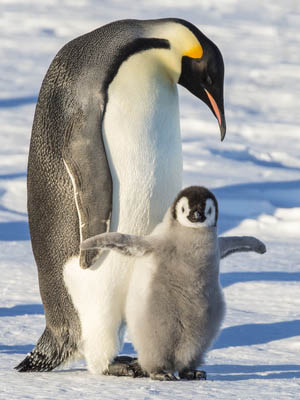
    Today, January 20th, is penguin awareness day. We can't let this important day pass without looking at some relevant maths. Penguins are well-known, and respected, for the incredible hardships some species endure in order to raise their chicks, including gruelling walks across Antarctic ice from nesting to feeding grounds. One of the lesser-known, and less challenging, parental duties of a penguin is to regularly rotate its unhatched eggs about their long axis.

    For a very long time nobody knew why they do it, but it was important to find out: captive breeding programmes of penguins usually take the eggs away from the incubating bird and place them in an incubator. The mother will then lay more eggs to make up for the loss, so as long as the artificial incubators do their job well, there will be more chicks than the mother alone could produce. To be maximally efficient, the artificial incubators need to mimic natural conditions as closely as possible, including the rotation of the eggs. But without knowing why the eggs are being rotated it's hard to replicate the rotation effectively, and without the rotations the chicks won't hatch.

    This is where maths comes in. Back in 2003 Bristol Zoo asked a study group of mathematicians at the Knowledge Transfer Network to investigate the penguin rotation problem by looking at the fluid dynamics within the egg. An initial idea was that the rotation ensures a uniform temperature of 37°C throughout the egg, but the study group's mathematical model, based on the equations of fluid dynamics, showed that the effects of rotation on temperature are minimal. They had more luck with a second theory: their model showed that the rotations produced the necessary mixing within the egg, ensuring that nutrients are distributed uniformly and waste is dispersed. The model described the turning and churning within the egg in detail and provided a theoretical basis to help with programming artificial incubators, not only for penguins but also for other species of bird. The group also recommended what type of further research would be necessary to improve their model.

    It's safe to assume, therefore, that there are currently penguins alive on this planet that owe their existence directly to an application of fluid dynamics. Who would have thought! The Industrial Mathematics Knowledge Transfer Network aims to help businesses benefit from academic expertise in mathematics. You can find out more about its work, including on penguins, in this Plus article.

    • Log in or register to post comments

    Comments

    johnsonkumar

    28 January 2017

    Permalink

    Global countries would take necessary action to protect penguins from destruction.

    • Log in or register to post comments

    Michael Gage

    3 February 2017

    Permalink

    I understand that eggs can be kept indefinitely in Antarctic research stations if they are periodically rotated.

    • Log in or register to post comments

    Read more about...

    mathematical modelling
    fluid dynamics
    Maths in a minute

    Our Podcast: Maths on the Move

    Our Maths on the Move podcast brings you the latest news from the world of maths, plus interviews and discussions with leading mathematicians and scientists about the maths that is changing our lives.

    Apple Podcasts
    Spotify
    Podbean

    Plus delivered to you

    Keep up to date with Plus by subscribing to our newsletter or following Plus on X or Bluesky.

    University of Cambridge logo

    Plus is part of the family of activities in the Millennium Mathematics Project.
    Copyright © 1997 - 2025. University of Cambridge. All rights reserved.

    Terms