
Home
plus.maths.org

Secondary menu

  • My list
  • About Plus
  • Sponsors
  • Subscribe
  • Contact Us
  • Log in
  • Main navigation

  • Home
  • Articles
  • Collections
  • Podcasts
  • Maths in a minute
  • Puzzles
  • Videos
  • Topics and tags
  • For

    • cat icon
      Curiosity
    • newspaper icon
      Media
    • graduation icon
      Education
    • briefcase icon
      Policy

    Popular topics and tags

    Shapes

    • Geometry
    • Vectors and matrices
    • Topology
    • Networks and graph theory
    • Fractals

    Numbers

    • Number theory
    • Arithmetic
    • Prime numbers
    • Fermat's last theorem
    • Cryptography

    Computing and information

    • Quantum computing
    • Complexity
    • Information theory
    • Artificial intelligence and machine learning
    • Algorithm

    Data and probability

    • Statistics
    • Probability and uncertainty
    • Randomness

    Abstract structures

    • Symmetry
    • Algebra and group theory
    • Vectors and matrices

    Physics

    • Fluid dynamics
    • Quantum physics
    • General relativity, gravity and black holes
    • Entropy and thermodynamics
    • String theory and quantum gravity

    Arts, humanities and sport

    • History and philosophy of mathematics
    • Art and Music
    • Language
    • Sport

    Logic, proof and strategy

    • Logic
    • Proof
    • Game theory

    Calculus and analysis

    • Differential equations
    • Calculus

    Towards applications

    • Mathematical modelling
    • Dynamical systems and Chaos

    Applications

    • Medicine and health
    • Epidemiology
    • Biology
    • Economics and finance
    • Engineering and architecture
    • Weather forecasting
    • Climate change

    Understanding of mathematics

    • Public understanding of mathematics
    • Education

    Get your maths quickly

    • Maths in a minute

    Main menu

  • Home
  • Articles
  • Collections
  • Podcasts
  • Maths in a minute
  • Puzzles
  • Videos
  • Topics and tags
  • Audiences

    • cat icon
      Curiosity
    • newspaper icon
      Media
    • graduation icon
      Education
    • briefcase icon
      Policy

    Secondary menu

  • My list
  • About Plus
  • Sponsors
  • Subscribe
  • Contact Us
  • Log in
  • Cat

    Happy birthday quantum mechanics!

    24 April, 2025

    This year marks the 100th anniversary of quantum mechanics. The theory describes the world at very small scales and is famously counter-intuitive. It suggests that the world is fundamentally random, that two particles can be in several places at once, and that they can be mysteriously linked even when they are very far apart. These things don't seem possible, but they are there, clear as day, in the mathematics that describes the theory, and they've also been confirmed in experiments.

    To celebrate the theory's 100th birthday we bring together some of our introductory articles on the topic. Let your mind roam free and enjoy this marvellous combination of nature and mathematics!

    To see all our content on quantum mechanics, click here.
    Why quantum mechanics? — Towards the end of the 19th century people thought that physics was done and dusted. Over the next few decades, however, alarming cracks started to open up in the theory. This short article explores why a revolution was needed.
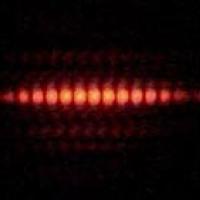
    The double slit experiment — Here's a quick introduction to a famous experiment which confirms some of the stranger predictions of quantum mechanics: that light is simultaneously wave-like and particle-like and that the very act of looking at a quantum system can change it.

    Who killed Schrödinger's cat? — Schrödinger's cat has become a well-known metaphor for mutually exclusive things happening at the same time. Here's a quick look at the origin of the famous feline.

    A ridiculously short introduction to some very basic quantum mechanics — This article does what it says on the tin, to the best of our ability.

    Heisenberg's uncertainty principle — The uncertainty principle is one of the central results of quantum mechanics. Here's a brief introduction which also shows how the principle drops out of the mathematics.

    Schrödinger's equation: what is it, what does it do, and what does it mean? — If you are up for a bit more of a challenge, here's a three-part article about one of the central equations of quantum mechanics. You will learn what the equation looks like, some of what it can tell us, and how we might interpret its consequences (could there be many parallel universes?)

    A brief history of quantum field theory — For another deep-dive, this series of accessible articles traces the history of quantum field theory, from its inception in quantum mechanics to the tantalising questions that are still open today. It's a story of pain and triumph, hardship and success. Happy reading!

    Read more about...
    quantum mechanics
    quantum physics
    • Log in or register to post comments

    You might also like

    article

    String theory: A promise from physics

    Mathematics is an indispensable tool in physics, but can physics solve problem in maths? Find out more in this article.

    article

    Quantum gravity in the can: The holographic principle

    It might sound like something from science fiction, but the holographic principle might help us answer the biggest problem in modern physics.
    article

    Physics in a minute: What's the problem with quantum gravity?

    At the heart of modern physics lurks a terrible puzzle: the two main theories that describe the world we live in just won't fit together.

    Read more about...

    quantum mechanics
    quantum physics
    University of Cambridge logo

    Plus is part of the family of activities in the Millennium Mathematics Project.
    Copyright © 1997 - 2025. University of Cambridge. All rights reserved.

    Terms