
'The Language of Mathematics'
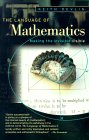
The Language of Mathematics: Making the invisible visible
Mathematics is the science of patterns, and those patterns can be found anywhere you care to look for them, in the physical universe, in the living world, or even in our own minds... mathematics serves us by making the invisible visible."
"The Language of Mathematics" is a book that sets itself an ambitious task - to sum up all of mathematics. Clearly, the author does not intend to do this without omissions - mathematics is far too large a subject for that - rather, he hopes that the reader will come away with an understanding of what maths is and what mathematicians do and why.
The topics Keith Devlin chooses to illustrate mathematics are: number theory, logic, motion, geometry, tilings and packings, topology, probability and particle physics. In each of these areas he sets out to illustrate the truth of his taglines "maths makes the invisible visible" and "maths is the science of patterns". He succeeds admirably in his aims - each section reinforces the others, and the book provides a useful antidote to the view of maths as something incredibly highly specialised. Of course, maths as done by modern mathematicians is highly specialised; however, some of the most interesting work is done in the overlap between different fields, and, at a more basic level, there is constant use of techniques of one area of maths in another - for example, algebraic arguments in geometry allow us to deal with dimensions higher than we can visualise.
The book focuses on the lives and accomplishments of the major players in each area. The primary focus isn't on showing the uses of mathematics - it really is about what (mostly pure) mathematicians do. One of the fun aspects of the book is the way things start to come together - characters, both human and symbolic, from previous chapters reappear later in different contexts. The task of showing what mathematicians do all day is difficult and important. But I don't think this book would be accessible to someone who hadn't already had a lot of mathematics. The problem is that the chains of reasoning used in mathematics are much longer than those commonly used elsewhere, and it requires practice to follow chains of such length.
The applications of the featured areas of maths are pointed out along the way, and are contingent rather than motivating for the mathematicians who proved the original results. This subordination of applications draws the reader away from a purely utilitarian classification of maths towards something like a "liberal arts" classification.
For example, if you weren't already persuaded of the importance of proof, then the usefulness of logic in proof wouldn't be useful in endearing logic to you. On the other hand, the throwaway comment that "today's electronic computer is... simply a device that can perform deductions in propositional logic" might be!
This is not to give the impression that applications are ignored - they aren't, it's just that Devlin focuses on mathematics done for its own sake, rather than to solve some pressing problem. He is an ardent champion of maths done for its own sake, by a mathematician searching for new patterns. He dutifully and regularly points out how often this work precedes a practical application.
Those applications that are given often seem to have been chosen for their breathtaking multidisciplinarity. It's not often that you read a sentence like "And there you have it: from snowflakes and pomegranates to modern telecommunications techniques, by way of the geometry of multidimensional space!"
Although the book is supposedly intended for a general audience, I don't think it is sufficiently accessible for this purpose. The language and notation are rigorous, and many long chains of reasoning - even formal proofs in mathematical language - are supplied. However, it would provide a very pleasurable overview of maths for anyone with A-level mathematics, and should also be enjoyable for someone who had done a maths degree, perhaps even for a professional mathematician. It is great fun to take a break from the more mundane business of working on one small corner of mathematics, and take instead a whistlestop tour through its most photogenic parts.
It is worth quoting at some length from Devlin's conclusion:
A mathematical study of any one phenomenon has many similarities to a mathematical study of any other. There is an initial simplification, in which the key concepts are identified and isolated. Then those key concepts are analysed in greater and greater depth, as relevant patterns are discovered and investigated. There are attempts at axiomatisation. The level of abstraction increases. Theorems are formulated and proved. Connections to other parts of mathematics are uncovered or suspected. The theory is generalised, leading to the discovery of further similarities to - and connections with - other areas of mathematics."
- Book details:
- The Language of Mathematics
- Keith Devlin
- paperback - 344 pages (2000)
- W. H. Freeman and Company
- ISBN 0-7167-3967-4