
Home
plus.maths.org

Secondary menu

  • My list
  • About Plus
  • Sponsors
  • Subscribe
  • Contact Us
  • Log in
  • Main navigation

  • Home
  • Articles
  • Collections
  • Podcasts
  • Maths in a minute
  • Puzzles
  • Videos
  • Topics and tags
  • For

    • cat icon
      Curiosity
    • newspaper icon
      Media
    • graduation icon
      Education
    • briefcase icon
      Policy

    Popular topics and tags

    Shapes

    • Geometry
    • Vectors and matrices
    • Topology
    • Networks and graph theory
    • Fractals

    Numbers

    • Number theory
    • Arithmetic
    • Prime numbers
    • Fermat's last theorem
    • Cryptography

    Computing and information

    • Quantum computing
    • Complexity
    • Information theory
    • Artificial intelligence and machine learning
    • Algorithm

    Data and probability

    • Statistics
    • Probability and uncertainty
    • Randomness

    Abstract structures

    • Symmetry
    • Algebra and group theory
    • Vectors and matrices

    Physics

    • Fluid dynamics
    • Quantum physics
    • General relativity, gravity and black holes
    • Entropy and thermodynamics
    • String theory and quantum gravity

    Arts, humanities and sport

    • History and philosophy of mathematics
    • Art and Music
    • Language
    • Sport

    Logic, proof and strategy

    • Logic
    • Proof
    • Game theory

    Calculus and analysis

    • Differential equations
    • Calculus

    Towards applications

    • Mathematical modelling
    • Dynamical systems and Chaos

    Applications

    • Medicine and health
    • Epidemiology
    • Biology
    • Economics and finance
    • Engineering and architecture
    • Weather forecasting
    • Climate change

    Understanding of mathematics

    • Public understanding of mathematics
    • Education

    Get your maths quickly

    • Maths in a minute

    Main menu

  • Home
  • Articles
  • Collections
  • Podcasts
  • Maths in a minute
  • Puzzles
  • Videos
  • Topics and tags
  • Audiences

    • cat icon
      Curiosity
    • newspaper icon
      Media
    • graduation icon
      Education
    • briefcase icon
      Policy

    Secondary menu

  • My list
  • About Plus
  • Sponsors
  • Subscribe
  • Contact Us
  • Log in
  • Mathematical mysteries: Right angle race

    1 June, 2000
    June 2000

    The German mathematician Adam Ries (1492-1559) was the author of the most successful textbook of commercial arithmetic of his day. The book, published in 1552, earned such a high reputation that the German phrase nach Adam Ries is used to this day to indicate a correct calculation.

    In An Introduction to the History of Mathematics, Howard Eves tells a story of a friendly contest between Adam Ries and a draughtsman to see who could construct the largest number of right angles in one minute, using only the traditional Euclidean tools of ruler and compasses.
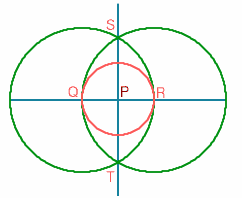
    Figure 1: The draughtsman's construct

    Figure 1: The draughtsman's construct

    The draughtsman used a standard school construction, probably the following:

    • Draw a straight line AB and mark a point P on it.
    • Describe a circle, centre P, cutting AB at points Q and R
    • With centres Q and R and radius QR, describe arcs intersecting at S and T.
    • Join ST.

    Then ST is perpendicular to AB at P, ie the angle SPR is ninety degrees.

    The draughtsman repeated this construction at a number of points on AB until his time ran out.

    After drawing the line AB, each right angle takes the draughtsman four steps to construct. Assuming each step takes one second, the draughtsman could construct 14 right angles in 57 seconds.
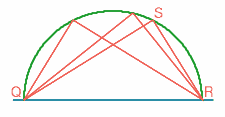
    Figure 2: Ries's construct

    Figure 2: Ries's construct

    Adam Ries started by drawing a line AB and then described a semicircle with centre P and diameter QR on it. He then chose a point S on the semicircle and joined QS and RS. Then, since the angle in a semicircle is a right angle, the angle QSR is ninety degrees. Ries repeated this construction at different points on the semicircle until his time ran out.

    After drawing the line AB and the semicircle, each right angle requires two construction steps. If each step takes one second, Adam Ries could construct 29 right angles in one minute by this method, winning the contest by a wide margin.

    However, if the draughtsman had not performed his constructions all on the same line AB, but had rather erected each successive perpendicular on the previous perpendicular, he could have won the contest easily.

    Leaving out the circle arcs and labelling the successive perpendiculars $L_1$, $L_2$, $L_3$, \ldots, the diagram below shows that:

    • $L_1$ and $L_2$ each produce one right angle.
    • $L_3$ and $L_4$ each produce two right angles.
    • $L_5$ and $L_6$ each produce three right angles.
    • $L_{2n-1}$ and $L_{2n}$ each produce $n$ right angles.

    \par So, after constructing the line $L_{2n}$, a total of $2(1+2+3+\ldots+n) = 2.\frac{1}{2}n(n+1) = n(n+1)$ right angles have been constructed. Since each line after AB takes 4 construction steps, the draughtsman could have constructed $n(n+1)$ right angles in $8n+1$ steps. With $n=7$ (and assuming as before that each step takes one second), the draughtsman could have constructed 56 right angles in 57 seconds, soundly defeating Adam Ries.

    You might like to have a go yourself with the applet below. In the toolbox (below right), you will see 5 buttons. These are:

    1. A "ruler" - which allows you to draw straight lines between 2 points. Click on it and then click and drag in the main window.
    2. A "compass". Click on it and then click and drag in the main window.
    3. A moving tool. Not strictly necessary, but useful if your diagram grows too large.
    4. An undo tool.
    5. A start again tool.

    Please enable Java for an interactive construction (with Cinderella).Please enable Java for an interactive construction (with Cinderella).Please enable Java for an interactive construction (with Cinderella).

    • Log in or register to post comments

    Read more about...

    Mathematical mysteries

    Our Podcast: Maths on the Move

    Our Maths on the Move podcast brings you the latest news from the world of maths, plus interviews and discussions with leading mathematicians and scientists about the maths that is changing our lives.

    Apple Podcasts
    Spotify
    Podbean

    Plus delivered to you

    Keep up to date with Plus by subscribing to our newsletter or following Plus on X or Bluesky.

    University of Cambridge logo

    Plus is part of the family of activities in the Millennium Mathematics Project.
    Copyright © 1997 - 2025. University of Cambridge. All rights reserved.

    Terms