

Home
plus.maths.org

Secondary menu

  • My list
  • About Plus
  • Sponsors
  • Subscribe
  • Contact Us
  • Log in
  • Main navigation

  • Home
  • Articles
  • Collections
  • Podcasts
  • Maths in a minute
  • Puzzles
  • Videos
  • Topics and tags
  • For

    • cat icon
      Curiosity
    • newspaper icon
      Media
    • graduation icon
      Education
    • briefcase icon
      Policy

    Popular topics and tags

    Shapes

    • Geometry
    • Vectors and matrices
    • Topology
    • Networks and graph theory
    • Fractals

    Numbers

    • Number theory
    • Arithmetic
    • Prime numbers
    • Fermat's last theorem
    • Cryptography

    Computing and information

    • Quantum computing
    • Complexity
    • Information theory
    • Artificial intelligence and machine learning
    • Algorithm

    Data and probability

    • Statistics
    • Probability and uncertainty
    • Randomness

    Abstract structures

    • Symmetry
    • Algebra and group theory
    • Vectors and matrices

    Physics

    • Fluid dynamics
    • Quantum physics
    • General relativity, gravity and black holes
    • Entropy and thermodynamics
    • String theory and quantum gravity

    Arts, humanities and sport

    • History and philosophy of mathematics
    • Art and Music
    • Language
    • Sport

    Logic, proof and strategy

    • Logic
    • Proof
    • Game theory

    Calculus and analysis

    • Differential equations
    • Calculus

    Towards applications

    • Mathematical modelling
    • Dynamical systems and Chaos

    Applications

    • Medicine and health
    • Epidemiology
    • Biology
    • Economics and finance
    • Engineering and architecture
    • Weather forecasting
    • Climate change

    Understanding of mathematics

    • Public understanding of mathematics
    • Education

    Get your maths quickly

    • Maths in a minute

    Main menu

  • Home
  • Articles
  • Collections
  • Podcasts
  • Maths in a minute
  • Puzzles
  • Videos
  • Topics and tags
  • Audiences

    • cat icon
      Curiosity
    • newspaper icon
      Media
    • graduation icon
      Education
    • briefcase icon
      Policy

    Secondary menu

  • My list
  • About Plus
  • Sponsors
  • Subscribe
  • Contact Us
  • Log in
  • Maths in a Minute: The wagon wheel effect

    by
    Aadit Jain
    18 October, 2021
    3 comments

    One of the greatest, most significant and major innovations in science is the wheel. However, most of us have overlooked a fascinating observation in a moving wheel. Sometimes, the wheels of an automobile are observed to be rotating backwards in movies or advertisements, even though the vehicle is moving forwards. Why? Let's explore the reason behind this intriguing phenomenon!

    This phenomenon is usually observed in high-speed vehicles. The perceived direction of motion is influenced by both the speed of the wheel as well as the video camera's capturing speed. Through diagrams and mathematics, we can illustrate the effect of these two factors on the observed direction of motion.

    We have created two cases which depict the observed motion of the wheel in both clockwise and anticlockwise direction. In these cases, we will change the wheel's speed and keep the camera's capturing speed the same. We discover that with low speeds, the wheel is noticed rotating in the clockwise direction while in the high-speed case it is perceived to be rotating in the anticlockwise direction.

    For the wheel of a slow-moving car, shown below, we start with the wheel at a bearing of 0°. On each observation, each frame captured by the camera, it moves 30° clockwise as represented in the diagram. Thus, we observe the wheel moving clockwise.
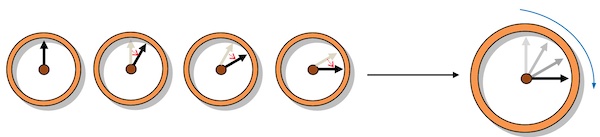
    clockwise motion

    The wheel of a slow moving car, captured by a video camera, appears to be moving clockwise.

    For the wheel of a fast-moving car, shown below, we again start with the wheel at a bearing of 0°. But now, with each observation captured by the camera, the wheel moves 300° clockwise. This movement of 300° clockwise can also be thought as moving 60° anti-clockwise. Our brain always interprets motion as that with the shortest angle. Thus, even though the wheel moves clockwise, we observe anti-clockwise motion, that is, the wheel moving in reverse.
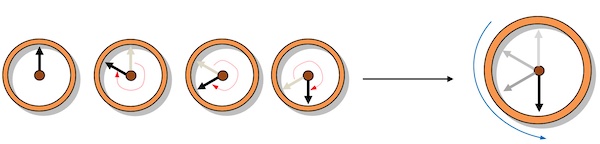
    clockwise motion

    The wheel of a fast moving car, captured by a video camera, appears to be moving anticlockwise.

    This optical illusion of perceiving the motion of a wheel moving in a backwards direction, when in fact the vehicle is moving forwards, is known as wagon-wheel or stage-coach effect.

    A simple model can be constructed to observe the wagon-wheel effect using a speed-controlled motor and a mobile phone, as shown in the video below.


    About the author

    Aadit Jain is high-school student with keen interest in maths, physics and their combined effect. He is always curious about how things work.

    • Log in or register to post comments

    Comments

    Dr. Rakesh Chouhan

    2 November 2021

    Permalink

    Nicely explained.

    • Log in or register to post comments

    Ronan

    15 July 2023

    In reply to Nicely explained. by Dr. Rakesh Chouhan

    Permalink

    Excellently explained. Thank you

    • Log in or register to post comments

    Jenn

    5 November 2023

    Permalink

    Thank you for making this clear. You made it easy to understand. Brilliant work.

    • Log in or register to post comments

    Read more about...

    Maths in a minute

    Our Podcast: Maths on the Move

    Our Maths on the Move podcast brings you the latest news from the world of maths, plus interviews and discussions with leading mathematicians and scientists about the maths that is changing our lives.

    Apple Podcasts
    Spotify
    Podbean

    Plus delivered to you

    Keep up to date with Plus by subscribing to our newsletter or following Plus on X or Bluesky.

    University of Cambridge logo

    Plus is part of the family of activities in the Millennium Mathematics Project.
    Copyright © 1997 - 2025. University of Cambridge. All rights reserved.

    Terms