
Home
plus.maths.org

Secondary menu

  • My list
  • About Plus
  • Sponsors
  • Subscribe
  • Contact Us
  • Log in
  • Main navigation

  • Home
  • Articles
  • Collections
  • Podcasts
  • Maths in a minute
  • Puzzles
  • Videos
  • Topics and tags
  • For

    • cat icon
      Curiosity
    • newspaper icon
      Media
    • graduation icon
      Education
    • briefcase icon
      Policy

    Popular topics and tags

    Shapes

    • Geometry
    • Vectors and matrices
    • Topology
    • Networks and graph theory
    • Fractals

    Numbers

    • Number theory
    • Arithmetic
    • Prime numbers
    • Fermat's last theorem
    • Cryptography

    Computing and information

    • Quantum computing
    • Complexity
    • Information theory
    • Artificial intelligence and machine learning
    • Algorithm

    Data and probability

    • Statistics
    • Probability and uncertainty
    • Randomness

    Abstract structures

    • Symmetry
    • Algebra and group theory
    • Vectors and matrices

    Physics

    • Fluid dynamics
    • Quantum physics
    • General relativity, gravity and black holes
    • Entropy and thermodynamics
    • String theory and quantum gravity

    Arts, humanities and sport

    • History and philosophy of mathematics
    • Art and Music
    • Language
    • Sport

    Logic, proof and strategy

    • Logic
    • Proof
    • Game theory

    Calculus and analysis

    • Differential equations
    • Calculus

    Towards applications

    • Mathematical modelling
    • Dynamical systems and Chaos

    Applications

    • Medicine and health
    • Epidemiology
    • Biology
    • Economics and finance
    • Engineering and architecture
    • Weather forecasting
    • Climate change

    Understanding of mathematics

    • Public understanding of mathematics
    • Education

    Get your maths quickly

    • Maths in a minute

    Main menu

  • Home
  • Articles
  • Collections
  • Podcasts
  • Maths in a minute
  • Puzzles
  • Videos
  • Topics and tags
  • Audiences

    • cat icon
      Curiosity
    • newspaper icon
      Media
    • graduation icon
      Education
    • briefcase icon
      Policy

    Secondary menu

  • My list
  • About Plus
  • Sponsors
  • Subscribe
  • Contact Us
  • Log in
  • Solving quadratics in pictures
    7 November, 2014
    3 comments

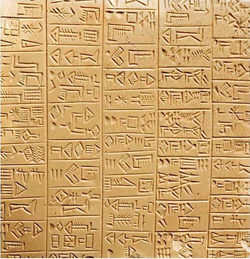
    A Babylonian inscription from around 2800 BC.

    Algebra is old: the Babylonians, a people who lived around 3000 years ago, already knew about versions of the famous formula for solving quadratic equations. But what they were inspired by was geometry: they needed to solve quadratics in order to work out problems involving areas of plots of land. So to celebrate their achievement, let's derive the famous quadratic formula using geometry.

    Suppose the quadratic equation you are looking at is $$x^2 + px = q,$$ with $p$ and $q$ both positive numbers. The term $x^2$ gives the area of a square with sides of length $x.$ The term $px$ gives the area of a rectangle with one side of length $p$ and the other side of length $x$. We can put the square and the rectangle next to each other to get a larger rectangle:
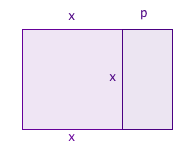
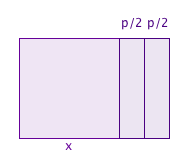
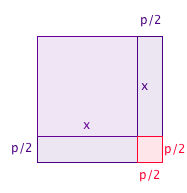
    The area of this larger rectangle is $x^2+px$ which, by our equation, is equal to $q.$ But it turns out that we can rearrange it to very nearly form a square. Simply slice the small rectangle into two strips with sides of lengths $x$ and $p/2$:

    And move one strip so it aligns with the bottom edge of the square:

    Let's call this region $R$. It still has area $x^2+px = q.$ But if we add a little square of side length $p/2$ to the bottom right corner of $R$ we get a big square with side length $x+p/2$ and area $\left(x+p/2\right)^2.$ Therefore, $$ \mbox{Area of the big square} = \left(x+p/2\right)^2 = \mbox{Area of R}+ \left(p/2\right)^2 = q + \left(p/2\right)^2.$$ Taking the square root of both sides gives $$x+p/2 = \pm{\sqrt{q + p^2/4}}.$$ Subtracting $p/2$ from both sides gives \begin{equation}x = \pm{\sqrt{q + p^2/4}}-p/2.\end{equation} How is that related to the quadratic formula we learn about at school? We usually write a general quadratic equation as $$ax^2+bx+c=0.$$ Dividing through by $a$ so that the coefficient of $x^2$ is 1 gives $$x^2 + \frac{b}{a}x + \frac{c}{a} = 0.$$ Bringing $\frac{c}{a}$ over to the other side gives $$x^2 + \frac{b}{a}x = -\frac{c}{a}.$$ So comparing with our equation above we see $p=\frac{b}{a}$ and $q=-\frac{c}{a}.$ Substituting these for $p$ and $q$ in expression (1) recovers the general quadratic formula $$x = \frac{-b\pm{\sqrt{b^2-4ac}}}{2a}.$$

    To say that the Babylonians knew this formula is a little misleading. Firstly, they didn't know about negative numbers, so they could only solve quadratics that had a positive solution. Also, they didn't write their maths using symbols and letters as we do, but using words. So a Babylonian student might be given questions such as:

    If I add to the area of a square twice its side, I get 48. What is the side?

    Which, writing $x$ for the side, translates to the equation $$x^2+2x=48.$$ The Babylonians knew about sequences of steps they could perform to find the solution to such a question — which is why we say they knew about the quadratic formula.
    • Log in or register to post comments

    Comments

    Anonymous

    7 November 2014

    Permalink

    Just a curiosity question, other than torturing Babylonian algebra students, what did they use the Quadratic Formula for?

    • Log in or register to post comments

    Anonymous

    8 November 2014

    Permalink

    After the part where the rectangles are rearranged, it says: "still has area p^2 +px=q...".
    It should be x^2 instead of p^2.

    • Log in or register to post comments

    Marianne

    17 November 2014

    In reply to Mistake in one equation by Anonymous

    Permalink

    Thanks for pointing that out, we've corrected it!

    • Log in or register to post comments

    Read more about...

    quadratic equation
    history of mathematics
    algebra
    geometry

    Our Podcast: Maths on the Move

    Our Maths on the Move podcast brings you the latest news from the world of maths, plus interviews and discussions with leading mathematicians and scientists about the maths that is changing our lives.

    Apple Podcasts
    Spotify
    Podbean

    Plus delivered to you

    Keep up to date with Plus by subscribing to our newsletter or following Plus on X or Bluesky.

    University of Cambridge logo

    Plus is part of the family of activities in the Millennium Mathematics Project.
    Copyright © 1997 - 2025. University of Cambridge. All rights reserved.

    Terms