
Home
plus.maths.org

Secondary menu

  • My list
  • About Plus
  • Sponsors
  • Subscribe
  • Contact Us
  • Log in
  • Main navigation

  • Home
  • Articles
  • Collections
  • Podcasts
  • Maths in a minute
  • Puzzles
  • Videos
  • Topics and tags
  • For

    • cat icon
      Curiosity
    • newspaper icon
      Media
    • graduation icon
      Education
    • briefcase icon
      Policy

    Popular topics and tags

    Shapes

    • Geometry
    • Vectors and matrices
    • Topology
    • Networks and graph theory
    • Fractals

    Numbers

    • Number theory
    • Arithmetic
    • Prime numbers
    • Fermat's last theorem
    • Cryptography

    Computing and information

    • Quantum computing
    • Complexity
    • Information theory
    • Artificial intelligence and machine learning
    • Algorithm

    Data and probability

    • Statistics
    • Probability and uncertainty
    • Randomness

    Abstract structures

    • Symmetry
    • Algebra and group theory
    • Vectors and matrices

    Physics

    • Fluid dynamics
    • Quantum physics
    • General relativity, gravity and black holes
    • Entropy and thermodynamics
    • String theory and quantum gravity

    Arts, humanities and sport

    • History and philosophy of mathematics
    • Art and Music
    • Language
    • Sport

    Logic, proof and strategy

    • Logic
    • Proof
    • Game theory

    Calculus and analysis

    • Differential equations
    • Calculus

    Towards applications

    • Mathematical modelling
    • Dynamical systems and Chaos

    Applications

    • Medicine and health
    • Epidemiology
    • Biology
    • Economics and finance
    • Engineering and architecture
    • Weather forecasting
    • Climate change

    Understanding of mathematics

    • Public understanding of mathematics
    • Education

    Get your maths quickly

    • Maths in a minute

    Main menu

  • Home
  • Articles
  • Collections
  • Podcasts
  • Maths in a minute
  • Puzzles
  • Videos
  • Topics and tags
  • Audiences

    • cat icon
      Curiosity
    • newspaper icon
      Media
    • graduation icon
      Education
    • briefcase icon
      Policy

    Secondary menu

  • My list
  • About Plus
  • Sponsors
  • Subscribe
  • Contact Us
  • Log in
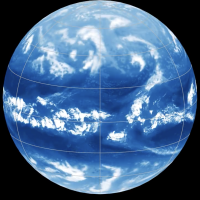
  • Image of the globe with no land, covered in clouds

    Maths in a minute: Aquaplanet

    27 April, 2026

    Understanding and predicting the Earth's climate requires an immense mathematical and computational effort. A full climate model uses mathematical equations to represent the many interacting factors that go into making the climate. Some of these equations are so hard to solve, you need masses of computing power to come up with approximate solutions. You can find out more in this article and in this episode of our Maths on the Move podcast.

    This is why scientists sometimes simplify matters by ignoring some of the complexity. The approach can still give valuable insights into the various processes that play out in the Earth's atmosphere. 

    A particularly lovely example of this is called Aquaplanet. We were recently introduced to it by Charles Powell, a post-doctoral research assistant at the Institute of Computing for Climate Science at the University of Cambridge.  The idea is to pretend the Earth is covered entirely by ocean, with no land at all. You also pretend that the Sun is fixed over the equator so there's a perpetual equinox. This means that there are no seasons.

    The movies below simulate the formation of clouds and precipitation on such an aqua-Earth over a period of 65 days.  The simulations have been shown to faithfully represent phenomena such as atmospheric waves, tropical cyclones and a pattern of winds high up in the stratosphere (known as  the quasi-biennial oscillation). This means that the simulations provide a physical basis for studying atmospheric processes, but in a much simpler framework than a full complexity climate model.

    The videos show the formation of clouds (top) and precipitation (bottom) on the aquaplanet. The resolution of the simulations is higher around the equator and lower at the poles, which is why it looks more fuzzy around the poles. The simulations start off from a "snapshot" of a resting atmosphere taken from a reference simulation which gives a realistic approximation of the base state of the aquaplanet. The simulations then need to "spin up" to reach a state that holds meaningful information about the real atmosphere. This is why the first 15 days are not shown.

    Even in this simplified set-up you still need a lot of computing power to produce simulations. The Mathematics Faculty at the University of Cambridge, where Powell works, hosts a state-of-the-art supercomputer known as COSMOS. Its main job is to serve the needs of the Stephen Hawking Centre for Theoretical Cosmology, crunching through the equations of Einstein's general theory of relativity to understand the Big Bang and black holes. Powell was able to use COSMOS for more earthly purposes, producing the lovely and insightful Aquaplanet simulations. Results have fed into research which sheds light into the Atlantic hurricane season.


    About this Article:

    We'd like to thank Charles Powell, a post-doctoral research assistant at the Institute of Computing for Climate Science at the University of Cambridge, for introducing us to Aquaplanet.

    • Log in or register to post comments

    You might also like

    article

    Maths in a minute: Mathematical models

    A basic introduction to the most powerful tools in science and engineering.
    article

    Climate change: Does it all add up?

    An insightful look at the climate models that predict our future.
    article

    Climate modelling made easy

    Make your own climate prediction with this simple, but powerful, model!

    Read more about...

    climate modelling
    mathematics and climate change
    weather forecasting
    meteorology
    mathematical modelling
    Maths in a minute
    University of Cambridge

    Our Podcast: Maths on the Move

    Our Maths on the Move podcast brings you the latest news from the world of maths, plus interviews and discussions with leading mathematicians and scientists about the maths that is changing our lives.

    Apple Podcasts
    Spotify
    Podbean

    Plus delivered to you

    Keep up to date with Plus by subscribing to our newsletter or following Plus on X or Bluesky.

    University of Cambridge logo

    Plus is part of the family of activities in the Millennium Mathematics Project.
    Copyright © 1997 - 2026. University of Cambridge. All rights reserved.

    Terms