Home
plus.maths.org

Secondary menu

  • My list
  • About Plus
  • Sponsors
  • Subscribe
  • Contact Us
  • Log in
  • Main navigation

  • Home
  • Articles
  • Collections
  • Podcasts
  • Maths in a minute
  • Puzzles
  • Videos
  • Topics and tags
  • For

    • cat icon
      Curiosity
    • newspaper icon
      Media
    • graduation icon
      Education
    • briefcase icon
      Policy

    Popular topics and tags

    Shapes

    • Geometry
    • Vectors and matrices
    • Topology
    • Networks and graph theory
    • Fractals

    Numbers

    • Number theory
    • Arithmetic
    • Prime numbers
    • Fermat's last theorem
    • Cryptography

    Computing and information

    • Quantum computing
    • Complexity
    • Information theory
    • Artificial intelligence and machine learning
    • Algorithm

    Data and probability

    • Statistics
    • Probability and uncertainty
    • Randomness

    Abstract structures

    • Symmetry
    • Algebra and group theory
    • Vectors and matrices

    Physics

    • Fluid dynamics
    • Quantum physics
    • General relativity, gravity and black holes
    • Entropy and thermodynamics
    • String theory and quantum gravity

    Arts, humanities and sport

    • History and philosophy of mathematics
    • Art and Music
    • Language
    • Sport

    Logic, proof and strategy

    • Logic
    • Proof
    • Game theory

    Calculus and analysis

    • Differential equations
    • Calculus

    Towards applications

    • Mathematical modelling
    • Dynamical systems and Chaos

    Applications

    • Medicine and health
    • Epidemiology
    • Biology
    • Economics and finance
    • Engineering and architecture
    • Weather forecasting
    • Climate change

    Understanding of mathematics

    • Public understanding of mathematics
    • Education

    Get your maths quickly

    • Maths in a minute

    Main menu

  • Home
  • Articles
  • Collections
  • Podcasts
  • Maths in a minute
  • Puzzles
  • Videos
  • Topics and tags
  • Audiences

    • cat icon
      Curiosity
    • newspaper icon
      Media
    • graduation icon
      Education
    • briefcase icon
      Policy

    Secondary menu

  • My list
  • About Plus
  • Sponsors
  • Subscribe
  • Contact Us
  • Log in
  • icon

    Puzzle page

    1 September, 2002
    September 2002

    Mathematical Misfits...continued

    Last issue we ran two puzzles; one two-dimensional and one three-dimensional. Quite a few people solved the two-dimensional puzzle, but noone even got started on the three-dimensional one! So this issue we're giving the solution of the first part, and leaving the second part for next issue.

    The two-dimensional puzzle

    Which fits best - a square peg in a round hole, or a round peg in a square hole?
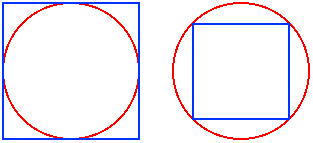
    Which fits best?

    Which fits best?

    The three-dimensional puzzle

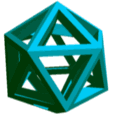
    Which fits best in a sphere - a dodecahedron or an icosahedron? That is, if you fit the largest possible dodecahedron and icosahedron inside a given sphere, which leaves least space?

    Dodecahedron

    Dodecahedron

    Icosahedron

    Icosahedron

    You can see rotating versions of these here.

    (Both images copyright by Rüdiger Appel)

    Hints for the solution

    If you can find the volume of one of these solids, the other shouldn't be hard, so we'll concentrate here on the dodecahedron.

    The volume of a dodecahedron
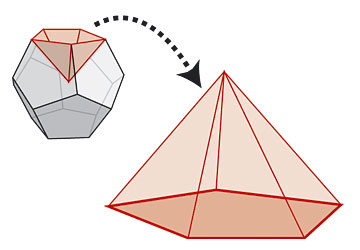
    The volume of an docecahedron

    A Dodecahedron is 12 of these

    We can think of the dodecahedron as a collection of twelve pyramids, each with one of the pentagonal faces as base, and the centre of the dodecahedron as the other vertex. Since the formula for the volume of a pyramid is one-third of the area of the base by the perpendicular height, we need to find both the area of a face and the distance from the centre of a face to the centre of the dodecahedron.

    First, the area of the face. This can be found using simple trigonometry, by noticing which lengths and angles are the same.

    The key to finding the distance from the centre of a face to the centre of the dodecahedron is finding the dihedral angle - the angle each face makes with its neighbours. For this, it's useful to know about duality.

    Dual polygons

    Regular dodecahedra and icosahedra are dual to each other. This means that if you take one and put a vertex in place of every face, and a face in place of every vertex, you get the other!

    Take the dodecahedron, for example. It has twelve pentagonal faces and a total of twenty vertices, each of which is a vertex of three of the faces. If you put a point at the centre of each face and join together those on adjoining faces, you get twenty equilateral triangle faces, and each vertex is a vertex of five faces - in other words, you get an icosahedron! The reverse works too - you can get a dodecahedron from an icosahedron.
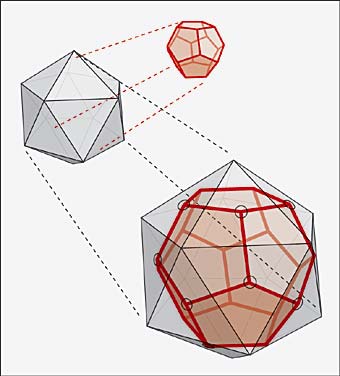
    The dodecahedron and icosahedron are dual

    The dodecahedron and icosahedron are dual


    If you are stumped by last issue's puzzle, here is the solution.

    Solution link
    Mathematical Misfits - three-dimensional solution
    • Log in or register to post comments
    University of Cambridge logo

    Plus is part of the family of activities in the Millennium Mathematics Project.
    Copyright © 1997 - 2025. University of Cambridge. All rights reserved.

    Terms