Maths can take you anywhere
Ahead of this summer’s exam results, the Academy for the Mathematical Sciences took its Maths Can Take You Anywhere campaign into thousands of schools and colleges across the UK, highlighting the many career pathways that mathematics can open up for students.
Is maths right for you? It may seem a strange question, but many students remain unaware of the wide range of careers that draw on maths, the diversity of people who work in them, and the enjoyment that can come from exploring the subject. That matters because subject choices shape future opportunities.
To challenge common misconceptions about who maths is for, and where it can lead, the Academy for the Mathematical Sciences launched its Maths Can Take You Anywhere (MCTYA) campaign in schools and colleges across the UK in 2026. Through the personal stories of people from very different backgrounds and with strikingly varied careers, the campaign shows how studying maths can shape lives and careers in unexpected ways.
One of the brilliant things about maths is that it opens doors. The Maths Can Take You Anywhere campaign shows that whether you dream of being an athlete, an artist, an author, a scientist, a teacher, or even an astronaut, maths can turn that dream into a reality.
At a time when young people are making decisions about subject choices and future career paths, this inspiring campaign shows the incredible range of career choices that will be open to them if they continue to study maths.
Bobby Seagull MBE FAcadMathSci, maths teacher and communicator
Young people in Years 10–13 or S3–S6 are facing big decisions about their subject options – which subjects they continue to study, and which they drop. As a student, do you choose the subjects you most enjoy, the ones at which you perform best, or the ones you believe will create the widest range of opportunities? The people featured in MCTYA have taken very different paths, but each shows how maths helped shape their journey. Their stories can help students, parents, and teachers think differently about subject choices.
Conversations about subject choices can have a lasting influence on the opportunities available later in life. By showing the breadth of people who use maths and the variety of careers it supports, the campaign aims to help students, parents, carers, and teachers make those decisions with a fuller understanding of where maths can lead.
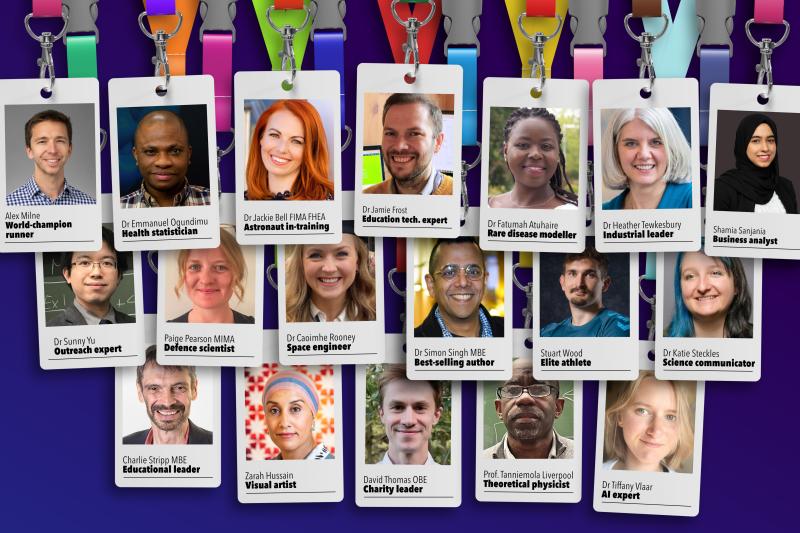
It is easy to assume, for example, that mathematicians must have found the subject easy at school. Not so. Sunny Yu, who now teaches maths at university, once hated maths so much that he ripped up his school textbook. He credits inspiring teachers with helping him move beyond those negative feelings and to discover what he describes as an “incredibly beautiful and fascinating” subject.
Thomas Woolley was the first person in his family to go to university. He grew up in an industrial town, earned a maths degree, and now applies maths to medical and biological problems. His work helped shape the Welsh Government’s policy during the COVID-19 pandemic.
A 2024 report by the Children’s Commissioner found that children recognise the importance of maths as a life skill. But knowing maths is useful is not the same as seeing that it opens doors to exciting careers — many students don’t realise that 15% of all jobs in the UK rely heavily on maths, and that salaries in such jobs are 48% higher on average than in other roles.
Maths took Caoimhe Rooney to NASA and she now works on state-of-the-art missions to remove junk from space; longer-term, she plans to become an astronaut. Jamie Frost became an investment banker before pursuing his passion for teaching. If you are in a secondary school in the UK, you have very likely used his DrFrostMaths online maths platform for lesson resources and exam questions!
We all draw confidence from having role models whose stories or interests resonate with our own. We hope the campaign helps young people, parents, carers and teachers see the remarkable breadth of careers that mathematical knowledge and skills can unlock, and gives them the confidence to pursue those opportunities.
Dr Christie Marr, Executive Director, Academy for the Mathematical Sciences
Finance, computing, and teaching in schools and universities are all widely recognised as careers that build on maths. But maths also plays a vital role in many other sectors where its presence may be less obvious.
Lisa McFetridge, for example, uses her maths skills to improve outcomes and help save lives in hospital intensive care units: using statistical modelling, she is developing an early-warning system for patients on mechanical ventilators who are at risk of complications. Before becoming Chief Executive of the Smith Institute, Heather Tewkesbury used mathematical techniques, including computer simulations, to help make chocolate smoother and tastier.
There are maths-based pathways into far more careers than most people realise. Tanniemola Liverpool uses maths to probe the origins of life. Myer Glickman monitors social and geographical health inequalities to help make the world a fairer place. Visual artist Zarah Hussain incorporates mathematical concepts such as geometric structures and tessellation into digital animations, sculptures, and paintings. Paralympic athlete Stuart Wood uses his mathematical skills to design bespoke technology and software for use in his training and racing.
Mathematicians come from everywhere, and maths can take you anywhere.
Professor Dame Alison Etheridge DBE FRS, President, Academy for the Mathematical Sciences
If you are choosing subjects — or helping someone else to choose—it is worth asking: ‘Where could maths take me?’ Talking about future careers and the opportunities maths can create can help young people make informed choices about whether to continue with the subject.
Curious where maths could take you? Take the online Maths Can Take You Anywhere quiz to explore the diverse and surprising world of maths and mathematicians, then dig into some of the profiles and stories that inspire you.
About the authors
Vinesh Maguire-Rajpaul is Research and Policy Lead and David Schley is Communications and Engagement Lead at the Academy for the Mathematical Sciences (AcadMathSci), the UK’s national academy for the mathematical sciences across academia, education, business, industry and government.