
Home
plus.maths.org

Secondary menu

  • My list
  • About Plus
  • Sponsors
  • Subscribe
  • Contact Us
  • Log in
  • Main navigation

  • Home
  • Articles
  • Collections
  • Podcasts
  • Maths in a minute
  • Puzzles
  • Videos
  • Topics and tags
  • For

    • cat icon
      Curiosity
    • newspaper icon
      Media
    • graduation icon
      Education
    • briefcase icon
      Policy

    Popular topics and tags

    Shapes

    • Geometry
    • Vectors and matrices
    • Topology
    • Networks and graph theory
    • Fractals

    Numbers

    • Number theory
    • Arithmetic
    • Prime numbers
    • Fermat's last theorem
    • Cryptography

    Computing and information

    • Quantum computing
    • Complexity
    • Information theory
    • Artificial intelligence and machine learning
    • Algorithm

    Data and probability

    • Statistics
    • Probability and uncertainty
    • Randomness

    Abstract structures

    • Symmetry
    • Algebra and group theory
    • Vectors and matrices

    Physics

    • Fluid dynamics
    • Quantum physics
    • General relativity, gravity and black holes
    • Entropy and thermodynamics
    • String theory and quantum gravity

    Arts, humanities and sport

    • History and philosophy of mathematics
    • Art and Music
    • Language
    • Sport

    Logic, proof and strategy

    • Logic
    • Proof
    • Game theory

    Calculus and analysis

    • Differential equations
    • Calculus

    Towards applications

    • Mathematical modelling
    • Dynamical systems and Chaos

    Applications

    • Medicine and health
    • Epidemiology
    • Biology
    • Economics and finance
    • Engineering and architecture
    • Weather forecasting
    • Climate change

    Understanding of mathematics

    • Public understanding of mathematics
    • Education

    Get your maths quickly

    • Maths in a minute

    Main menu

  • Home
  • Articles
  • Collections
  • Podcasts
  • Maths in a minute
  • Puzzles
  • Videos
  • Topics and tags
  • Audiences

    • cat icon
      Curiosity
    • newspaper icon
      Media
    • graduation icon
      Education
    • briefcase icon
      Policy

    Secondary menu

  • My list
  • About Plus
  • Sponsors
  • Subscribe
  • Contact Us
  • Log in
  • Heather Harrington

    Advent calendar door #22: Euromaths, Heather Harrington

    22 December, 2024

    We all know what data is: bits of information of which in this age of Big Data we have lots of. You might also know what topology is: the study of shapes that considers two shapes to be the same if you can deform one into the other without tearing them or gluing things together.

    But what is topological data analysis? And how might it help to understand proteins or diseases such as cancer? We find out with Heather Harrington a mathematician we met at the European Congress of Mathematics (ECM) this summer. Heather tells us how topological data analysis can produce a so-called barcode for a given data set which gives deep insights into its structure. Below are a couple of images illustrating a barcode to illustrate what we talk about in the podcast.

    We attended the ECM with kind support of the London Mathematical Society (LMS). Heather gave the LMS lecture at the ECM.

    You might also want to listen to more episodes of our Euromaths series which reports on the ECM.
    circles

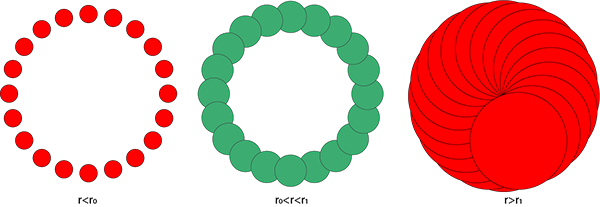
    Circles drawn around 20 points in the plane. If the radius r is less than r0, the circles are small enough to not overlap (left). Once the radius exceeds r0, but is smaller than r1, the circles overlap and together form a ring-like structure (middle). One the radius is larger than r1 the circles join up in the centre of this ring-like structure. What you see now is a single blob without a hole.

    circles

    The barcode captures this information. For r < r0 there are 20 red lines indicating there are twenty connected components without holes. For r0 < r < r1 there is one green line indicating there is one connected component with one hole (the colours red and green differentiate between no hole and one hole). For r > r1 there is one red line indicating there is one connected component without a hole.

    Return to the advent calendar 2024!

    You can listen to the podcast using the player above, and you can listen and subscribe to our podcast through Apple Podcasts, Spotify and through most other podcast providers via podbean.


    This content was produced with kind support from the London Mathematical Society.

     

    • Log in or register to post comments

    Our Podcast: Maths on the Move

    Our Maths on the Move podcast brings you the latest news from the world of maths, plus interviews and discussions with leading mathematicians and scientists about the maths that is changing our lives.

    Apple Podcasts
    Spotify
    Podbean

    Plus delivered to you

    Keep up to date with Plus by subscribing to our newsletter or following Plus on X or Bluesky.

    University of Cambridge logo

    Plus is part of the family of activities in the Millennium Mathematics Project.
    Copyright © 1997 - 2025. University of Cambridge. All rights reserved.

    Terms