

Shattering geometric shapes
Brief Summary
This article looks at Ranganathan's work in algebraic geometry, exploring the concept of log geometry which is used to understand objects called algebraic varieties.
Dhruv Ranganathan is Professor of Algebraic Geometry and one of our colleagues here at the Department of Pure Mathematics and Mathematical Statistics (DPMMS) at the University of Cambridge.
Ranganathan has won a prestigious Whitehead Prize by the London Mathematical Society for being "an extraordinary algebraic geometer with boundless energy and tireless dedication to the mathematical community." We spoke to him to find out more about his work.
Productive lying
The field of algebraic geometry, explains Ranganathan, is about "the interaction between different parts of your brain, the one that likes solving equations and the one that thinks visually."
The fact that this interaction can be useful is something most of us will know from school. A straight line can be described by an equation of the form $y = ax + b$, where $a$ is the slope and $b$ the intercept. Similarly, an equation of the form $x^2+y^2=r^2$ defines a circle of radius $r$ The algebraic description helps you get a handle on the geometric shape and the geometry lends meaning to the abstract equation.
Circles and lines are examples of algebraic varieties: geometric shapes that are defined by polynomial equations. Both are one-dimensional curves, but if you allow a third variable into your equations, along with x and y, you generally get a two-dimensional surface. For example, the equation $x^2+y^2+z^2=r^2$ defines a sphere.
Allowing even more variables takes us into the wonderful world of higher dimensions. We can no longer visualise the varieties in this case, but mathematicians don't bat an eyelid. Algebra helps them explore this invisible world, with guidance from geometric intuition.
"In a way, most geometers come up with well-tuned lies," says Ranganathan. "When you are drawing on the blackboard you have a set of rules in your head that you infer from algebra, which you [impose] on your [pictures] even if [the pictures are] not quite right. This form of productive lying is part of the skill."
Ranganathan has clearly mastered that skill, and more. The Whitehead Prize citation calls him "the master of combining log geometry with moduli theory". These are technical terms, but really it all comes down to the most basic question you can ask about any geometric shape: what is it actually like?
Geometry by numbers
Even when you're dealing with lower-dimensional objects you can visualise, this isn't an easy question to answer. "What does it mean to understand any shape, other than just having it in front of you?," says Ranganathan. "You should be able to call your friend and say, without drawing a picture, this is what I understand about the shape. Maybe you have to make some kind of measurement, to get a number out."
You might start by trying to measure lengths, volumes, or surface areas, until you realise these far from pin an object down — an incredibly knobbly potato, or a long and twisted tube, can have the same volume or area as a perfect sphere.
A different approach is to take a simpler shape you do understand and see how it relates to the more complex object you're trying to describe.
A favourite example of Ranganathan's is called the bitangent problem. Given a smooth curve in the plane you can ask how many straight lines there are that are tangent to the curve (touch it, but don't cross it) in exactly two places.
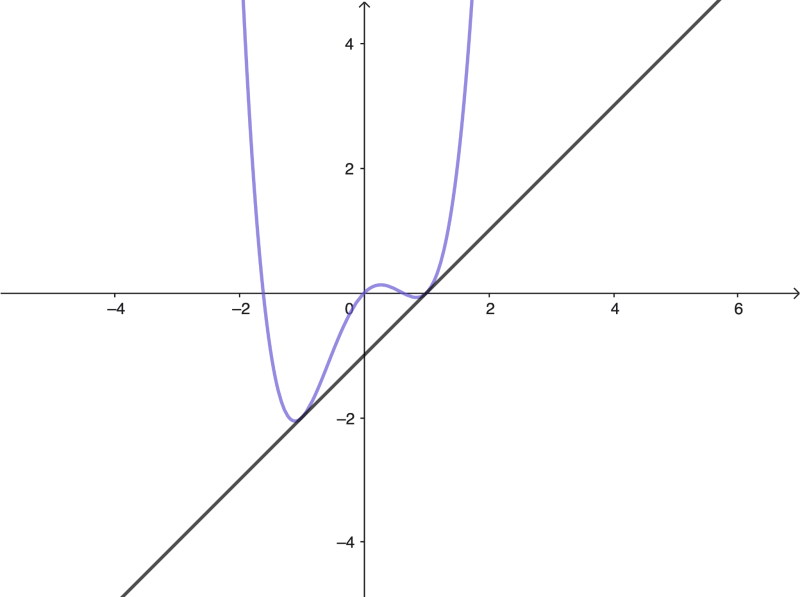
If your curve is given by a polynomial equation of degree 1, 2, or 3, the answer is zero: there are no such bitangents. If it's a polynomial equation of degree 4, there are at most 28 bitangents. If it's degree 5, the answer is at most 120. In general, for a degree n polynomial equation, there are at most $½ n(n-2)(n^2-9)$ lines tangent to the curve in exactly two places.
If you were looking for a way of characterising such curves by degree, and knew nothing else about them, then the maximal number of bitangents wouldn't be a bad start. It's something you could quite easily tell a friend over the phone.
The bitangent problem falls into the realm of enumerative geometry, which is about counting the number of solutions to geometric questions.
Spaces of spaces
Attacking problems from enumerative geometry using the visual side of your brain often involves moving things around. You might start with a line that touches a curve in one place and then move it around until it touches it in a second place. What you're doing here is exploring the space of all lines to find the line that solves the problem.
The space of all lines is called the moduli space of lines. If you're thinking of lines given by equations of the form $y=ax+b$, then exploring the space of all such lines amounts to varying the coefficients $a$ and $b$ in the equation.
But here's a lovely twist: each pair $(a, b)$ can also be taken to define a point in the plane ($a$ and $b$ are the point's coordinates). This means that the moduli space of such lines can be identified with the plane, itself a geometric space. As you move around this plane, you vary the line. It's this kind of interplay that makes algebraic geometry so beautiful.
Moduli spaces exist for other types of algebraic variety as well. "[Generally] a moduli space is the space of all ways you can configure a geometric [object]," says Ranganathan. "It's really a more fundamental object than the enumerative problem." And since moduli spaces can usually themselves be seen as geometric objects — indeed as algebraic varieties — you can bring the tools from algebraic geometry to bear on them too.
Shattering varieties
With moduli spaces now (roughly) explained, let's turn to the other part of our quote from the Whitehead Prize citation: log geometry. The "log" here comes from "logarithm", but it's not very illuminating. "It's quite tricky to find out where the logarithm is," says Ranganathan. "It comes up somewhere in season twelve, episode four of the show."
So forget about the logarithm and instead imagine an algebraic variety as being made of clay or glass — something breakable. "The basic idea is that then you throw it on the floor and break it," says Ranganathan. "In some moral sense, the individual pieces have to be simpler. The art of trying to figure out the answer to whatever question you are interested in from the pieces is part of what log geometry does."
There's a neat algebraic incarnation of this geometric intuition. "[You have an algebraic variety given by a polynomial equation with variables and coefficients]," explains Ranganathan. "What you do is, you start changing the coefficients until something interesting happens: the polynomial factors into two simpler polynomials. When that happens on the algebraic side, what's happening on the geometric side is that the geometric object is breaking."
Putting the broken pieces back together involves something called tropical geometry, which provides a kind of blueprint for reassembly. Unlike with log geometry the name here isn't mysterious. Tropical geometry is called tropical because the Brazilian computer scientist Imre Simon pioneered the central ideas while working in tropical São Paulo.
Master of two worlds
The link from log geometry to moduli spaces can again be illustrated by enumerative geometry. A type of question that is often asked to understand an algebraic variety is how many curves of a given type you can draw on it. As with our bitangent example above, this kind of problem involves exploring the moduli space of the curves in question.
If you also use log geometry to find an answer, you arrive at a sort of meta question: what happens to the moduli space of the curves when you break the variety they are drawn on? That's exactly the type of question Ranganathan's work has helped to answer.
The results have been extremely fruitful. In algebraic geometry there are two dominant ways of characterising varieties by counting curves. One is named after Mikhael Gromov and Edward Witten and the other was developed by Simon Donaldson and Richard Thomas (the latter two are both former Whitehead Prize winners and count among Ranganathan's heroes).
The two approaches differ wildly, and so do the numbers they produce. Yet, the suspicion is that, like two translations of the same text, they provide the same information about the variety the curves are drawn on. Ranganathan's work has provided log versions of both Gromov-Witten and Donaldson-Thomas theories which allow computations to be done on the simpler pieces of a shattered variety. This has led to great progress in showing that the two approaches really do tell us the same thing. And this counts as major progress in the entire field.
The Whitehead Prize citation also praises Ranganathan for "his commitment to mentorship of young researchers." His outstanding teaching has been recognised by a 2026 Pilkington Prize too. But he points out that the benefits flow in both directions,. "The students here are just amazing. I've been lucky to have had many PhD students — and they have taught me more than I have taught them."
About this article
Dhruv Ranganathan is Professor of Algebraic Geometry at the University of Cambridge. Marianne Freiberger is Editor of Plus. She interviewed Ranganathan in August 2026.