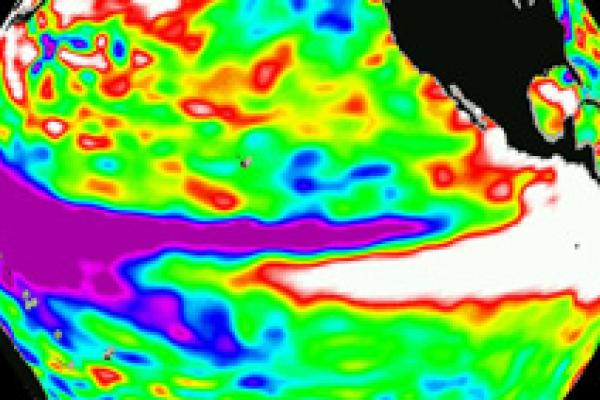
El Niño: What on Earth will happen next?
El Niño is a climate event without equal, causing droughts, floods, hurricanes and typhoons around the globe. How can we understand and predict it?


Probabilities and statistics: they are everywhere, but they are hard to understand and can be counter-intuitive. So what's the best way of communicating them to an audience that doesn't have the time, desire, or background to get stuck into the numbers? This article explores modern visualisation techniques and finds that the right picture really can be worth a thousand words.
This article is based on a talk I gave at the recent John Cage exhibition in the Kettles Yard gallery in Cambridge. Cage is perhaps best known for his avant-garde music, particularly his silent 1952 composition 4′33″ but also for his use of randomness in aleatory music. But Cage also used randomness in his art.
England's performance in the World Cup last summer was thankfully overshadowed by the attention given to Paul the octopus, who was reported as making an unbroken series of correct predictions of match winners. David Spiegelhalter looks at Paul's performance in an attempt to answer the question that (briefly) gripped the world: was Paul psychic?
David Spiegelhalter explains that waiting for an infinite number of monkeys to produce the complete works of Shakespeare is not just a probabilistic certainty, it also gives us an insight into how long we can expect to wait for a rare event to happen.
One in nine women will get breast cancer in her lifetime, and it seems sensible to screen women for breast cancer to treat them as early as possible. But, as David Spiegelhalter explains, screening is a controversial issue.
On May 22nd 2009 the English Premier league had one more match day ahead, with West Bromwich Albion at the bottom of the league and Manchester United at the top, sure to remain there. Taking up a challenge from a BBC radio programme, David Spiegelhalterand Yin-Lam Ng used their statistical finesse to predict the outcome of the last matches — and they were 90% correct. Find out how they did it.