
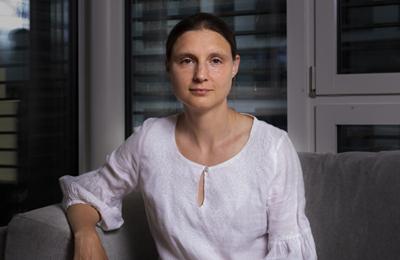
Maryna Viazovska, a mathematician at the EPFL in Switzerland, won one of the 2022 Fields Medals at the International Congress of Mathematicians. The Fields Medal is one of the most prestigious prizes in mathematics. It is awarded every four years "to recognise outstanding mathematical achievement for existing work and for the promise of future achievement". She was only the second woman to receive a Fields Medal, following on from Maryam Mirzakhani who won it in 2014. This year, Hong Wang became the third.
Viazovska was awarded the Fields Medal for a ground-breaking proof that relates to a problem we're all familiar with from everyday life: when you pack round things, such as oranges, into a box, there'll always be gaps between them. This raises a geometric question: how should you arrange spheres into a box to make sure you can fit in as many as possible? What's the biggest proportion of space you can fill with spheres?
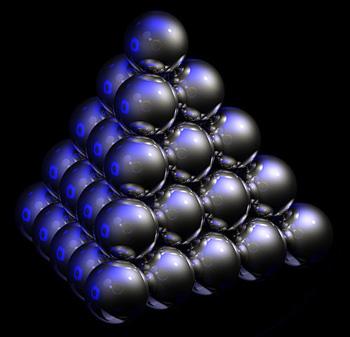
If the box is small, then the answer depends on the shape of the box. But if the box is very large, the effect of the shape is negligible, and the answer depends only on the volume of the box. The question is known as Kepler's conjecture after the 17th century mathematician Johannes Kepler. Kepler had suggested an arrangement that fills about 75% of space with spheres. There are many good ways to achieve this proportion, including the one you see in the fruit market where oranges are stacked in pyramids. But it wasn't until 1998 that the mathematician Thomas Hales proved that this was indeed the optimal proportion.
Viaszovska's work concerns the analogous problem in higher dimensions. Although we cannot visualise higher-dimensional spheres, mathematicians have a way of describing them. Viazovska answered the question for dimensions 8 and 24: in dimension 8 you can fill at most around 25% of space with hyperspheres, as higher dimensional spheres are called, and in dimension 24 it's only around 0.1% of space. Her proof stunned the mathematics community in its ingenuity and elegance.
Esoteric as they may seem, higher-dimensional sphere packings have applications in communications technology, where they ensure that the messages we send via the internet, a satellite, or a telephone can be understood even if they have been scrambled in transit (find out more here). So what makes dimensions 8 and 24 so special? "Everybody asks what is special about dimensions 8 and 24 — I don't know, it's a mystery," Viazovska said in 2018. "In these dimensions we have these two extremely great configurations, which we don't have in other dimensions. They are so good that methods which fail in all other dimensions, in these dimensions give a sharp estimate. If you ask me why, I don't know."
This is an easy introduction to the work of Maryna Viazovska, you can read more of the mathematical details in this article.
Back to the Plus advent calendar 2026
This content was produced as part of our collaborations with the London Mathematical Society and the Isaac Newton Institute for Mathematical Sciences. You can find all our content on the 2022 International Congress of Mathematicians here.