Article

Light attenuation and exponential laws

Arguably, the exponential function crops up more than any other when using mathematics to describe the physical world. In the first of two articles on physical phenomena which obey exponential laws, Ian Garbett discusses light attenuation - the way in which light decreases in intensity as it passes through a medium.
Article
Cartoon man walking

Modelling, step by step

Why can't human beings walk as fast as they run? And why do we prefer to break into a run rather than walk above a certain speed? Using mathematical modelling, R. McNeill Alexander finds some answers.

News story

Stellar heartbeats

Astronomers have for the first time listened to the heartbeat of a star other than our own Sun.
News story

Population ex-explosion?

Along with nuclear proliferation and the deteriorating condition of the natural environment, human population growth has become an issue of significant public concern during the past century. With the global population increasing at an ever-accelerating rate, how can the world continue to support its freight of humanity?
News story

The buzz on bumblebees

The common bumblebee is a familiar visitor to European gardens. At first sight there's nothing particularly remarkable about this small furry interloper, but it has been a source of mathematical controversy for nearly a century.
Article
Bank notes and a cheque

Rogue trading?

The dangers of trading derivatives have been well-known ever since they were catapulted into the public eye by the spectacular losses of Nick Leeson and Barings Bank. John Dickson explains what derivatives are, and how they can be both risky, and used to reduce risk.

News story

PLUS WINS a Webby!

At the Webby Awards - the Oscars for the internet - held last week, Plus magazine was officially named as the best science site on the web.
Article
Tesselating diamonds

From quasicrystals to Kleenex

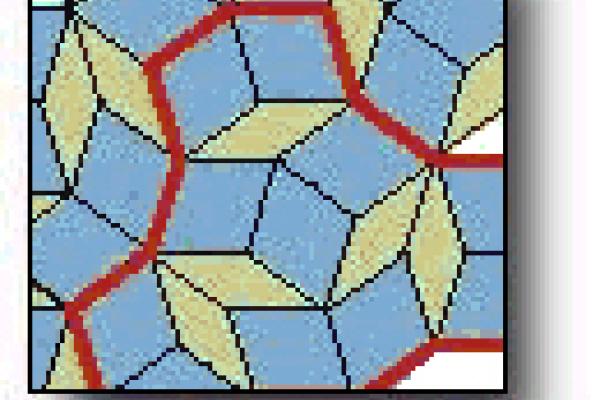
This pattern with kite-shaped tiles can be extended to cover any area, but however big we make it, the pattern never repeats itself. Alison Boyle investigates aperiodic tilings, which have had unexpected applications in describing new crystal structures.

Article
grey, red and green tesselating squares

On the dissecting table

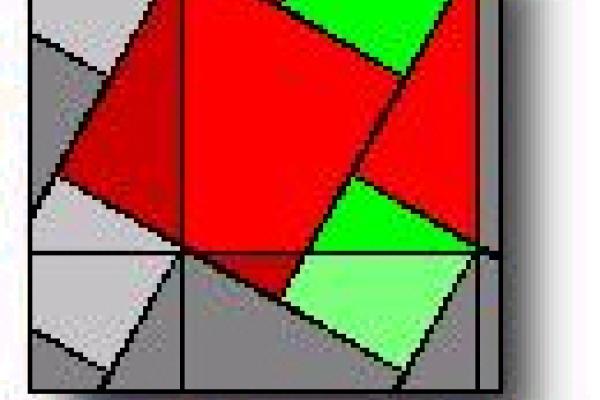
Bill Casselman writes about the intriguing amateur mathematician Henry Perigal, who took his elegant proof of Pythagoras' Theorem literally to his grave - by having it carved on his tombstone.