

Cambridge appoints first-ever Hawking Professor of Cosmology
Brief Summary
Daniel Baumann will be treading in Hawking's legendary footsteps, pursuing a central question of the field: How did the Universe begin? This article looks at his research in more detail.
Plus is based at the Department of Applied Mathematics and Theoretical Physics at the University of Cambridge. For many years we were lucky to share a building with the legendary Stephen Hawking, who passed away in 2018.
Now the University of Cambridge has appointed the first-ever Stephen W. Hawking Professor of Cosmology with generous support of the Avery-Tsui Foundation. Daniel Baumann will be treading in Hawking's legendary footsteps, pursuing a central question of the field: How did the Universe begin?
"It's a tremendous honour for me to become the first Stephen Hawking Professor," says Baumann. "Stephen Hawking was an enormous figure in my field, so it is profoundly humbling to hold a Chair established in his name."
The Department of Applied Mathematics and Theoretical Physics (DAMTP) is thrilled to have him. "Daniel has made an extraordinary number of highly influential contributions to cosmology," says Professor of Theoretical Physics Enrico Pajer. "His work displays remarkable physical insight and an unusually refined sense for identifying deep and timely open problems. He combines originality, clarity, and breadth in a way that is truly rare."
Looking into the past
Baumann first became aware of Hawking's work aged 14 when his father, a film director, gave him Hawking's popular science book A brief history of time. "I didn’t understand much of it, but I was fascinated by the deep questions about the Universe it describes, so I started studying physics."
It's easy to see the fascination. Cosmology studies the origin, nature, and the history of the Universe — and who hasn't looked up at the night sky and wondered what is out there and where it all comes from? If you do this with powerful telescopes you see more than just the pin-pricks of stars. Entire galaxies reveal themselves, forming what is known as the cosmic web.
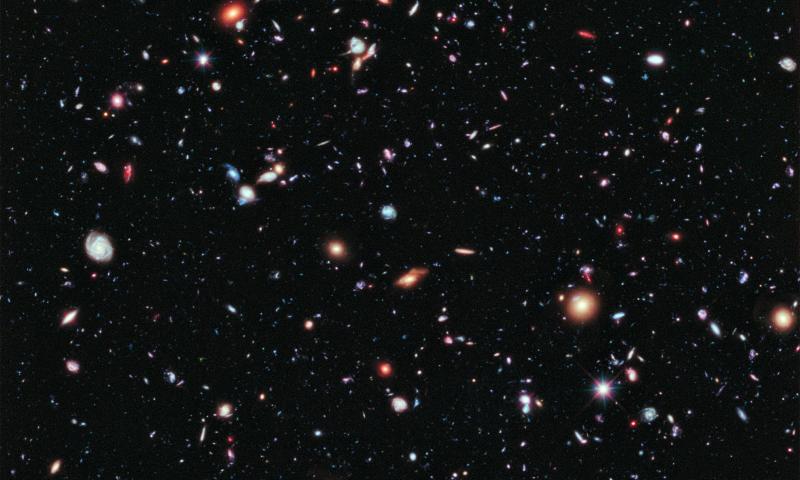
"At first sight, it looks like those galaxies are randomly distributed," says Baumann. "But if you look more closely, you see that they are not. That's one of the most amazing features of our Universe." If you're keen to know what caused those galaxies to exist, then you'll also want to know what caused their distribution to be so non-random.
An important clue comes from the first light in the Universe. Light takes time to travel across space — it's fast, but not instantaneous. Much of the light we see has travelled vast distances before reaching us, which means it was emitted a very long time ago. Looking up into the sky is looking into the past.
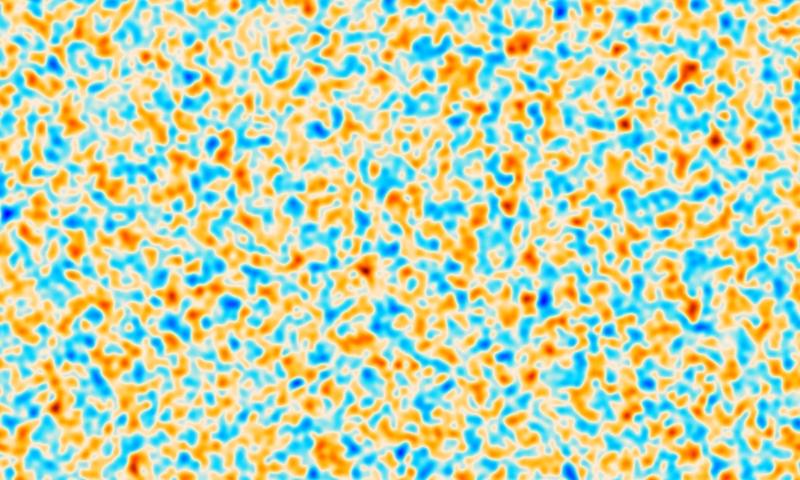
When you do so with the right equipment, you see more than just the cosmic web. You also see a faint, ever-present glow of microwave radiation. When this glow was first discovered by Arno Penzias and Robert Wilson in 1964, they thought it was down to pigeon poo interfering with their equipment. Repeated cleaning, however, revealed the glow was real and it was soon identified as left-over light from the hot Big Bang, emitted 13.8 billion years ago.
Indeed, the cosmic microwave background, or CMB, as the glow is known, provided compelling evidence for the idea that the Universe was born in a primordial fireball. Around the same time, but independent of the CMB discovery, Stephen Hawking and Roger Penrose provided rigorous theoretical evidence for the idea that the Universe may have had a beginning.
The seeds of galaxies
As a baby picture of the Universe, the CMB has proved a treasure trove of information. One striking feature are tiny fluctuations in the CMB temperature that appear across the sky. These variations indicate that the Universe was a tiny bit lumpy at the time the CMB was formed: there was a slightly higher density of matter in some places than in others. The variations match the pattern in the distribution of galaxies we see today.
Indeed, there's a direct theoretical link. Using Einstein's theory of gravity, you can show how regions of higher density would have attracted more matter to them as time wore on. "The tiny fluctuations grew over time and eventually they formed galaxies," explains Baumann. "So those initial fluctuations were the seeds of the galaxies we see today." The fluctuations are described in terms of statistical correlations between the density values at points separated by various distances. It's these correlations which show that the distribution is not random.
"Our challenge is to study those correlations in more detail to find out how the initial fluctuations were created," says Baumann. "The correlations are our fossil record."
Before the Big Bang
In his research, Baumann is rising to the challenge, building on two striking features of the correlations.
"The first is that the correlations span enormous distances," he explains. "In fact, the distances over which structures are correlated are larger than the distances you'd think signals could have travelled before the CMB was formed." This then raises the question of how fluctuations in the first light came to be correlated on such large scales.
The conundrum leads to a surprising conclusion. "It tells us that the hot Big Bang was not the beginning of time," says Baumann. In 1929, Edwin Hubble discovered that the Universe is expanding. Initially it was therefore very small, consisting of an extremely hot and dense soup of particles. It is this hot, dense state that Baumann refers to as the "hot Big Bang."
But there's also another notion of the Big Bang, related to the work of Hawking and Penrose from the mid 1960s. The work showed that an initial singularity is an inevitable feature of a mathematical model of the Universe built on Einstein's theory of gravity. You can think of the singularity as time zero, though the theory breaks down at that point: it doesn't tell us what really happened at the auspicious moment.
Traditionally cosmologists associated the hot Big Bang with this notion of time zero, but this wouldn't allow the observed correlations over vast distances. Something must have happened before.
Exponential expansion
A second feature of the correlations enables us to draw conclusions about that mysterious early period. We can infer from the CMB that the initial seed fluctuations display a statistical pattern which doesn't change as you zoom in or out. They are scale invariant. In a Universe that changes in time, processes which happened earlier would leave imprints on larger scales than processes that happened later. "The fact that we're not observing any dependence on scale suggests that there was little evolution in time," says Baumann. "The physical conditions at different moments during that early period were nearly identical."
This in turn lends weight to an idea first proposed in 1979 by Alan Guth who suggested that, for the briefest of moments at the very beginning, the Universe expanded exponentially. But while its size grew, the amount of energy per unit volume of space remained nearly constant. This reflects the fact that the physical conditions changed very little during this period and helped to produce the scale-invariance of the fluctuations.
The rate of expansion during this brief period of inflation is truly mind-boggling. The size of the Universe doubled at least 80 times. A region of space the size of a fly was turned into an entire galaxy. At the end of inflation, the observable Universe was the size of an orange, which came from a patch of space smaller than an atomic nucleus.
Tiny quantum fluctuations during inflation were stretched to cosmic scales and became the primordial fluctuations that seeded stars and galaxies. Because of the exponential expansion, regions could become correlated over vast distances.
"The observed correlations therefore give us two clues," says Baumann. "One is that something happened before the hot Big Bang. The other is that it was something like inflation because there was no dependence on time."
The cosmological bootstrap
Can the correlations tell us more about what happened during the presumed period of inflation? You'd hope so and cosmologists do indeed have mathematical models for inflation that fit with the observed correlations. The trouble is that these models make assumptions about what physics was like during that period — and that's something we don't know. "The physical conditions back then were so extreme, involving enormous energy scales far beyond what we can probe with terrestrial experiments."
Baumann has been instrumental in developing an alternative approach which, according to Pajer, "has helped drive a genuine paradigm shift in the field." It was inspired by methods from particle physics and is known as the cosmological bootstrap. The idea is not to rely on individual models, but to start from some widely accepted, bedrock principles of physics. These principles include locality (particles can't interact instantaneously over large distances), unitarity (probabilities in quantum mechanics must add up to one), as well as the symmetries of space and time.
Assuming only that these basic principles held in the early Universe, one can then reconstruct (bootstrap) what the cosmic correlations could possibly look like. This has opened up a broader view. "We now understand how many of these principles are imprinted in the correlations, and we can look for these imprints in observations," says Baumann. "Very important contributions have come from Enrico Pajer's group at DAMTP." A beautiful consequence are elegant relationships between correlations involving multiple points in space, rather than just pairs, which would otherwise be extremely hard to compute.
The bootstrap also helps distinguish features in the correlations that follow solely from universal principles from those that would point to additional processes in specific models of inflation. In this way, it offers a strategy for testing whether those processes actually occurred.
Although the programme is still a work in progress, it provides a roadmap for decoding the correlations with minimal reliance on specific models. It uses a small number of assumptions to extract as much information as possible.
Spacetime from geometry?
Intriguingly, the cosmological bootstrap has recently also uncovered geometric structures hidden within the mathematics that describes the cosmological correlations. The structures involved, called positive geometries, are generalisations of triangles and other convex polyhedra. They have previously appeared in particle physics, where they describe the scattering of elementary particles.
Remarkably, these objects do not live in ordinary spacetime. Instead, they inhabit an auxiliary space built from the energies and momenta of the particles involved. In this picture, the familiar notion of particles tracing paths through spacetime is replaced by a more abstract geometric description.
Similarly geometric objects appear in connection with the cosmic correlations. As Baumann explains, these ideas remain speculative, but they point to a radical possibility: perhaps these new geometric shapes are more fundamental than spacetime itself, with ordinary spacetime dynamics emerging only as a secondary feature of reality.
Nowhere is the question of the emergence of spacetime more urgent than in cosmology, where the birth of spacetime and the Universe itself are intimately connected at the Big Bang singularity. Together with Nima Arkani-Hamed, Johannes Henn and Bernd Sturmfels, Baumann leads the UNIVERSE+ collaboration which explores the role of positive geometries for particle physics and cosmology. One of the ambitious goals of this programme is to develop a new, timeless description of cosmology that can capture the physics of the Big Bang singularity.
Stress testing physics
The cosmological bootstrap is just one of Baumann's many contributions, which have also included results on astrophysics, quantum field theory, and gravitational-wave physics — "far too many to count adequately in a few lines," as Pajer puts it.
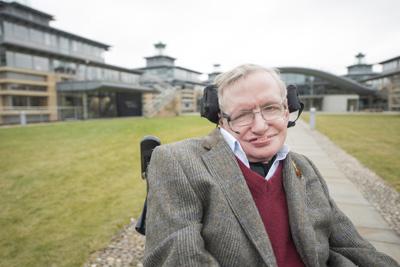
Stephen Hawking's work pervades all of these topics. Not just because of his work on the Big Bang singularity, but also because he was the first to dare to apply the physics of the very small, quantum physics, in a cosmological context. Hawking was also one of the first to predict the tiny quantum fluctuations during inflation at the Nuffield Workshop on the Very Early Universe at DAMTP in 1982.
This touches on the reason why cosmology is so appealing to Baumann. "All the pillars of theoretical physics, known and unknown, combine when we think about the early Universe. It's an arena where the laws of Nature are stress-tested in the most extreme environment."
At DAMTP, Baumann will be working at the intersection of various research groups and also play a leading role at the Centre for Theoretical Cosmology. Beyond that he is planning to forge connections with the Institute of Astronomy as well as other leading research centers around the world, including the Leung Center for Cosmology and Particle Astrophysics at National Taiwan University, where he will continue to hold a joint appointment for some time.
When Baumann arrives in Cambridge, it will not be his first time. He was an undergraduate student here and later spent several years as a faculty member at DAMTP. "Cambridge is one of the world’s leading centres for research in cosmology, and I am excited to become part of this inspiring and vibrant intellectual community again. I also look forward to contributing to the department's teaching activities and working with many of its amazing students." Baumann was a popular lecturer during his previous time at Cambridge. He has written a highly influential textbook and lecture notes which, according to Pajer, "have been used by thousands of undergraduate and graduate students over nearly two decades."
Finally, Baumann also hopes to share the excitement of his field with wider audiences. One of Stephen Hawking's great legacies was his extraordinary impact as a communicator of science, bringing some of the deepest questions about the Universe to the public. As Hawking Professor, Baumann therefore sees outreach as an important part of his role. Through these activities, he hopes to inspire the next generation—just as he himself was once inspired by Stephen Hawking.
About the article
Marianne Freiberger is Editor of Plus. She interviewed Daniel Baumann in May 2026.