The Chern Medal 2026: A conversation with Graeme Segal
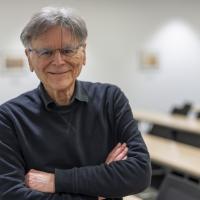
Oxford mathematician Graeme Segal has won a Chern Medal at this year's International Congress of Mathematicians (ICM). The Chern Medal, awarded every four years, is a life-time achievement award named after the eminent mathematician Shiing-Shen Chern (1911–2004).
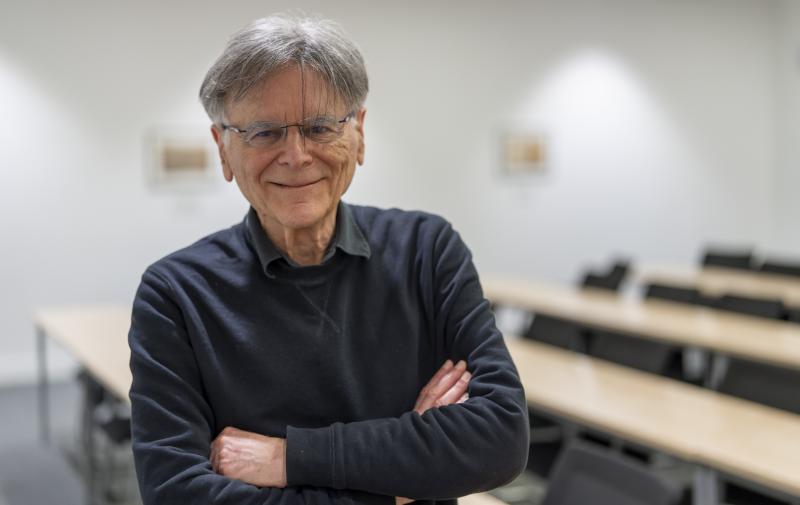
"I'm very delighted to be given this prize, very amazed and absolutely astounded," said Segal in our interview just before the ICM. "I believe very strongly that mathematics is a communal activity. I feel that everything I have done has come from interactions with [others]." This, he says, does not just apply to him as an individual and to modern mathematics, but also to earlier times and "meteors" like Isaac Newton. Everyone works within a bigger context. "There is a mathematical community that is constantly filtering things and assessing them."
This view of mathematics as more of a beehive than a firmament studded by a few bright stars doesn't sit so easily with grand prizes that single out individuals. But singled out he has been, as "a mathematician of extraordinary depth and vision, whose work has profoundly influenced multiple areas." Fields mentioned in his citation include topology, mathematical physics, representation theory, and category theory.
On his website Segal describes himself as a geometer and topologist who has been "trying to understand the role of the concept of space in fundamental physics". And it's this aspect of his work that Segal chose to focus on for our interview, as well as in the Chern Medal Lecture he had just recorded, to be played at the ICM the following week.
From physics to maths…
Segal's interest in physics already existed back in 1963, when he arrived at Cambridge from his native Australia as a Commonwealth Scholar. He was particularly keen on a theoretical framework for describing the physical world called quantum field theory. "So I went to lectures on quantum field theory, but I hated them." This, he says, may have been to do with his lack of background in the area, but also with the fact that quantum field theory was rather stagnant at the time. It later experienced a revival in the 1980s.
Segal attended other lectures on "this and that" and discovered an interest in the study of shapes. On the one hand there was differential geometry, which uses tools from calculus to study geometric objects, paying strict attention to their exact shapes. On the other hand, there was topology, a more lenient version of geometry which only cares about the overall nature of shapes, such as whether they can be morphed into a perfect sphere, or whether they have holes which mean that they can't. Algebraic topology uses tools from algebra to study these more loosely defined shapes.

After his stint at Cambridge, Segal went on to complete his doctorate at Oxford, under the supervision of Michael Atiyah, one of the most famous mathematicians of the twentieth century. His thesis focused on a branch of algebraic topology called K-theory.
…and back again
Anyone wanting to stay within one field, however, should not do a doctorate under Atiyah. "Michael was eager to be a universal mathematician," says Segal. "He refused to say he worked in a [particular] field."
It's no surprise, then, that Segal's interest in physics was rekindled through Atiyah's influence. Atiyah had been in touch with the physicist Jeffrey Goldstone at Cambridge about work to do with the earliest beginnings of string theory: a framework that builds on quantum field theory and Einstein's general theory of relativity to provide a candidate theory of everything that can describe all fundamental forces and particles of nature.
What emerged was a surprising connection. "Goldstone had conjectured some formulas and I recognised these formulas as things that come up in algebraic topology," explains Segal. "To this day, no one seems to have the faintest idea why this is true." But to his own retrospective amazement, Segal was able to show that the formulas were indeed the same on both sides.
"This wasn't directly quantum field theory, but it got me again into thinking about quantum field theory and finding out what was going on."
Physics, but mathematical
With physics back on Segal's mind, he went on to work on mathematics relevant to both sides.
The next seminal period came in the late 1980s. Atiyah had become interested in a young physicist by the name of Edward Witten. Segal got to sit in on the conversations.
"Witten taught all of us a great deal about quantum field theory," recalls Segal. "In 1986 he gave a famous plenary lecture at the ICM in Berkeley and that was a very formative [experience] for me. Witten [presented] modern physics as it seems to a mathematical physicists' eye, but with emphasis on mathematics. This seemed light years apart from what I had experienced as a graduate student in Cambridge in the 1960s." Indeed, Witten went on to become the first physicist to be awarded a Fields Medal in 1990.
Work by Daniel Friedan and Alexander Zamolodchikov further astounded Segal as it revealed a deep link between quantum field theory and geometric objects known as Riemannian manifolds. All this suggested to him that quantum field theory could be turned from what he calls a "way of life" — described by a messy jumble of mathematical objects and properties — into a mathematician's delight. "What I wanted was a definition — a way of saying, sufficiently crisply, what a quantum field theory is, so that you can prove something that a mathematician would accept as a theorem."
Such a definition is what Segal provided in the late 1980s for a type of quantum field theory known as two-dimensional conformal field theory. His axiomatic formulation provided, according to the Chern Medal citation, "a rigorous mathematical foundation for a central concept in physics" and has "become a guiding principle for decades of research."
A life of its own
The cobordism definition, as it has become known, has since developed a life of its own, proving useful in other areas, such as solid state physics and statistical mechanics. "It got out of my grasp completely," he says. "I took a first step and it went all over the place [in a way that] has nothing to do with me". Statements like these are not down to false modesty, but a true reflection of how mathematics works: as a collaborative community.
Driving Segal's passion for his research has been a desire to understand the fundamental structure of the world, something he shared with Michael Atiyah. The idea that the world is made of strange quantum fields we couldn't even divine without mathematics, and deep insights like Maxwell's theory of electromagnetism — "I can't tell you how fascinating I find these things to be."
About this article
Marianne Freiberger is Editor of Plus. She interviewed Graeme Segal in the run-up to the International Congress of Mathematicians in July 2026
This content was produced as part of the collaboration between plus.maths.org and the London Mathematical Society and with kind support of the Institute of Mathematics and its Applications.