Home
plus.maths.org

Secondary menu

  • My list
  • About Plus
  • Sponsors
  • Subscribe
  • Contact Us
  • Log in
  • Main navigation

  • Home
  • Articles
  • Collections
  • Podcasts
  • Maths in a minute
  • Puzzles
  • Videos
  • Topics and tags
  • For

    • cat icon
      Curiosity
    • newspaper icon
      Media
    • graduation icon
      Education
    • briefcase icon
      Policy

    Popular topics and tags

    Shapes

    • Geometry
    • Vectors and matrices
    • Topology
    • Networks and graph theory
    • Fractals

    Numbers

    • Number theory
    • Arithmetic
    • Prime numbers
    • Fermat's last theorem
    • Cryptography

    Computing and information

    • Quantum computing
    • Complexity
    • Information theory
    • Artificial intelligence and machine learning
    • Algorithm

    Data and probability

    • Statistics
    • Probability and uncertainty
    • Randomness

    Abstract structures

    • Symmetry
    • Algebra and group theory
    • Vectors and matrices

    Physics

    • Fluid dynamics
    • Quantum physics
    • General relativity, gravity and black holes
    • Entropy and thermodynamics
    • String theory and quantum gravity

    Arts, humanities and sport

    • History and philosophy of mathematics
    • Art and Music
    • Language
    • Sport

    Logic, proof and strategy

    • Logic
    • Proof
    • Game theory

    Calculus and analysis

    • Differential equations
    • Calculus

    Towards applications

    • Mathematical modelling
    • Dynamical systems and Chaos

    Applications

    • Medicine and health
    • Epidemiology
    • Biology
    • Economics and finance
    • Engineering and architecture
    • Weather forecasting
    • Climate change

    Understanding of mathematics

    • Public understanding of mathematics
    • Education

    Get your maths quickly

    • Maths in a minute

    Main menu

  • Home
  • Articles
  • Collections
  • Podcasts
  • Maths in a minute
  • Puzzles
  • Videos
  • Topics and tags
  • Audiences

    • cat icon
      Curiosity
    • newspaper icon
      Media
    • graduation icon
      Education
    • briefcase icon
      Policy

    Secondary menu

  • My list
  • About Plus
  • Sponsors
  • Subscribe
  • Contact Us
  • Log in
  • Maths in a Minute: Category Theory

    Marianne Freiberger
    18 March, 2026

    Category theory was first developed in the 1940s by pure mathematicians Samuel Eilenberg and Saunders Mac Lane. A category consists of a family of abstract objects and morphisms between pairs of objects. You might imagine the objects as blobs and morphisms as arrows that point from one blob to another blob. They indicate some sort of relationship between the corresponding objects. Finally there's a rule for how two arrows can combine (see here for the details).
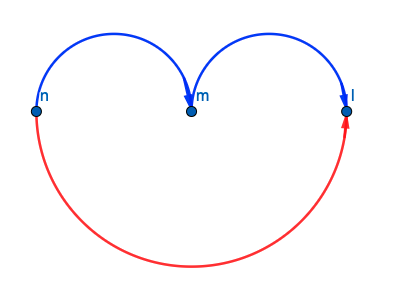
    Diagram illustrating categories defining partial order of the natural numbers.
    If n < m< l  then n < l, so the arrow from n to m combined with the arrow from m to l gives an arrow from n to l.

    The definition appears so abstract as to be meaningless, but here's a simple example of a category: think of the natural numbers 1, 2, 3, 4, …. Draw an arrow from a number n to a number m if n < m. There's an obvious way of combining two arrows. If n < m < l  then n < l, so the arrow from n to m combined with the arrow from m to l gives an arrow from n to l.

    This example captures how category theory applies to something as ordinary as the number line, but it also has applications outside of maths. Find out more in Category theory: From genes to gravity and From abstract nonsense to essential tool.

    • Log in or register to post comments

    You might also like

    article

    New phases of matter: Abstract nonsense comes good

    Category theory, which has previously been described as "abstract nonsense" turns out to be just the language we need to describe materials that may help us build quantum computers. Find out more in this article.

    article

    Category theory: from genes to gravity

    A quick introduction to an abstract concept that's useful in anything from genetics to cosmology.

    Read more about...

    category theory
    Maths in a minute

    Our Podcast: Maths on the Move

    Our Maths on the Move podcast brings you the latest news from the world of maths, plus interviews and discussions with leading mathematicians and scientists about the maths that is changing our lives.

    Apple Podcasts
    Spotify
    Podbean

    Plus delivered to you

    Keep up to date with Plus by subscribing to our newsletter or following Plus on X or Bluesky.

    University of Cambridge logo

    Plus is part of the family of activities in the Millennium Mathematics Project.
    Copyright © 1997 - 2026. University of Cambridge. All rights reserved.

    Terms