

Home
plus.maths.org

Secondary menu

  • My list
  • About Plus
  • Sponsors
  • Subscribe
  • Contact Us
  • Log in
  • Main navigation

  • Home
  • Articles
  • Collections
  • Podcasts
  • Maths in a minute
  • Puzzles
  • Videos
  • Topics and tags
  • For

    • cat icon
      Curiosity
    • newspaper icon
      Media
    • graduation icon
      Education
    • briefcase icon
      Policy

    Popular topics and tags

    Shapes

    • Geometry
    • Vectors and matrices
    • Topology
    • Networks and graph theory
    • Fractals

    Numbers

    • Number theory
    • Arithmetic
    • Prime numbers
    • Fermat's last theorem
    • Cryptography

    Computing and information

    • Quantum computing
    • Complexity
    • Information theory
    • Artificial intelligence and machine learning
    • Algorithm

    Data and probability

    • Statistics
    • Probability and uncertainty
    • Randomness

    Abstract structures

    • Symmetry
    • Algebra and group theory
    • Vectors and matrices

    Physics

    • Fluid dynamics
    • Quantum physics
    • General relativity, gravity and black holes
    • Entropy and thermodynamics
    • String theory and quantum gravity

    Arts, humanities and sport

    • History and philosophy of mathematics
    • Art and Music
    • Language
    • Sport

    Logic, proof and strategy

    • Logic
    • Proof
    • Game theory

    Calculus and analysis

    • Differential equations
    • Calculus

    Towards applications

    • Mathematical modelling
    • Dynamical systems and Chaos

    Applications

    • Medicine and health
    • Epidemiology
    • Biology
    • Economics and finance
    • Engineering and architecture
    • Weather forecasting
    • Climate change

    Understanding of mathematics

    • Public understanding of mathematics
    • Education

    Get your maths quickly

    • Maths in a minute

    Main menu

  • Home
  • Articles
  • Collections
  • Podcasts
  • Maths in a minute
  • Puzzles
  • Videos
  • Topics and tags
  • Audiences

    • cat icon
      Curiosity
    • newspaper icon
      Media
    • graduation icon
      Education
    • briefcase icon
      Policy

    Secondary menu

  • My list
  • About Plus
  • Sponsors
  • Subscribe
  • Contact Us
  • Log in
  • Maths in a minute: Euler's identity

    15 September, 2017
    8 comments

    Euler's identity is often hailed as the most beautiful formula in mathematics. People wear it on T-shirts and get it tattooed on their bodies. Why?

    The identity reads $$e^{i\pi}+1=0,$$
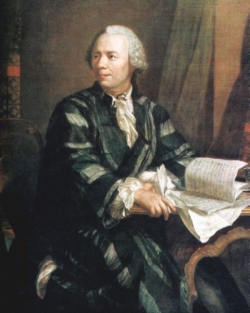
    Leonhard Euler, 1707-1783. Portrait by Johann Georg Brucker.

    Leonhard Euler, 1707-1783. Portrait by Johann Georg Brucker.

    where $e= 2.7182818284... $ is the base of the natural logarithm, $\pi=3.1415926535...$ is the ratio between a circle's circumference and diameter, and $i =\sqrt{-1}$. These three constants are extremely important in maths — and since the identity also involves $0$ and $1$, we have a formula that connects five of the most important numbers in mathematics using four of the most important mathematical operations and relations – addition, multiplication, exponentiation and equality. That's why mathematicians love Euler's identity so much.

    But where does it come from and what does it mean? As we mentioned above, $i =\sqrt{-1}$. This might seem shocking because negative numbers are not supposed to have square roots. However, if we simply decree that $-1$ does have a square root and call it $i$, then we can build a whole new class of numbers, called the complex numbers. Complex numbers have the form $x+iy,$ where $x$ and $y$ are ordinary real numbers (for the complex number $i$ we have $x=0$ and $y=1$). See here for a quick introduction to complex numbers and how to calculate with them. Note that a real number can also be viewed as a complex number. The number $-1$, for example, is a complex number with $x=-1$ and $y=0$.

    Just like a real number is represented by a point on a number line, a complex number $z$ is represented by a point on the plane. To the complex number $z=x+iy$ we associate the point with coordinates $(x,y)$.
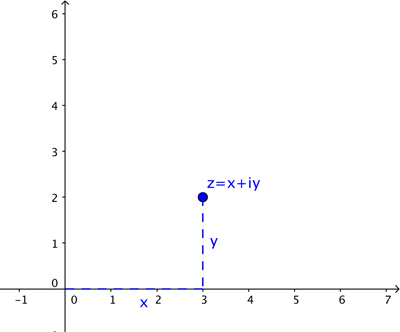
    Cartesian coordinates

    In this description we used Cartesian coordinates: they describe the location of a point by telling you how far to walk along the horizontal direction and how far to walk along the vertical direction. Sometimes, however, it's more convenient to describe the location of a point in terms of the arrow starting at the crossing point of the two axes as shown below.
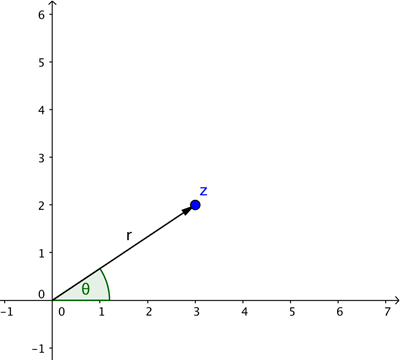
    Polar coordinates

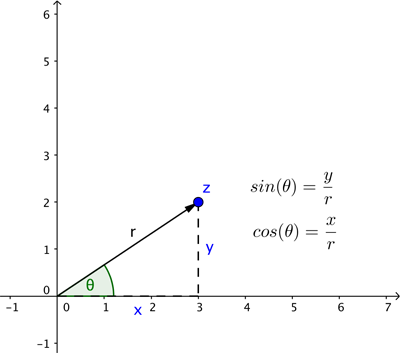
    To define that arrow you need its length $r$ and the angle $\theta$ it makes with the positive $x$-axis (measured anti-clockwise). These are the polar coordinates of our point. Basic trigonometry (see the diagram below) tells us that if a point has Cartesian coordinates $(x,y)$ and polar coordinates $(r,\theta)$, then $$x=r \cos{(\theta)}$$ and $$y=r \sin{(\theta)}.$$
    trigonometry

    Therefore the complex number $z$ represented by our point, $x+iy$, can also be written as $$z= r (\cos{(\theta)}+i\sin{(\theta)}).$$ Here comes the crucial point. It just so happens that for real numbers $r$ and $\theta$ $$ r(\cos{(\theta)} + i \sin{(\theta)}) = re^{i\theta}.$$

    You can prove this using power series, see here to find out more. It's a beautiful fact that the exponential function and the two trigonometric functions sine and cosine are linked in this way. And it means that any complex number $z$ can be written as $re^{i\theta}$ where $r$ is the length of the line connecting the point on the plane that is associated to $z$ to the crossing point of the axes, and $\theta$ is the angle that line makes with the positive $x$-axis (measured anti-clockwise).

    This now makes Euler's identity crystal clear. The complex number $e^{i\pi} = 1 \times e^{i\pi}$ represents the point on the plane at distance $1$ from the crossing point of the axes with an associated angle of $\pi$. That's the point with Cartesian coordinates $(-1,0)$ which represents the complex number $-1$.
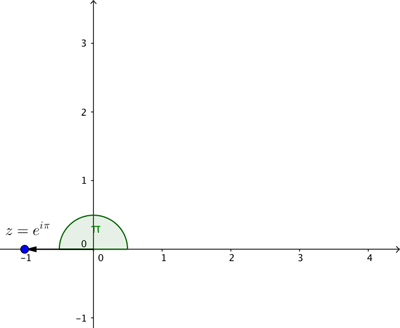
    Euler's identity

    Putting all this together, we see that $$e^{i\pi} = -1,$$ which means that $$e^{i\pi}+1 = 0.$$ And that's Euler's identity.
    • Log in or register to post comments

    Comments

    Adewunmi Fareo

    16 September 2017

    Permalink

    Beautifully written. Even a lay man will understand

    • Log in or register to post comments

    Robin

    18 September 2017

    In reply to Euler's identity by Adewunmi Fareo

    Permalink

    This is beautiful indeed, but for the every man and every woman, it could use a more robust explanation of the significance of e.

    • Log in or register to post comments

    Tavio D'Angelis

    22 September 2017

    Permalink

    If I ask whether one real number a is greater than one real number b, I can imagine 'walking' along the real number line from a to b and determining whether i am walking to the left or to the right, intuitively:

    if a-b>0 then a>b else a

    • Log in or register to post comments

    warren wolfe

    13 February 2018

    In reply to Can the complex numbers be well-ordered? by Tavio D'Angelis

    Permalink

    No, they can't. You can order their magnitudes, real parts, imaginary parts and angles, but you can't order the numbers themselves. For example, is 3 + 4i greater than equal to or less than 4 + 3i?

    • Log in or register to post comments

    Chris G

    12 December 2017

    Permalink

    I think I found an interesting fact about e independently, which of course doesn't make it a new discovery.

    I was looking at self roots, that is numbers that are the nth root of n. 1 root 1 = 1, 2 root 2 = 1.4142..., 3 root 3 = 1.4422. 4 root 4 = 1.4142..., 5 root 5 = 1.3797..., 6 root 6 = 1.3480, 100 root 100 = 1.0471..., 1000 root 1000 = 1.0069...

    At first the values in the list increase from 1 to a maximum with 3 root 3, then appear to converge on 1 again. But while 3 may have the biggest self root of any integer at 1.4422, a smaller number, 2.7, has an even bigger one at 1.444655705... But e root e rises to 1.444667861..., while 2.718981828 root 2.71898828 (which is just 0.0007 bigger than e) declines again to 1.444667843...

    So e has the biggest self root of any number.

    (Another interesting fact to emerge is that 2 root 2 = 4 root 4, are they the only two equal self roots?)

    Please tell me where I can find this in the literature.

    • Log in or register to post comments

    Ahmad Mahmood Qureshi

    7 July 2020

    In reply to The self root of e by Chris G

    Permalink

    Check the function y=x^(1/x) for extreme values!
    The function has a maximum at x=e.

    • Log in or register to post comments

    Ron Duggleby

    1 November 2021

    Permalink

    I'm not much of a mathematician but it seems to be wrong.

    Here is my logic:
    e^(i x Pi) = -1
    Squaring:
    e^(2 x i x Pi) = 1
    Take natural logs:
    2 x i x Pi = 0
    Square it:
    -4 x Pi x Pi = 0
    Therefore:
    -39.4784176 ... = 0

    I don't see where I have gone wrong, but I'm sure it must be totally elementary.

    • Log in or register to post comments

    x

    25 March 2022

    In reply to Euler's identity by Ron Duggleby

    Permalink

    you didnt square the LHS correctly. ( e^(i x pi) )^2

    • Log in or register to post comments

    Read more about...

    Euler
    Euler's identity
    complex number
    Maths in a minute

    Our Podcast: Maths on the Move

    Our Maths on the Move podcast brings you the latest news from the world of maths, plus interviews and discussions with leading mathematicians and scientists about the maths that is changing our lives.

    Apple Podcasts
    Spotify
    Podbean

    Plus delivered to you

    Keep up to date with Plus by subscribing to our newsletter or following Plus on X or Bluesky.

    University of Cambridge logo

    Plus is part of the family of activities in the Millennium Mathematics Project.
    Copyright © 1997 - 2025. University of Cambridge. All rights reserved.

    Terms