Home
plus.maths.org

Secondary menu

  • My list
  • About Plus
  • Sponsors
  • Subscribe
  • Contact Us
  • Log in
  • Main navigation

  • Home
  • Articles
  • Collections
  • Podcasts
  • Maths in a minute
  • Puzzles
  • Videos
  • Topics and tags
  • For

    • cat icon
      Curiosity
    • newspaper icon
      Media
    • graduation icon
      Education
    • briefcase icon
      Policy

    Popular topics and tags

    Shapes

    • Geometry
    • Vectors and matrices
    • Topology
    • Networks and graph theory
    • Fractals

    Numbers

    • Number theory
    • Arithmetic
    • Prime numbers
    • Fermat's last theorem
    • Cryptography

    Computing and information

    • Quantum computing
    • Complexity
    • Information theory
    • Artificial intelligence and machine learning
    • Algorithm

    Data and probability

    • Statistics
    • Probability and uncertainty
    • Randomness

    Abstract structures

    • Symmetry
    • Algebra and group theory
    • Vectors and matrices

    Physics

    • Fluid dynamics
    • Quantum physics
    • General relativity, gravity and black holes
    • Entropy and thermodynamics
    • String theory and quantum gravity

    Arts, humanities and sport

    • History and philosophy of mathematics
    • Art and Music
    • Language
    • Sport

    Logic, proof and strategy

    • Logic
    • Proof
    • Game theory

    Calculus and analysis

    • Differential equations
    • Calculus

    Towards applications

    • Mathematical modelling
    • Dynamical systems and Chaos

    Applications

    • Medicine and health
    • Epidemiology
    • Biology
    • Economics and finance
    • Engineering and architecture
    • Weather forecasting
    • Climate change

    Understanding of mathematics

    • Public understanding of mathematics
    • Education

    Get your maths quickly

    • Maths in a minute

    Main menu

  • Home
  • Articles
  • Collections
  • Podcasts
  • Maths in a minute
  • Puzzles
  • Videos
  • Topics and tags
  • Audiences

    • cat icon
      Curiosity
    • newspaper icon
      Media
    • graduation icon
      Education
    • briefcase icon
      Policy

    Secondary menu

  • My list
  • About Plus
  • Sponsors
  • Subscribe
  • Contact Us
  • Log in
  • The happy ending problem

    by
    Marianne Freiberger
    7 November, 2016
    5 comments

    The happy ending problem is one of those mathematical questions that are quite easy to explain but have as yet defied all attempts to answer them. Some of the best mathematicians in the world have put their minds to it, to no avail. It concerns points drawn on a piece of paper and the figures you can create by connecting them up.

    Let's start with three points, drawn on a piece of paper, that don't all lie on a line. You can always connect them up to form a triangle which has the three points as its corners:

    Triangles

    Three points in the plane form a triangle (as long as they don't lie on the same line).

    What happens when you have four points (with no three of them lying on the same line)? Connecting them you can create a four-sided figure (called a quadrilateral) which has the four points as its corners:

    Quadrilaterals

    Some quadrilaterals.

    But depending on how the points are distributed, the quadrilateral might look a bit odd (like the centre one in the image above) containing dents and spikes and not at all resembling the neat and regular rectangle that first springs to mind when we think of four-sided figures. So let's impose a further restriction. Let's see if we can draw a convex quadrilateral with our four points, that is, one in which all internal angles are at most 180 degrees. This ensures the shape contains no corners that are "pushed inwards", creating a dent. The quadrilateral below is not convex, but the left and right ones in the figure above are.
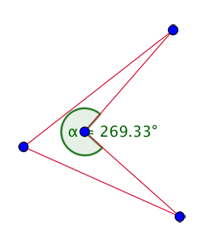
    Non-convex quadrilateral

    A non-convex quadrilateral.

    Some simple examples show that given four points, you can't always draw a convex quadrilateral:

    Non-convex quadrilaterals

    Given four points, it's not always possible to connect them up to form a convex quadrilateral.

    Things change, though, when you add one more point. When you have five points drawn on a piece of paper (without three of them lying on the same line), you can always connect four of them to form a convex quadrilateral. The extra point gives you just enough flexibility to do it. Here are some examples (you might actually be able to draw several different convex quadrilateral with the same five points):

    Quadrilaterals

    Given five points (with no three lying on the same line), you can always find a convex quadrilateral which has four of them as its corners.

    This result was named the happy ending theorem by the mathematician Paul Erdős, because two of his friends who worked on it, George Szekeres and Esther Klein, ended up getting married. You can see a sketch proof of this result below.

    Adding sides

    The obvious next question is how many points you need to ensure that you can connect five of them to form a convex pentagon (five-sided figure). The answer is 9 (without three of them lying on the same line). Here are two examples:

    Pentagons

    Given nine points (with no three lying on the same line), you can always find a convex pentagon which has five of them as its corners.

    To be sure you can draw a convex hexagon (six sides) you need 17 points. Here's an example:

    Hexagon

    Given 17 points (with no three lying on the same line), you can always find a convex hexagon which has six of them as its corners.

    How many points do you need to be sure you can draw a convex heptagon ($7$ sides), which has these points as its corners? The answer is that nobody knows. The same goes for $8$, $9$, $10$ or any number $n$ of sides. Erdős and Szekeres believed that given a natural number $n \geq 3 $, the number of points you need to ensure you can connect $n$ of them to form a convex $n$-sided polygon is $$1+2^{n-2}.$$ The result is true for $n=3$ (triangles), as in that case $$1+2^{n-2} = 1+2^{3-2} = 1+2 = 3.$$ It also works for $n=4$, $n=5$ and $n=6$, as $$1+2^{4-2} = 1+2^{2} = 1+4 = 5,$$ $$1+2^{5-2} = 1+2^{3} = 1+8 = 9,$$ and $$1+2^{6-2} = 1+2^{4} = 1+16 = 17.$$ But whether the result is true for $n>6$ is not known. Erdős and Szekeres were able to prove that the number of points you need to guarantee a convex $n$-sided polygon is always at least $1+2^{n-2}$ and they also proved that it is finite: in other words, by drawing enough points you can be sure that there'll be a convex $n$-sided polygon within them. What hasn't been proved is how much is enough.

    The happy ending problem illustrates an interesting phenomenon: if a system is large enough (e.g. sufficiently many points) then you can hope to find some order within it (e.g. convex figures), even if the system as a whole is disordered. It's a phenomenon studied by an area of maths called Ramsey theory. You can find out more in the Plus article Friends and strangers.

    Sketch proof of the happy ending theorem for n=4

    Suppose you have five points in the plane. Let's first suppose that three of these points can be connected up to form a triangle that contains the two remaining points, call them $A$ and $B$, in its interior. The line that connects these two interior points cuts the triangle into two parts. One piece only contains one of the triangle's corners, and the other contains two: call these two corners $C$ and $D$.

    Proof

    The triangle cut in two pieces.

    It's now not too difficult to convince yourself, using some elementary geometry, that the quadrilateral $ABCD$ (see the figure below) has no interior angles greater than $180$ degrees. This means that it is convex.
    Proof

    At least one point lies outside of the triangle.
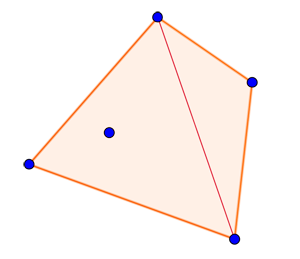
    What if there isn't a triangle that contains two of the five points in its interior? Then at least one of them lies outside any triangle you form with three of the points (see the figure below). You can form a quadrilateral from the three points of the triangle and the outside point, and again it's not too hard to show that all the interior angles of that quadrilateral are less than $180$ degrees, which means that it is convex.
    Proof


    About the author

    Marianne Freiberger is Editor of Plus.

    • Log in or register to post comments

    Comments

    Giorgio Antonelli

    7 November 2016

    Permalink

    Let's see if we can draw a convex quadrilateral with our four points, that is, one in which all internal angles are at most 180 degrees.

    I think 180 was meant to be 360.

    • Log in or register to post comments

    Rachel

    14 November 2016

    In reply to Error in article by Giorgio Antonelli

    Permalink

    The internal angles of any convex polygon are at most 180, otherwise it would be concave.

    • Log in or register to post comments

    puzzlemaker3

    18 January 2017

    In reply to Convex by Rachel

    Permalink

    No, each internal angle of any convex polygon is not at most 180 degrees. That would mean they could be 180 degrees. Every n-sided convex polygon has n internal angles, and each of them is less than 180 degrees. "At most" means "less than or equal to," and that is false here.

    • Log in or register to post comments

    danlboon

    19 June 2019

    In reply to Error in the article by puzzlemaker3

    Permalink

    I believe that a polygon with a 180 degree angle would still be considered convex. In general, a convex region is defined as a region where the line segment connecting any two points in he region falls entirely within the region. In any case, the Happy End problem was originally considering a set of points in the plane in "general position", which meant that no three points were co-linear. In such a case, there could be no 180 degree angles.

    • Log in or register to post comments

    Jay Hurley

    31 October 2022

    In reply to Convex Polygon by danlboon

    Permalink

    I think I solved this problem for 7-gon, and on the path to a provable formula for n-gon.

    • Log in or register to post comments

    Read more about...

    geometry
    Euclidean geometry
    happy ending problem
    polygon

    Our Podcast: Maths on the Move

    Our Maths on the Move podcast brings you the latest news from the world of maths, plus interviews and discussions with leading mathematicians and scientists about the maths that is changing our lives.

    Apple Podcasts
    Spotify
    Podbean

    Plus delivered to you

    Keep up to date with Plus by subscribing to our newsletter or following Plus on X or Bluesky.

    University of Cambridge logo

    Plus is part of the family of activities in the Millennium Mathematics Project.
    Copyright © 1997 - 2025. University of Cambridge. All rights reserved.

    Terms