

Home
plus.maths.org

Secondary menu

  • My list
  • About Plus
  • Sponsors
  • Subscribe
  • Contact Us
  • Log in
  • Main navigation

  • Home
  • Articles
  • Collections
  • Podcasts
  • Maths in a minute
  • Puzzles
  • Videos
  • Topics and tags
  • For

    • cat icon
      Curiosity
    • newspaper icon
      Media
    • graduation icon
      Education
    • briefcase icon
      Policy

    Popular topics and tags

    Shapes

    • Geometry
    • Vectors and matrices
    • Topology
    • Networks and graph theory
    • Fractals

    Numbers

    • Number theory
    • Arithmetic
    • Prime numbers
    • Fermat's last theorem
    • Cryptography

    Computing and information

    • Quantum computing
    • Complexity
    • Information theory
    • Artificial intelligence and machine learning
    • Algorithm

    Data and probability

    • Statistics
    • Probability and uncertainty
    • Randomness

    Abstract structures

    • Symmetry
    • Algebra and group theory
    • Vectors and matrices

    Physics

    • Fluid dynamics
    • Quantum physics
    • General relativity, gravity and black holes
    • Entropy and thermodynamics
    • String theory and quantum gravity

    Arts, humanities and sport

    • History and philosophy of mathematics
    • Art and Music
    • Language
    • Sport

    Logic, proof and strategy

    • Logic
    • Proof
    • Game theory

    Calculus and analysis

    • Differential equations
    • Calculus

    Towards applications

    • Mathematical modelling
    • Dynamical systems and Chaos

    Applications

    • Medicine and health
    • Epidemiology
    • Biology
    • Economics and finance
    • Engineering and architecture
    • Weather forecasting
    • Climate change

    Understanding of mathematics

    • Public understanding of mathematics
    • Education

    Get your maths quickly

    • Maths in a minute

    Main menu

  • Home
  • Articles
  • Collections
  • Podcasts
  • Maths in a minute
  • Puzzles
  • Videos
  • Topics and tags
  • Audiences

    • cat icon
      Curiosity
    • newspaper icon
      Media
    • graduation icon
      Education
    • briefcase icon
      Policy

    Secondary menu

  • My list
  • About Plus
  • Sponsors
  • Subscribe
  • Contact Us
  • Log in
  • Chocolate Cake

    Sharing cakes

    3 February, 2020

    We'd like to thank Syed Abbas, Associate Professor and Chairperson SBS, IIT Mandi, India, for sending in this puzzle. Reportedly, a version of it was put to Ali ibn Abi Talib in the seventh century AD. Another version appears in Fibonacci's famous Liber Abaci.
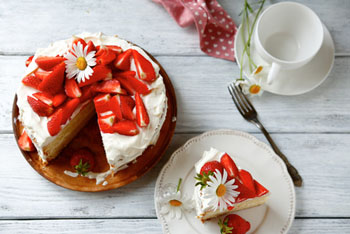

    Cake


    Two people on a long walk sit down for a well-deserved break. Person A has brought along 3 cakes to eat and person B has brought along 5 cakes.

    As they are just about to tuck in person C arrives and asks to share their meal. A and B agree. They cut each cake into three equal pieces and each person eats one piece of each cake.

    After the meal person C pays 8 coins for the cake. Person A gives 5 of these coins to person B and keeps 3 for himself. But person B complains. She demands to be given 7 of the coins with only 1 remaining for A.

    Who is right and why?

    Can you generalise the solution for an initial $k$ people having $n_1, n_2, ...,n_k$ cakes respectively, who are then joined by another $m$ people who pay $n_1+n_2+n_3+...+n_k$ coins each?

    Solution link
    Sharing cake: Solution
    • Log in or register to post comments

    Maths guy

    10 March 2023

    Permalink
    Comment

    I think that person A is correct as each coin should contribute to a cake

    • Log in or register to post comments

    Comment

    29 March 2023

    In reply to Answer by Maths guy

    Permalink
    Comment

    I think person A in corect as each coin should be worth a cake.

    • Log in or register to post comments

    Comment

    29 March 2023

    In reply to Answer by Maths guy

    Permalink
    Comment

    Person A is right because each coin should equal 1 slice.

    • Log in or register to post comments

    Janvi

    1 July 2023

    In reply to Math by Comment

    Permalink
    Comment

    No bro
    A person also eats 2 extra slice from person b so he should give him 2 coins extra

    • Log in or register to post comments

    Neel S

    23 April 2023

    Permalink
    Comment

    Person c paid 8 coins meaning for 8/3 proportion of cake equals 8 coins.
    Therefore, if we count what person A contributes it comes to 1/3 portion after subtracting his share for food. It means he should get 1 coin.
    Person B is final score comes at 7/3 meaning she should get 7 coins.

    • Log in or register to post comments

    Andy Kong

    25 May 2023

    Permalink
    Comment

    C is paying 8 coins for 8/3 cakes, of which 1/3 is contributed by A and 7/3 by B. To fairly share these coins, A should get 1 and B should get 7.

    • Log in or register to post comments

    aston

    28 September 2023

    In reply to B is right by Andy Kong

    Permalink
    Comment

    so thats correcet answer

    • Log in or register to post comments
    University of Cambridge logo

    Plus is part of the family of activities in the Millennium Mathematics Project.
    Copyright © 1997 - 2025. University of Cambridge. All rights reserved.

    Terms