

Stubborn equations and the study of symmetry
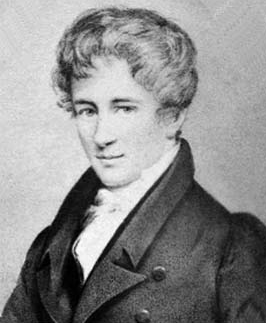
Niels Henrik Abel.
In 1824 a young Norwegian mathematician called Niels Henrik Abel proved a shocking result involving a certain type of equation. A little later the French prodigy Évariste Galois provided deep insight into why that result was true — and in the process founded the mathematical study of symmetry. Neither of the two lived long to enjoy the fruits of their work. Abel died in 1829, at the age of 26, from tuberculosis and in poverty. Galois died in 1832, from wounds he received in a duel allegedly fought over a woman. He was only twenty years old.
So what was their work about? And what do equations have to do with symmetry?
Solving equations
One of the most famous mathematical formulas is the one that gives you the solution to a quadratic equation. If the equation is $ax^2 + bx +c =0$ then the formula tells you that the solutions are $$x_1 = \frac{-b+\sqrt{b^2-4ac}}{2a}$$ and $$x_2 = \frac{-b-\sqrt{b^2-4ac}}{2a}.$$ No matter what $a$, $b$ and $c$ are, this formula hands you the solution on a plate. It's very handy.There is a similar formula, though a lot more complicated (see here), which gives you a general solution to a cubic equation of the form
$$ax^3 + bx^2 + cx +d =0.$$ Even more complicated formulas will give you a general solution to the quartic equation, which has the form $$ax^4 + bx^3 + cx^2 + dx + e =0.$$ The formulas that give the solutions to the quadratic, cubic and quartic may look complicated, but they only involve a limited number of operations: addition, subtraction, multiplication and division, as well as taking square roots, cube roots, or fourth roots. The obvious question you might ask yourself now is whether we can find similar general formula for the quintic equation $$ax^5 + bx^4 + cx^3 + dx^2 + ex + f =0,$$ or polynomial equations involving even higher powers of $x$.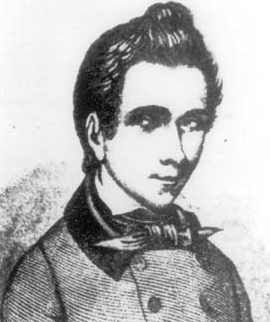
Évariste Galois, drawn from memory by his brother in 1848, sixteen years after his death.
What we would like is a formula that gives a general solution and only involves addition, subtraction, multiplication and division, and taking roots. If an equation has such a formula giving a general solution, then we say it is solvable by radicals.
The result proved by Abel in 1824 is that there isn't such a solution: the general quintic cannot be solved by radicals. This doesn't mean that you can never solve a quintic. For example, the polynomial
$x^5-1=0$ has a solution $x=1.$ But it does mean that there is not a nice, neat formula that gives the solution to the quintic in its most general form.Abel proved the result, but it was Galois who a few years later provided real insight into why the quintic isn't solvable by radicals. Galois is often credited with laying the foundation of group theory, the mathematical study of symmetry, with his work on equations. We usually think of symmetry as a visual thing: a picture, or a pattern might be symmetric. But what do symmetries have to do with equations? The answer is subtle, but beautiful.
Unchanging symmetry
First let's think about what symmetry really is. We say that a square is symmetric because we can rotate it through multiples of 90 degrees, or reflect it in various axes, without changing its appearance. So symmetry is immunity to change: something is symmetric if you can perform a certain operation on it without changing it.
We can detect a hint of symmetry when we think about quadratic equations. As an example, the quadratic $$x^2-2 = 0$$ has solutions $$x_1 = \sqrt{2}$$ and $$x_2 = -\sqrt{2}.$$These are two distinct solutions, but in some intuitive sense they are very similar: one is just the negative of the other. Perhaps swapping these two solutions does not really make a difference. Just as a reflection, which does not make a difference to a square, is a symmetry, so swapping the solutions of the equation might also be a symmetry. But a symmetry of what?
Including irrationals

Like butterflies equations have symmetries too!
Switching solutions
Now we can go back to our idea of swapping the two solutions $\sqrt{2}$ and $-\sqrt{2}$ of the equation $x^2-2=0$. Doing this to all numbers in the field $\mathbb{Q}(\sqrt{2})$ amounts to swapping a number $a+b\sqrt{2}$ with the number $a-b\sqrt{2}.$ Let's represent this swapping operation by a function $f:$ $$f(a+b\sqrt{2}) = a-b\sqrt{2}.$$ Applying $f$ to all numbers in the field $\mathbb{Q}(\sqrt{2})$ does not really make a difference to $\mathbb{Q}(\sqrt{2})$ and its structure. It does not make any difference to the rational numbers in the field at all, as $$f(a) = f(a + 0\times \sqrt{2}) = a - 0\times \sqrt{2} = a.$$ It does change the irrational numbers in the field, but once we have applied $f$ to all of them, the overall collection of numbers is still exactly the same: it's still $\mathbb{Q}(\sqrt{2})$. (This is because if $a+b\sqrt{2}$ is a member of $\mathbb{Q}(\sqrt{2})$, then so is $a-b\sqrt{2}.$) What is more, applying $f$ to all members of $\mathbb{Q}(\sqrt{2})$ preserves the structure of addition, subtraction, multiplication and division. Suppose you add/subtract/multiply/divide two numbers $a+b\sqrt{2}$ and $c+d\sqrt{2}$ in $\mathbb{Q}(\sqrt{2})$ to get a third number $e+f\sqrt{2}$. Then adding/subtracting/multiplying/dividing $f(a+b\sqrt{2}) = a-b\sqrt{2}$ and $f(c+d\sqrt{2}) = c-d\sqrt{2}$ gives as the result $f(e+f\sqrt{2}) = e-f\sqrt{2}$ In this sense, the function $f$ (which comes from swapping the two solutions) is a symmetry associated to the equation $x^2-2=0.$ It does not make a difference to $\mathbb{Q}(\sqrt{2}).$ To give it its proper name, the function $f$ is called a $\mathbb{Q}$-automorphism of the field $\mathbb{Q}(\sqrt{2})$: it is a bijective function from $\mathbb{Q}(\sqrt{2})$ to itself, which leaves members of $\mathbb{Q}$ unchanged and preserves the structure of the arithmetic operations.Galois' group
Are there any other $\mathbb{Q}$-automorphisms of $\mathbb{Q}(\sqrt{2})$? The answer is yes, there is one more, although it's a boring one. It's leaving every member of $\mathbb{Q}(\sqrt{2})$ unchanged. This is represented by the identity function $g(x) = x$ So the collection of $\mathbb{Q}$-automorphisms of $\mathbb{Q}(\sqrt{2})$ (that is, the collection of symmetries arising from $x^2-2=0$) consist only of the functions $g$ and $f.$ The collection of symmetries of any object, whether it's a shape like a square or an equation, forms a self-contained system called a group. (A group is not dissimilar, though simpler, than a field.) The system is self-contained because when you follow one symmetry by another symmetry, the result is also a symmetry. In our example, following the symmetry ($\mathbb{Q}$-automorphism) $f$ by itself gets you back to where you started, so it amounts to performing the identity symmetry: $$f(f(a+b\sqrt{2})) = f(a-b\sqrt{2}) = a+b\sqrt{2}=g(a+b\sqrt{2}).$$ Similarly, following $f$ by $g$ or $g$ by $f$ amounts to doing just $f$, and following $g$ by $g$ amounts to just doing $g.$ The group of symmetries that comes from our equation, consisting of the two $\mathbb{Q}$-automorphisms $g$ and $f$, is called the Galois group of the equation $x^2-2=0.$Why you can't solve the general quintic
We can do all of this for any other polynomial equation $P$, for example for a quintic of the form $$ax^5 + bx^4 + cx^3 + dx^2 + ex + f =0,$$ where the coefficients $a$, $b$, $c$, $d$, $e$ and $f$ are rational numbers. Again you can extend the field of rational numbers, $\mathbb{Q}$, to form the smallest field (call it $\mathbb{Q}(P)$) that includes $\mathbb{Q}$ and all the solutions to the equation $P.$ This is called the splitting field of $P$. Just as we did for the quadratic, you can look at the symmetries of this splitting field. These are $\mathbb{Q}$-automorphisms of $\mathbb{Q}(P)$, which leave all the members of $\mathbb{Q}$ unchanged, swap around the irrational members of $\mathbb{Q}(P)$ and preserve the structure of addition, subtraction, multiplication and division. These form the Galois group of the equation $P$.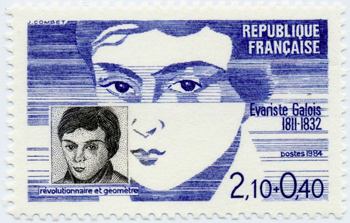
A French stamp celebrating Galois.
What Galois was able to show is that whether or not an equation is solvable by radicals depends on the structure of its Galois group. Sometimes the Galois group breaks up into smaller components that correspond to taking square roots, or cube roots, or $n$th roots for some larger $n.$ If that is the case, then the equation is solvable by radicals. If, however, it doesn't break up into smaller components in the right way, if you can't disentangle the symmetries from each other, then you can't find a general solution that involves only addition, subtraction, multiplication, division and taking roots — in that case you can't solve the equation by radicals. It's possible to show that there are quintic equations that don't break up in the right way. These therefore aren't solvable by radicals. And this means that we can't find a general solution to the quintic as we have for the quadratic. The same is true for polynomial equations that involve higher powers of $x$ too: there isn't a general formula that solves them by radicals. The study of the solutions of equations using group theory is known as Galois theory, after its inventor.
You can read a more detailed, but still accessible, account of this on our sister site NRICH.
About this article
The article now forms part of our coverage of a major research programme on group theory held at the Isaac Newton Institute for Mathematical Sciences (INI) in Cambridge. The INI is an international research centre and our neighbour here on the University of Cambridge's maths campus. It attracts leading mathematical scientists from all over the world, and is open to all. Visit www.newton.ac.uk to find out more.

About the author
Marianne Freiberger is Editor of Plus.
Comments
Anonymous
Hello,
Great article! Just a small correction:
In the second last line in the last paragraph of the section " Switching Solutions", it should read:
" it is a bijective function from $\mathbb {Q}(\sqrt{2})$ to itself..."
Thanks,
Roy
Marianne
Thanks very much for pointing out the mistake, we have corrected it.
Bruno
The best introductory article on Galois' concepts that I've encountered till now. Very intuitive!