
Home
plus.maths.org

Secondary menu

  • My list
  • About Plus
  • Sponsors
  • Subscribe
  • Contact Us
  • Log in
  • Main navigation

  • Home
  • Articles
  • Collections
  • Podcasts
  • Maths in a minute
  • Puzzles
  • Videos
  • Topics and tags
  • For

    • cat icon
      Curiosity
    • newspaper icon
      Media
    • graduation icon
      Education
    • briefcase icon
      Policy

    Popular topics and tags

    Shapes

    • Geometry
    • Vectors and matrices
    • Topology
    • Networks and graph theory
    • Fractals

    Numbers

    • Number theory
    • Arithmetic
    • Prime numbers
    • Fermat's last theorem
    • Cryptography

    Computing and information

    • Quantum computing
    • Complexity
    • Information theory
    • Artificial intelligence and machine learning
    • Algorithm

    Data and probability

    • Statistics
    • Probability and uncertainty
    • Randomness

    Abstract structures

    • Symmetry
    • Algebra and group theory
    • Vectors and matrices

    Physics

    • Fluid dynamics
    • Quantum physics
    • General relativity, gravity and black holes
    • Entropy and thermodynamics
    • String theory and quantum gravity

    Arts, humanities and sport

    • History and philosophy of mathematics
    • Art and Music
    • Language
    • Sport

    Logic, proof and strategy

    • Logic
    • Proof
    • Game theory

    Calculus and analysis

    • Differential equations
    • Calculus

    Towards applications

    • Mathematical modelling
    • Dynamical systems and Chaos

    Applications

    • Medicine and health
    • Epidemiology
    • Biology
    • Economics and finance
    • Engineering and architecture
    • Weather forecasting
    • Climate change

    Understanding of mathematics

    • Public understanding of mathematics
    • Education

    Get your maths quickly

    • Maths in a minute

    Main menu

  • Home
  • Articles
  • Collections
  • Podcasts
  • Maths in a minute
  • Puzzles
  • Videos
  • Topics and tags
  • Audiences

    • cat icon
      Curiosity
    • newspaper icon
      Media
    • graduation icon
      Education
    • briefcase icon
      Policy

    Secondary menu

  • My list
  • About Plus
  • Sponsors
  • Subscribe
  • Contact Us
  • Log in
  • Happy Pi Day!

    14 March, 2014

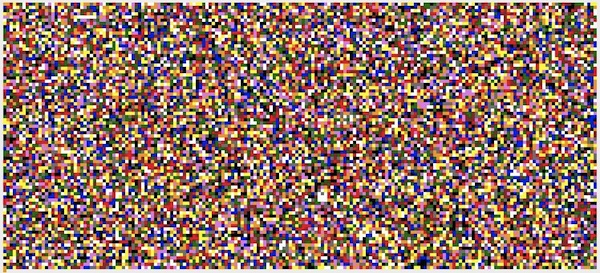
    We love every number here at Plus equally (ok, not really, 3 and i are the best numbers), but there is no denying the fame, ubiquity and usefulness of the number $\pi$. Today, written as 3.14 in US date format, is known as Pi Day, and we are celebrating with this lovely image created by Mick Joyce.
    pi

    Graphic representation of $\pi$, created by Mick Joyce

    Joyce wrote a computer programme to create the image, with each of the digits in the decimal expansion of $\pi$ represented by a different coloured pixels, demonstrating that the expansions is essentially without repeats or structure. Joyce's page is one of our favourites from the upcoming book, 50 Visions of Mathematics. The book (which we were lucky enough to help edit) will be released in May to coincide with the 50th anniversary of the Institute of Mathematics and its Applications, but you can preorder it now!

    Our friend Alex Bellos is also celebrating Pi Day with beautiful pictures in his Guardian blog, as well as translating the classics into Pilish. And we loved the, perhaps photoshopped, $\pi$ in the sky from @inFinnityPi.

    You can read all about $\pi$ on Plus:

    • What is the area of a circle?
    • Number crunching ants
    • Transcendental meditation
    • Pi not a piece of cake
    But, of course, if you are anti-pi, you are in good company….
    • Log in or register to post comments
    University of Cambridge logo

    Plus is part of the family of activities in the Millennium Mathematics Project.
    Copyright © 1997 - 2025. University of Cambridge. All rights reserved.

    Terms