

Helping maths to help us
Mathematics is vital to the UK economy: last year it contributed nearly £500 billion. "Key growth sectors – AI, cybersecurity, defence – are all underpinned by mathematical science," said Ian Sollom MP. "However, the challenge isn't recognising that maths matters. The challenge is rather making the long-term investments needed: more specialist maths teachers, stronger university provision, sustained research funding."
Sollom was speaking on November 19, 2025, at Maths Week Parliamentary Expo. The event was organised by the Campaign for Mathematical Sciences (CaMS), hosted by Sollom in the House of Commons, and brought the mathematics community together with MPs, civil servants and people from across industry.
The impact of mathematics in our daily lives was evident in the range of exhibits, which included contributions from the Met Office, the Mathematics for Deep Learning (M4DL) research programme and VisualPDE, as well as organisations such as the Institute of Mathematics and its Applications (IMA), the London Mathematical Society (LMS), and the Isaac Newton Institute for Mathematical Sciences (INI). (You can find out more about M4DL and VisualPDE on Plus.) But, as Sollom noted, the challenge is to provide investment and long-term support of the maths community to ensure that the mathematical sciences continue to flourish and the opportunities and benefits are shared equally across the UK.
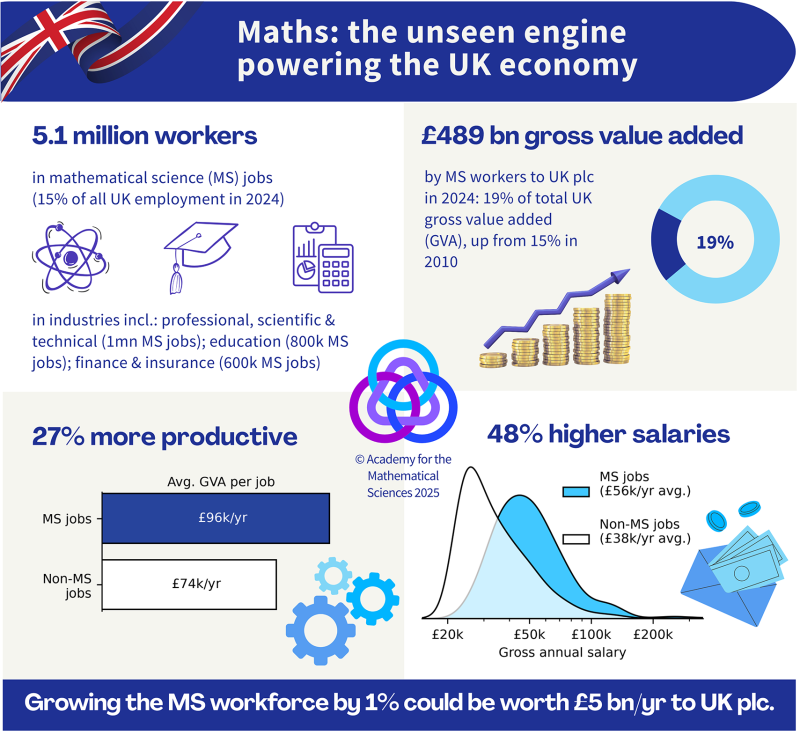
Highly relevant but not so visible
Mathematics is already helping to tackle many of the challenges we face in society, said Heather Tewkesbury, incoming president of the IMA. It has been key in moving the UK energy sector towards net zero, ensuring the continuing safe operation of nuclear reactors, guiding investment in infrastructure to reduce the risk of energy poverty, and balancing energy across the grid. Maths has been used to plan for food security in the face of climate change, and modelled the impact of extreme weather on infrastructure, such as the rail network.
"[The mathematics community] can show how relevant the mathematical sciences are today, more than ever," said Tewkesbury. "And business, industry and government have an increasing role to play, in making more visible how maths enables us to tackle national challenges."
The lack of visibility of mathematics in the minds of politicians and the public can be partly explained by its diversity and broad range of applications. "The impact of mathematics isn't always visible because it is so broad," said Jens Marklof, outgoing President of the LMS. "Maths is a very interdisciplinary area that underpins so many things. If you get a maths degree you can move into so many areas, from finance to engineering, to AI, to life and health sciences." As people move into these other areas, mathematics remains part of their jobs, but the word "mathematician" usually disappears from their job titles.
Maths degrees for the future
Another challenge to mathematics are cuts to university funding which have impacted mathematics departments around the UK. Some have even closed down. The CaMS was founded in 2021 in response to such a closure — of the Pure Mathematics Department at the University of Leicester — and exists to advance the mathematical sciences by supporting engagement and providing specialist advice in maths policy.
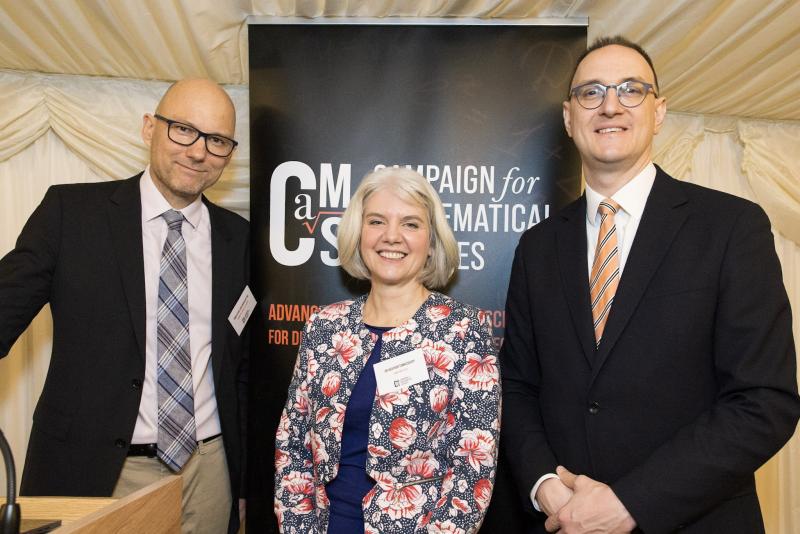
In its first project, the CaMS recently awarded half a million pounds each to five universities via the Maths Degrees for the Future competition. The grants will enable these universities to create and realise their vision of what a mathematics degree should look like. "A core component of that was to make those maths degrees more attractive to a wider group of kids, who love maths and want to go and do something in the subject, but don't quite think of a mathematics degree as a way into an exciting profession," said Marklof. Like many others at the Expo, Marklof had just returned from an event at the INI, organised by the Newton Gateway to Mathematics, called The Future of Mathematics Higher Education, at which these visions were discussed. At the Expo these discussions were continued and the excitement about the ideas involved was palpable.
Supporting the pipeline and basic skills
There was also recognition of the importance of school education, so crucial in shaping students' first experiences of mathematics. The UK may be leading the mathematical sciences in the world today, but that position isn't assured. Marklof had just returned from trips to Vietnam and India: "The recognition [there] that mathematics is important is quite staggering, and I think we have to make sure that we don't fall behind internationally. Without a strong community of maths teachers, we will lose a lot of talent in the pipeline. We have to make sure that doesn't happen."
The Expo was timed to coincide with Maths Week England, a week-long celebration of all things maths, designed to make the subject accessible to all students, of all backgrounds. "The point of Maths Week England is to get people together to talk about and understand why maths is so important, socially and economically, both for individuals and for the whole country," said Andrew Jeffrey, founder of Maths Week England. Mathematics, he stressed, is an indispensable core skill for individuals, granting people access to jobs and allowing them to make informed decisions about their finances. "It's about equity as much as anything else. So I'm thrilled [this is being discussed] – the whole journey from school to university, academia, business and beyond."
About this article
Marianne Freiberger and Rachel Thomas are Editors of Plus. They spoke to Andrew Jeffrey, Jens Marklof, and Heather Tewkesbury at the Maths Week Parliamentary Expo on November 19, 2025.
This content forms part of our collaborations with the Isaac Newton Institute for Mathematical Sciences (INI) and the Newton Gateway to Mathematics.
The INI is an international research centre and our neighbour here on the University of Cambridge's maths campus. You can find all the content from the collaboration here. The Newton Gateway is the impact initiative of the INI, which engages with users of mathematics. You can find all the content from the collaboration here.

