Home
plus.maths.org

Secondary menu

  • My list
  • About Plus
  • Sponsors
  • Subscribe
  • Contact Us
  • Log in
  • Main navigation

  • Home
  • Articles
  • Collections
  • Podcasts
  • Maths in a minute
  • Puzzles
  • Videos
  • Topics and tags
  • For

    • cat icon
      Curiosity
    • newspaper icon
      Media
    • graduation icon
      Education
    • briefcase icon
      Policy

    Popular topics and tags

    Shapes

    • Geometry
    • Vectors and matrices
    • Topology
    • Networks and graph theory
    • Fractals

    Numbers

    • Number theory
    • Arithmetic
    • Prime numbers
    • Fermat's last theorem
    • Cryptography

    Computing and information

    • Quantum computing
    • Complexity
    • Information theory
    • Artificial intelligence and machine learning
    • Algorithm

    Data and probability

    • Statistics
    • Probability and uncertainty
    • Randomness

    Abstract structures

    • Symmetry
    • Algebra and group theory
    • Vectors and matrices

    Physics

    • Fluid dynamics
    • Quantum physics
    • General relativity, gravity and black holes
    • Entropy and thermodynamics
    • String theory and quantum gravity

    Arts, humanities and sport

    • History and philosophy of mathematics
    • Art and Music
    • Language
    • Sport

    Logic, proof and strategy

    • Logic
    • Proof
    • Game theory

    Calculus and analysis

    • Differential equations
    • Calculus

    Towards applications

    • Mathematical modelling
    • Dynamical systems and Chaos

    Applications

    • Medicine and health
    • Epidemiology
    • Biology
    • Economics and finance
    • Engineering and architecture
    • Weather forecasting
    • Climate change

    Understanding of mathematics

    • Public understanding of mathematics
    • Education

    Get your maths quickly

    • Maths in a minute

    Main menu

  • Home
  • Articles
  • Collections
  • Podcasts
  • Maths in a minute
  • Puzzles
  • Videos
  • Topics and tags
  • Audiences

    • cat icon
      Curiosity
    • newspaper icon
      Media
    • graduation icon
      Education
    • briefcase icon
      Policy

    Secondary menu

  • My list
  • About Plus
  • Sponsors
  • Subscribe
  • Contact Us
  • Log in
  • Latitude by the stars
    by
    the Plus team
    3 June, 2015
    3 comments
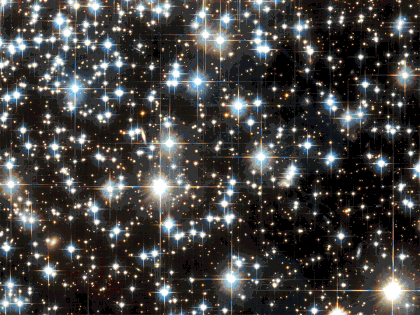
    A Hubble image

    Finding your latitude by the stars. Image courtesy NASA.

    How do you find your way around the world? GPS? Well what if you haven't got reception? A map? Good idea, but what if you're travelling on the high seas with no land mark in sight? That's a situation that many, many people have found themselves in over the millennia. These brave seafarers used the Sun and the stars to navigate instead. And to do this, they needed a fair bit of geometry, in particular trigonometry.

    Suppose you are on the open ocean and you want to work out your latitude (see here for a definition of latitude). The Sun and most of the stars change their position in the sky over time. But some stars always appear to be in the same place. An example is Polaris, also called the North star, which always appears to be sitting directly overhead the North pole. It turns out that your latitude is the angle at which Polaris appears to sit above the horizon.

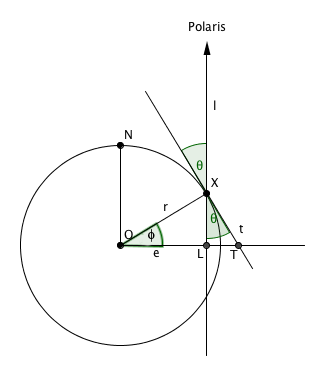
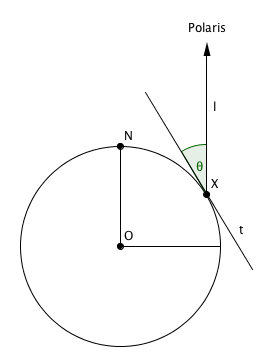
    To see why, let's look at a two-dimensional picture. Consider the plane that contains the North pole, the point $X$ you are sitting at and the centre $O$ of the Earth. Strictly speaking, Polaris doesn't sit vertically above $X$, as shown in the picture, but it is so far away that the line of sight from $X$ to Polaris is very nearly vertical, so we can pretend that it does.
    diagram

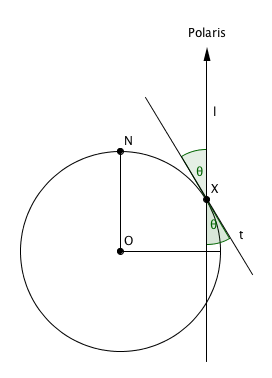
    The angle that "Polaris sits above the horizon" is the angle $\theta$ indicated in the figure. It's the angle our line of sight to Polaris, call it $l$, forms with the line $t$ that is tangent to the Earth at the point $X$ (that's our line of sight towards the horizon). Extending $t$ and $l$, we see the angle $\theta$ again on the other side of the crossing point $X$:
    diagram

    The latitude of $X$ is defined to be the angle $\phi$ that the line $r$ from $O$ to $X$ makes with the plane containing the equator. In our two-dimensional picture, that equatorial plane is just a horizontal line $e,$ which passes through $O.$ It meets the vertical line $l$ in a point $L$ and the tangent line $t$ in a point $T.$
    diagram

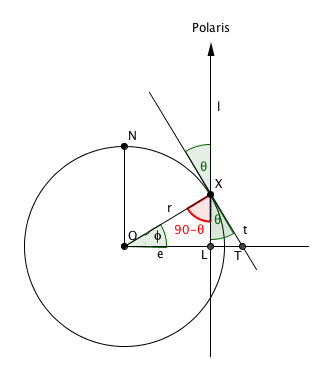
    Because $r$ is the radius of the circle and $t$ a tangent, we know that $r$ and $t$ form a right angle at $X.$ And since $t$ and $l$ form an angle $\theta,$ we know that the angle between $l$ and $r$ is $90-\theta.$
    diagram

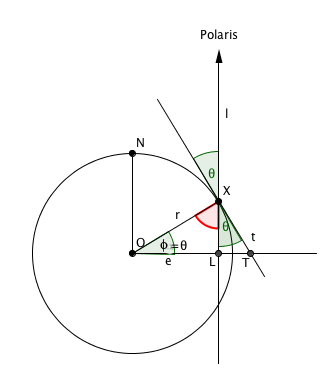
    Now consider the triangle with vertices $O$, $X$ and $L.$ As we have just seen, the angle at $X$ is $90-\theta.$ Since $l$ is vertical and $e$ horizontal, the angle at $L$ is $90^\circ$. And because angles in a triangle always add up to $180^\circ$, the angle $\phi$, which is our latitude, is $$\phi = 180 - 90 - (90-\theta) = \theta.$$
    diagram

    Et voilà — your latitude is given by the angle $\theta$ Polaris sits above the horizon. The Greek astronomer Hipparchus defined latitude in this way over 2000 years ago. He didn't even know that the Earth was round, but our little picture here should explain why Hipparchus' definition agrees with the modern one.

    There is no equivalent of Polaris in the South, but to find your latitude if you are in the Southern hemisphere you can use a constellation called the Southern cross (illustrated on the flag of Australia) and two stars called the Southern Pointers.

    Over the millennia navigators have used different devices to measure the angle at which a star appears above the horizon. These include beautiful astrolabes and sextants, which you often find in antique shops and museums.

    That sorts out latitude, but how do you work out your longitude? That's another story.

    • Log in or register to post comments

    Comments

    Anonymous

    20 June 2015

    Permalink

    Et volià — your latitude is given by the angle $\theta $ Polaris sits above the horizontal

    "Et voilà " surely

    Philip Bradfield (Trinity, 1960)

    kindly old pedant

    • Log in or register to post comments

    Gus

    1 May 2020

    In reply to latitude by the stars ----longitude etc by Anonymous

    Permalink

    Ok, but thats half the world. How do you find latitude in Southern Hemisphere?

    • Log in or register to post comments

    Tim

    16 August 2020

    In reply to half an answer by Gus

    Permalink

    Not sure if this was added later - but the answer to this is in the text

    There is no equivalent of Polaris in the South, but to find your latitude if you are in the Southern hemisphere you can use a constellation called the Southern cross (illustrated on the flag of Australia) and two stars called the Southern Pointers.

    • Log in or register to post comments

    Read more about...

    history of mathematics
    trigonometry
    latitude
    navigation

    Our Podcast: Maths on the Move

    Our Maths on the Move podcast brings you the latest news from the world of maths, plus interviews and discussions with leading mathematicians and scientists about the maths that is changing our lives.

    Apple Podcasts
    Spotify
    Podbean

    Plus delivered to you

    Keep up to date with Plus by subscribing to our newsletter or following Plus on X or Bluesky.

    University of Cambridge logo

    Plus is part of the family of activities in the Millennium Mathematics Project.
    Copyright © 1997 - 2025. University of Cambridge. All rights reserved.

    Terms