Maths in a minute: Gödel's incompleteness theorems
In the early 20th century, the mathematician David Hilbert had a dream. He was hoping that all of mathematics could be grounded on a small, elegant collection of self-evident truths, or axioms. Using the rules of logical inference, one should then be able to derive any true mathematical statement directly from these axioms.
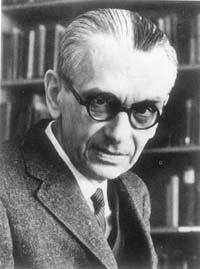 Kurt Gödel
The ancient mathematician Euclid of Alexandria had had a similar vision for geometry. In this case there were five axioms, including self-evident statements such as "the shortest distance between two points is a straight line". Any result in geometry, such as Pythagoras' theorem, should be derivable from the five axioms using the rules of logic.
Hilbert wanted to extend this idea to all of maths. The resulting system of mathematics should be sound: it should only be possible to prove those statements that really are true. It should also be consistent, that is, free from contradictions. And it should be complete: it should be possible to either prove or disprove any statement. In addition, one should also be able to recognise that the axioms are sound by finitary means — that is, minds limited to finitely many inferences, such as human minds, should be able to recognise the axioms as sound.
Gödel's incompleteness theorems, named after the mathematician Kurt Gödel, drove a nail into the coffin of Hilbert's dream. His first incompleteness theorem, loosely stated, says that:
This means that such a system cannot be complete. If we strictly adhere to the rule that every statement must be derived from the axioms, and not appeal to any "truth" that's not part of the axioms, then there will be statements we cannot prove or disprove.
Gödel's second incompleteness theorem says that:
This means that to show that such a formal system does not contain contradictions, you need to move outside of that system, for example by appealing to "truths" that are not part of your collection of axioms.
Gödel's incompleteness theorems have profound consequences for the philosophy of mathematics. Luckily they don't throw doubt on the mathematical calculations that are used in practice, for example to build cars or planes, or to test medical drugs. Neither do they apply to the maths we use everyday, for example to sort out our finances. They are therefore not an excuse to stop learning maths at school (not that anyone would want to anyway).
To find out more about this fascinating topic, read:
- Gödel and the limits of logic
- Picking holes in mathematics
- Searching for the missing truth
- Cantor and Cohen: Infinite investigators
- This is not a carrot: Paraconsistent mathematics
This article is particle partly based on the Plus article This is not a carrot: Paraconsistent mathematics by Maarten McKubre-Jordens.
This article was produced as part of our collaborations with the Isaac Newton Institute for Mathematical Sciences (INI) and the Mathematics for Deep Learning (Maths4DL) research programme – you can find all the content from the collaborations by clicking INI or Maths4DL here.
The INI is an international research centre and our neighbour here on the University of Cambridge's maths campus. It attracts leading mathematical scientists from all over the world, and is open to all. Visit www.newton.ac.uk to find out more.
Maths4DL brings together researchers from the universities of Bath and Cambridge, and University College London. Maths4DL aims to combine theory, modelling, data and computation to unlock the next generation of deep learning. Visit https://maths4dl.ac.uk/ to find out more.